Do you want to know which platform wins in the Omnisend vs. Klaviyo debate?
We all know that these two platforms are often compared with each other, and for valid reasons. They are made for ecommerce brands and also offer solid email, SMS, and automation tools that cover the full customer journey.
In this article, we compare all the aspects that matter most: pricing, automation, segmentation, reporting, integrations, and support. After reading this, you’ll be more confident in choosing the right platform.
Omnisend vs Klaviyo: Quick Verdict
We highly recommend that you read the detailed side-by-side comparison of Omnisend and Klaviyo. But here’s a short version if you need to see which platform may work for your business:
Omnisend is for ecommerce brands that want:
- Multichannel marketing across email, SMS, and web push without complex setup
- Predictable, budget-friendly pricing with no hidden add-ons
- User-friendly email marketing tools (pre-built flows and templates)
- 24/7 support on every plan, including free
Klaviyo is more ideal for merchants and businesses that want:
- Advanced segmentation using predictive data like CLV and churn risk
- Detailed performance tracking, revenue attribution, and in-depth reporting
- Native two-way SMS and WhatsApp without third-party integrations
- More flow variety and deeper automation control as the store scales
The best choice depends on three things: budget, marketing complexity, and how mature your email marketing strategy already is.
Early-stage stores will get more mileage out of Omnisend. But brands that are already generating consistent revenue and ready to invest in data may find Klaviyo better.
How We Compare Omnisend and Klaviyo
We want to create a solid and detailed comparison of these two apps. So, we looked at the following factors:
Comparison Scope and Audience
This won’t be a simple generic email marketing comparison. We evaluated each tool based on what it can offer Shopify merchants, DTC brands, and online stores that are actively trying to grow through email and SMS.
Primary Evaluation Criteria
We also checked the most important factors: pricing, automation, segmentation, reporting, integrations, and support of each app. These are the areas that will directly affect how well a platform fits your store.
Shopify and Ecommerce Store Focus
As a Shopify merchant, you’ll need a tool that can help you with your pre- and post-purchase workflows. So to help you use the right one, we assessed each platform’s capability in handling the order and customer behavior data.
We also checked how deep (or easy) you can connect these two with third-party apps.
What Is Omnisend?
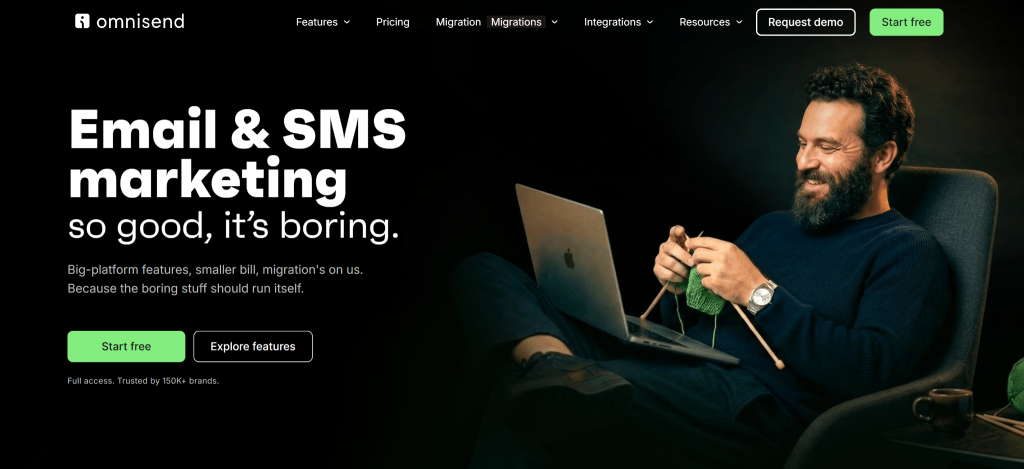
Omnisend is a multichannel marketing tool that’s popular for its affordability, speed, and ease of use. You can use it to get more leads and grow your sales by initiating more engagement with your customers’ inboxes.
The app provides over 250 ecommerce templates and pre-built automation workflows that ecommerce businesses can use to create more attractive (and effective) email campaigns, SMS, web push alerts, and sign-up forms.
All of these don’t need any technical setup… and that’s why it’s ideal for start-ups and brands with small teams.
Omnisend can power important workflows like abandoned cart recovery and post-purchase follow-up for Shopify merchants. And if there’s any problem, their 24/7 live chat support is available no matter what plan you’re on.
What Is Klaviyo?
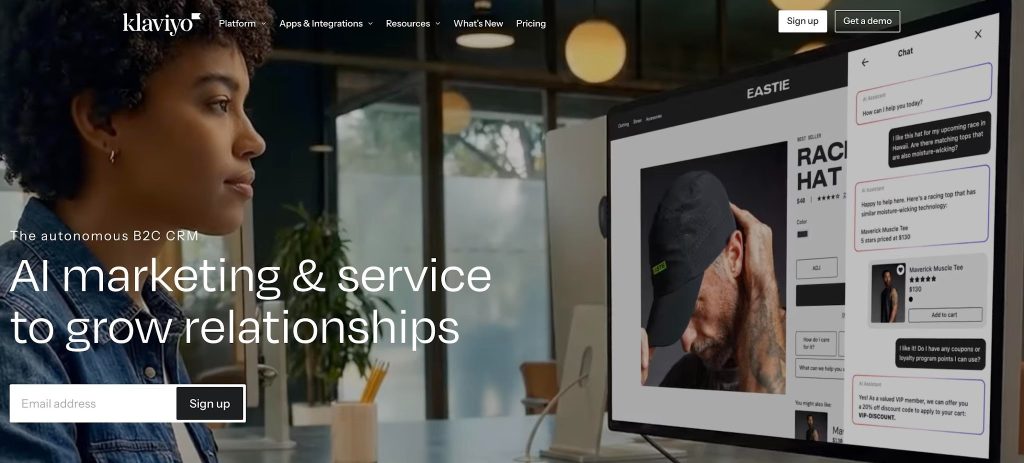
Klaviyo offers features for SMS and email marketing campaigns, but gives an advantage in analytics. It gives marketers (who already know their way around email tools) a lot of room to be creative with their campaigns and reporting.
The customer data you sync here can be used for targeted marketing campaigns. So, you can build better strategies that can help you predict order dates, churn risk, lifetime value, and spending potential.
On top of that, it offers an AI-powered segment builder that lets you define audiences with a simple prompt, which then automatically builds the logic behind it.
So who gets the most out of Klaviyo? Shopify store owners manage large contact lists, complex customer journeys, and purchase history-based flows.
Omnisend vs Klaviyo: Side-by-Side Comparison
Before we get into the details, here’s a quick look at how both platforms compare across the factors that matter most to Shopify merchants.
| Comparison Factor | Omnisend | Klaviyo | What It Means for Shopify Merchants |
| Pricing and free plan | Free plan: 250 contacts, 500 emails/month, web push, 24/7 support. Paid from $16/month | Free plan: 250 contacts, 500 emails/month, 150 SMS credits, 60-day email support. Paid from $20/month | Omnisend’s free plan covers more channels with longer support access |
| Email campaigns and editor | 250+ templates, click-to-edit, auto mobile optimization, AI on all plans | 160+ templates, block-based editor, more design elements, HTML/CSS access | Omnisend is easier to launch campaigns. Klaviyo offers more design control |
| SMS and messaging | Email, SMS, web push. SMS from $0.009/SMS. Flexible top-ups, 60-day credit rollover | Email, SMS, WhatsApp. SMS from $0.012/SMS. Native two-way messaging | Klaviyo supports more channels natively, including WhatsApp |
| Automation workflows | 15+ preset flows, up to 10 conditional splits | 60+ flow templates, price drop and low inventory triggers, profile filters | Omnisend is easier to start. Klaviyo covers more of the customer journey |
| Segmentation and customer data | Unlimited segments, 30+ pre-built, purchase history, behavior, and tags | Unlimited segments, predictive CLV, proximity filtering, real-time sync | Klaviyo’s segmentation depth grows more valuable as your list scales |
| Reporting and analytics | Unified dashboard, custom attribution windows, advanced reporting on Pro only | Three attribution models, revenue by product and segment, industry benchmarks | Klaviyo provides more detailed reporting for data-driven decisions |
| A/B testing | Subject lines and sender names only | Subject lines, send timing, content, and CTA style across campaigns and flows | Klaviyo gives more testing options |
| Deliverability | SPF, DKIM, DMARC, sender health monitoring, dedicated IPs | Full Deliverability Hub, Google Postmaster Tools, automated sunset flows | Klaviyo’s tools are more detailed for high-volume senders |
| Signup forms and list growth | Popups, exit-intent, Wheel of Fortune, free landing page builder | Popups, embedded forms, multistep forms, basic landing pages | Omnisend has more form variety and a better landing page builder |
| Shopify integrations | 130+ integrations | 350+ integrations, including CRMs, ad platforms, and analytics tools | Klaviyo suits stores with more complex tech stacks |
| AI features | AI copywriting, subject lines, forms, and product recommender. All plans | K:AI: Composer, predictive CLV, Flows AI, Segment AI, Image Remix. Mostly paid plans | Klaviyo’s AI is more advanced. Omnisend is more accessible |
| Customer support | 24/7 live chat and email on all plans, Omnisend Academy | Email support for 60 days on the free plan, live chat on paid plans | Omnisend’s support is more accessible regardless of plan |
| Best-fit use case | Small to mid-sized stores, lean teams, multichannel beginners | Scaling DTC brands, data-driven teams, complex segmentation needs | Choose based on your growth stage and marketing complexity |
Note: Platform features may change over time. If you spot any updates, let us know, and we’ll keep this comparison up to date.
1. Free Plans, Pricing, and Upgrade Paths
Okay. Now it’s time to fully evaluate each aspect and compare Klaviyo and Omnisend in detail. Let’s start with the free plans and pricing.
Free Plan Limits and Starter Value
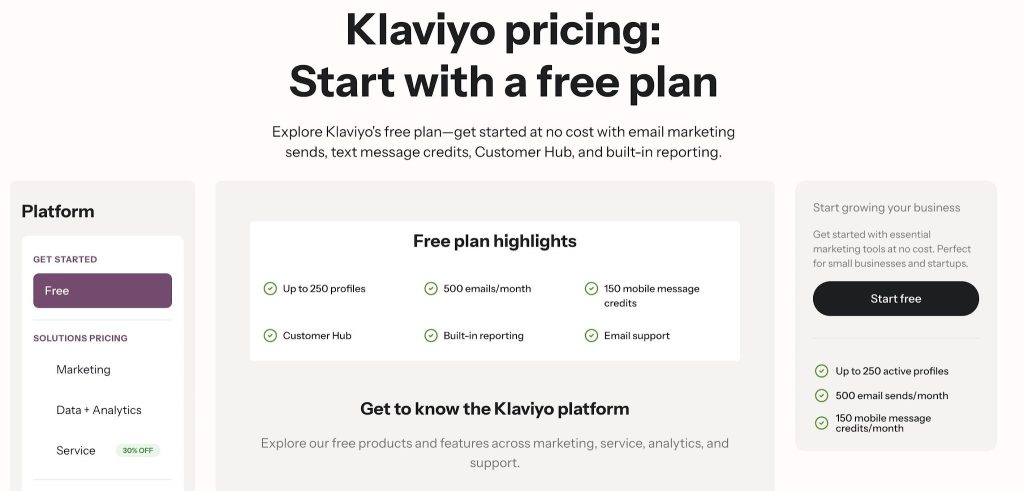
Klaviyo and Omnisend offer a free plan that can handle up to 250 contacts and 500 emails/month.
Klaviyo’s free plan includes 150 monthly SMS credits, built-in reporting, and a Customer Hub, but email support is only available for the first 60 days.
Omnisend’s free plan also comes with 500 web push notifications, unlimited segmentation, an AI segment builder, and 24/7 live chat support.
If you’re looking for a more practical option for your brand, Omnisend has a bit of an advantage here. It supports more channels and provides longer support access.
Paid Plan Costs as Your Store Grows
We all know that different stages of business also have varying needs. And as your contact list grows, so does your bill.
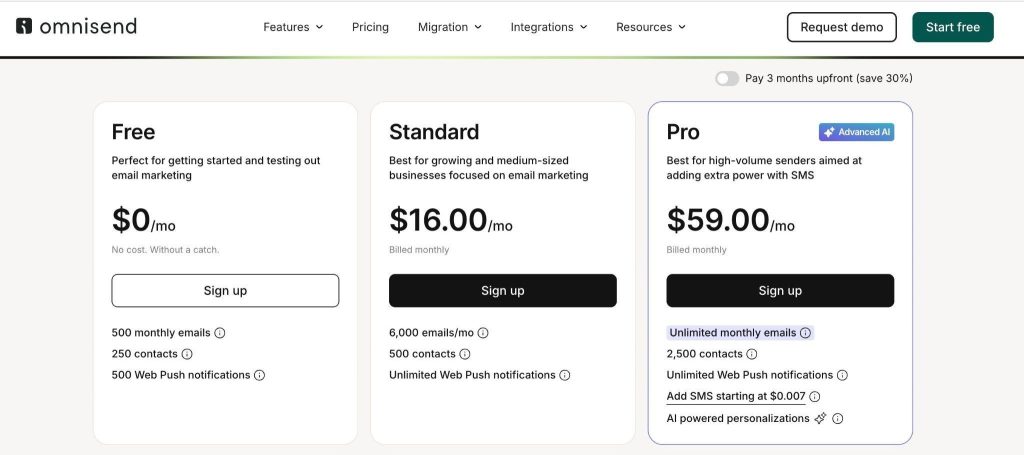
Omnisend’s pricing is a bit easier to grasp than Klaviyo’s. Your plan cost adjusts based on your list size. The Standard plan starts at $16/month for up to 500 contacts, and the Pro plan starts at $59/month for up to 2,500 contacts, with SMS starting at $0.007 per message.
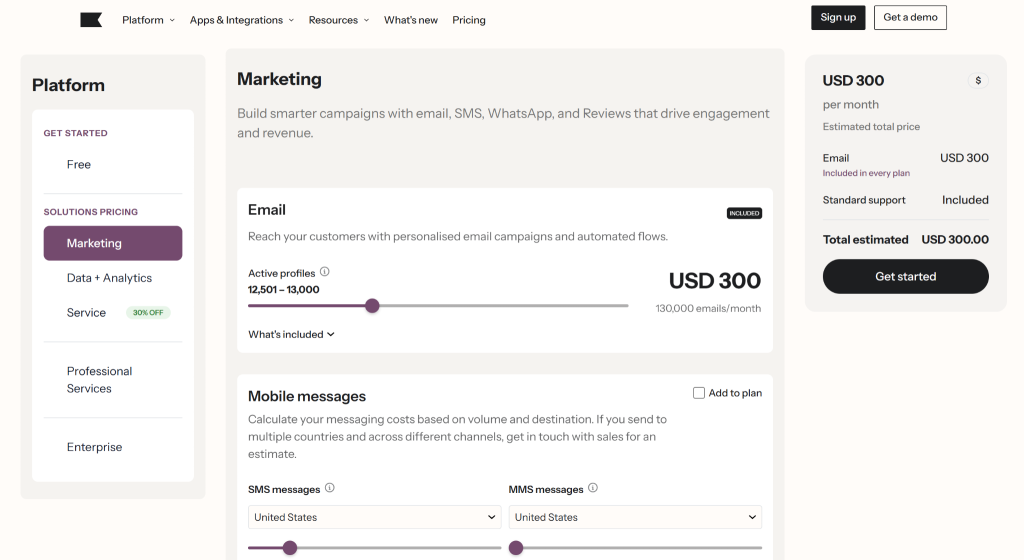
Klaviyo gives you more scalability. But that comes with more feature-and volume-dependent pricing. Your monthly subscription bill can change based on the active profiles, mobile message volume, and any feature add-ons like Reviews, Data and Analytics, or Service tools.
Your bill can start as low as $20/month… or could go MUCH higher (like $70,000++) if you choose to add all the channels and features available.
The starting price is very important, but you also have to know the possible monthly subscription your business has to pay once you start growing.
Which Pricing Model Fits Your Store?
You can choose to go for Klaviyo or Omnisend, depending on your store type, goals, or features you need for your brand. Here’s a table you can use as a guide:
| Store Type | List Size | What They Need | Best Fit |
| Startup | Under 250 contacts | Basic email, simple automation | Either (both free) |
| Budget-conscious brand | 250–5,000 contacts | Multichannel at low cost, solid support | Omnisend |
| Growing ecommerce brand | 1,000–10,000 contacts | Pre-built flows, SMS, and simple segmentation | Omnisend |
| Large DTC brand | 10,000+ contacts | Deep segmentation, advanced reporting, and data tools | Klaviyo |
2. Email Campaigns, Editor, and Signup Forms
After the pricing breakdown, let’s look at how both platforms handle campaign creation, email editing, and the tools you can use to grow your subscriber list.
Campaign Builder and Design Flexibility
For ecommerce brands, email campaigns are “front runners” in bringing in more revenue. These platforms don’t disappoint and provide drag-and-drop builders powerful enough to create impressive (and high-converting) emails.
Klaviyo and Omnisend also offer mobile-ready and beautiful templates. Klaviyo provides around 160 templates, while Omnisend has more design variety (with 250+ designs available).
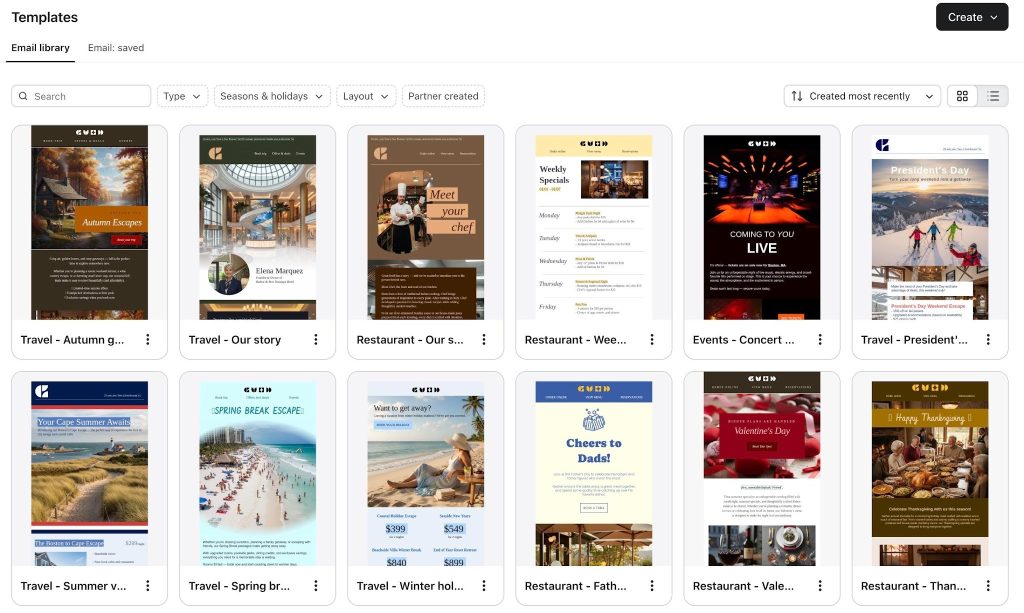
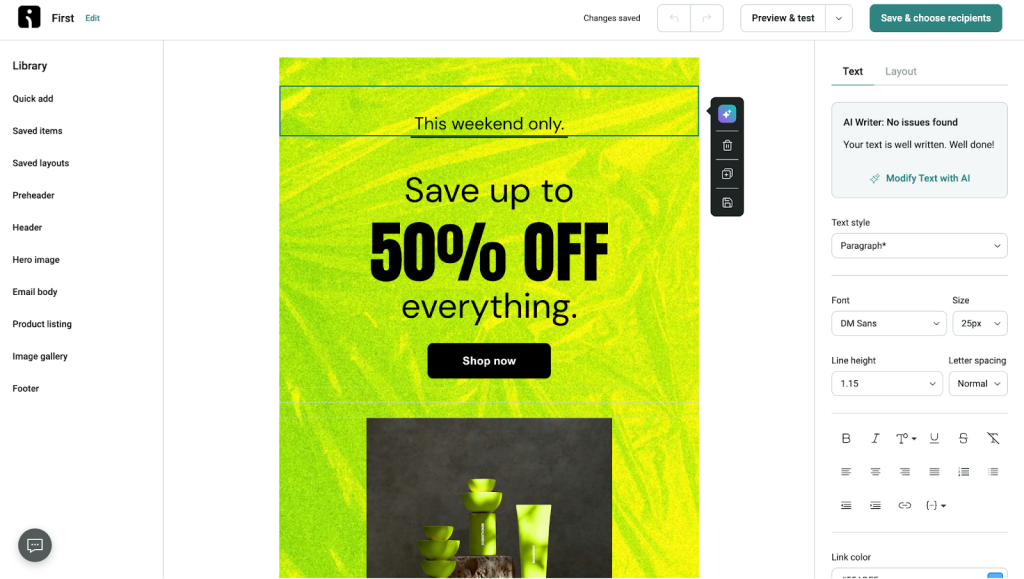
Let’s also talk about their email editors. Omnisend’s email editor is designed to make building and launching campaigns much easier. It comes with “click-to-edit” sections and an AI text assistant for faster copy creation.
Klaviyo’s block-based editor offers more design elements and customization tools. You can add more personality with HTML and CSS… but that also means a bit steeper learning curve.
Product Content, Forms, and List Growth
Klaviyo and Omnisend both support multiple product content tools like product feeds, blocks, and dynamic content inside your emails. Here’s how:
| Description | Klaviyo | Omnisend | |
| Product Feeds | Raw catalog data that powers your email product displays | Pulls from the catalog based on category, price, stock level, and customer behavior. | Auto-fills emails with the newest products. Limited feed customization compared to Klaviyo. |
| Product Blocks | The drag-and-drop display units inside your emails | Block-based, requires more clicks to configure but offers more control over layout | Drag up to 8 products per email across 4 columns, choose which details to show (image, price, CTA) |
| Dynamic Product Content | Personalization logic that shows each subscriber relevant products | Personalizes based on recently viewed, added to cart, and past purchases | Recently viewed and similar to past purchases |
For forms and landing pages, Omnisend has the edge. You get popups, flyouts, embedded forms, exit-intent forms, a gamified Wheel of Fortune, and a free built-in landing page builder.
Of course, Klaviyo has form-building features too, and it recently added basic landing pages… but they aren’t as “beginner-friendly,” and the designs may not be enough for some users.
With these features, you can run a comprehensive customer acquisition and conversion cycle in one platform.
Who Wins? Omnisend. It offers more built-in tools for forms, landing pages, and campaign creation.
3. SMS and Omnichannel Messaging
Besides emails, SMS and push notifications are becoming more important channels for ecommerce retention. Here’s how each platform handles them.
Omnisend
Omnisend combines email, SMS, and web push notifications. And you can use them all with pre-built flows for abandoned cart, post-purchase, and browse abandonment automations. But if you want to manage two-way SMS conversations, Omnisend currently integrates with Gorgias for that. So, your team receives and replies to customers through this third-party app. It may require a separate subscription to Gorgias.
Its SMS credits start at $10 for 1,111 messages in the US at $0.009/SMS. What we like about it is that the unused credits roll over for 60 days.
Klaviyo
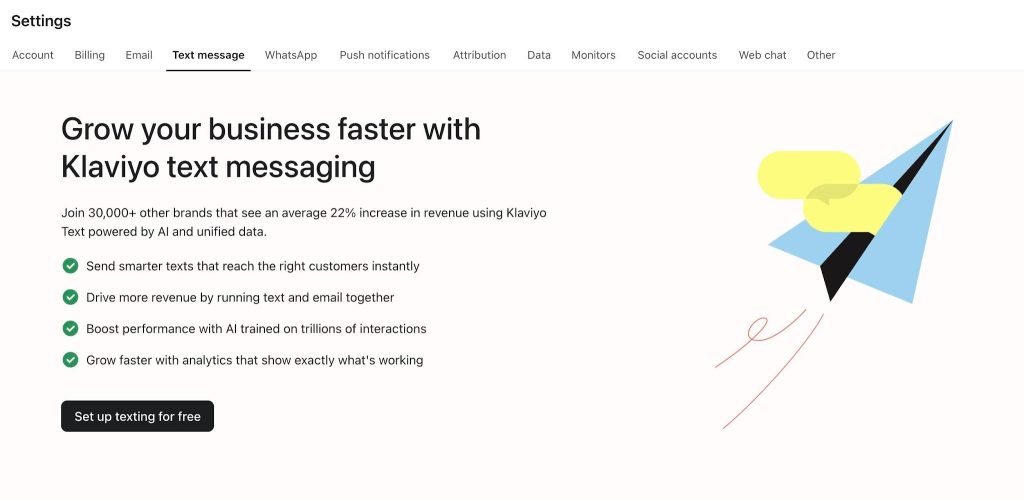
Klaviyo also supports email, SMS, push notifications, and WhatsApp in its flows, and it can cover useful e-commerce automations like sending reminders, nurturing subscribers, and cross-selling.
The SMS marketing feature starts at $0.012 per message for up to 1,250 credits per month. But you can save more as you increase the credits you need. The advantage it has is that the two-way messaging (both on SMS and WhatsApp) is available natively.
For opt-in collection, both platforms include TCPA-compliant SMS opt-in tools built into their signup forms.
Who Wins? Klaviyo. It supports multi-channel retention and also offers a native two-way SMS conversation and WhatsApp support. There’s no need to pay for an extra tool.
4. Automation Workflows and Customer Journey Coverage
Workflow automation allows you to reduce the time spent on creating emails that are personalized and delivered on-time. Let’s see the score between Klaviyo and Omnisend.
Starter Automation Templates
You can get the “essential flows” on both platforms. We’re talking about welcome series, cart recovery, post-purchase, and win-back. Workflows come with timing, triggers, and message templates. But…one platform gives you more flows to choose from, and that’s Klaviyo.
c has 15+ preset and well-thought-out workflows. Klaviyo offers 4x more flow templates. You get 60+ on your dashboard, and they cover predicted next order, VIP/loyalty, and sunsetting (for inactive customers).
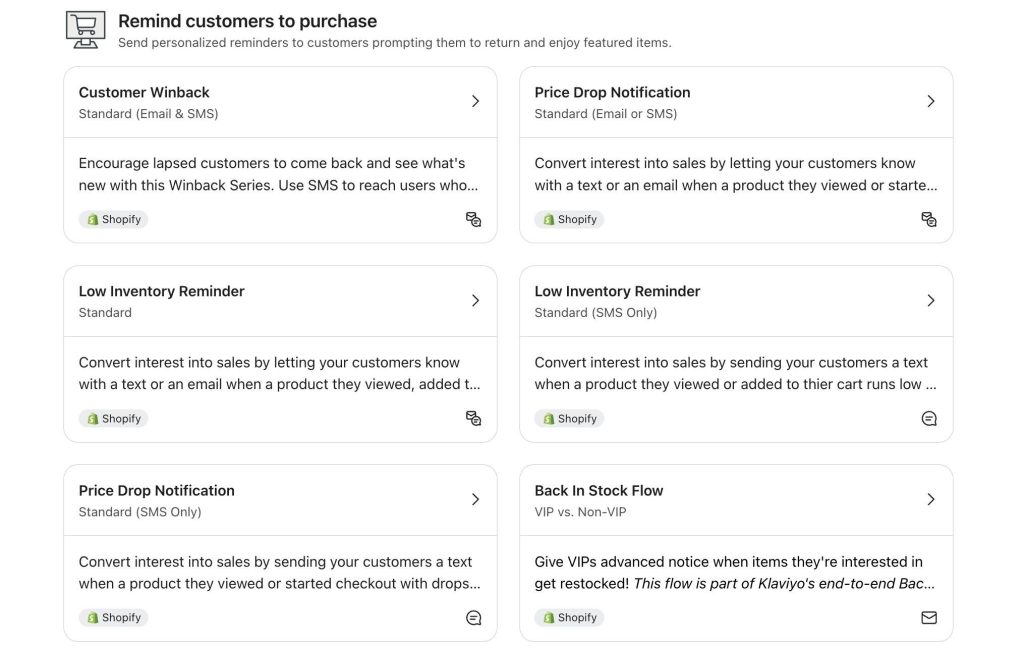
Both platforms are great starting points for your first automations (like a simple welcome series and abandoned cart flow).
Workflow Depth and Conditional Logic
Omnisend lets you add up to 10 conditional splits per workflow, 5 trigger filters, and 4 exit conditions. If you want to do some A/B tests with automations, that’s still possible, but with the help of third-party apps like ParcelWILL or Gorgias.
Klaviyo uses six trigger types, including price drop and low inventory triggers (which are useful for product-heavy stores). Its profile filters check customer data before every message is sent.
So if someone buys mid-flow, Klaviyo skips them from the remaining abandoned cart messages automatically. You don’t have to do anything on your part anymore, and that kind of feature allows you to manage more complex situations.
Retention Automation Fit
Omnisend allows you to handle retention through post-purchase flows. It covers cross-sells, replenishment reminders, and win-back campaigns on emails, SMS, and push notifications.
And to make them more effective, the platform lets you personalize the messages with customer names, purchase history, and dynamic product recommendations.
You can do all these in Klaviyo, but you get more flows like review requests, RFM analysis (to identify at-risk buyers), and CLV-based targeting (so you can prioritize who gets what message).
Its loyalty app integrations through the Klaviyo App Marketplace give you more flow options to keep existing customers buying.
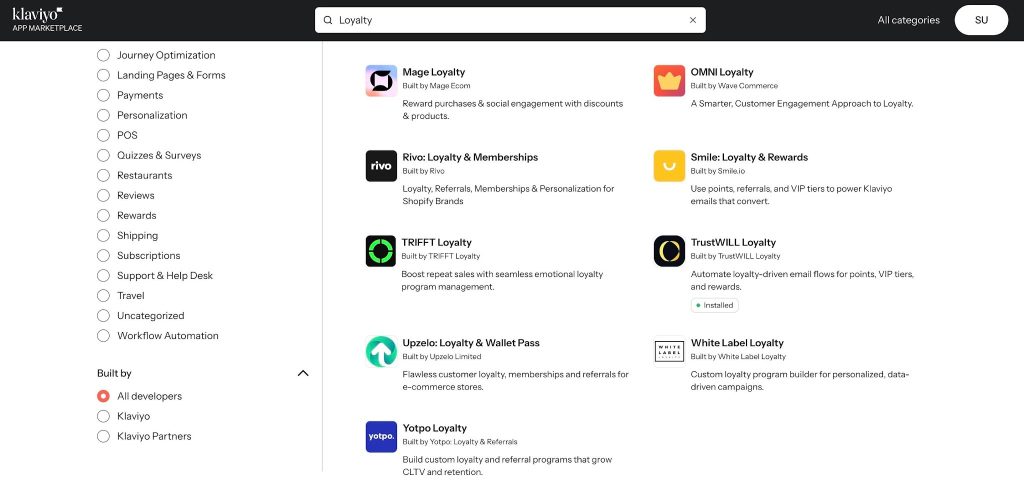
Who Wins? Klaviyo for flow variety, workflow depth, and retention targeting. Omnisend is the easier starting point and handles multichannel retention well, but Klaviyo gives you more control as your store scales.
💡Learn more about how to build a high-performing Klaviyo post-purchase flow to keep customers engaged after checkout.
5. Segmentation, Customer Data, and Personalization
If you want your workflows to be more effective, you need to make sure your platform can read and use customer data accurately. Here’s how the two platforms compare:
Segmentation Depth
Both platforms support unlimited segments, but the depth of what you can build differs. Here’s a quick comparison:
| Feature | Omnisend | Klaviyo |
| Segmentation flexibility | Purchase history, browsing behavior, engagement, tags, and custom events | All of Omnisend’s options plus demographic data, predictive analytics, and custom data fields |
| Ease of setup | Quick setup with 30+ pre-built segments and an AI segment builder | Slightly more complex, but more customizable |
| Real-time updates | Basic real-time updates based on customer activity | Pinpointed real-time tracking with fast data sync |
| Behavioral targeting | Email clicks, purchases, and site visits | Browsing behavior, purchase history, and proximity-based location filtering |
| Custom rules | Based on activity and campaign history | AND/OR conditions, relative time frames, and segment inclusion/exclusion |
Omnisend shows CLV data at the individual contact level, but you can’t segment by it. Klaviyo lets you segment by predicted CLV, export it in bulk, and use it directly in flows and forms. For stores with a growing contact list, that distinction becomes more relevant over time.
Predictive Customer Insights
Klaviyo’s predictive analytics let you forecast a customer’s next order date, lifetime value, churn risk, and spending potential, all feeding directly into your segments and flows.
Omnisend offers historical and predicted CLV at the contact level, but the predictive tools are more limited.
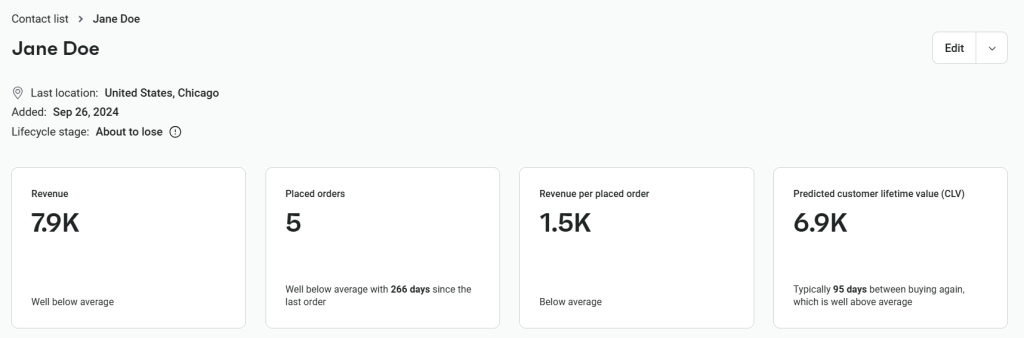
For larger Shopify brands (managing thousands of customers across different buying stages), Klaviyo’s predictions help you decide who to target and when.
Ecommerce Personalization
Omnisend personalizes across email, SMS, and push notifications using dynamic content, product recommendations, and lifecycle flows covering welcome, post-purchase, and win-back campaigns.
Klaviyo pulls any customer data into messages through personalization tags, uses AI-driven send times, and builds product recommendations from individual browsing and purchase history.
For lifecycle messaging, it uses predictive data to time messages based on when a customer is likely to buy again or churn.
Who Wins? Klaviyo, as it offers better segmentation depth, predictive insights, and personalization.
6. Reporting, Testing, and Deliverability
If you really want to create effective segmentation and automation, you need to make sure they’re working and also know whether they’re performing well.
Reporting and Revenue Attribution
Omnisend lets you track the performance of emails, SMS, and push notifications in just one dashboard. You’ll be able to check:
- Open rates, click-through rates, and unsubscribe rates
- Revenue per campaign (and automation)
- Audience growth and signup form reports
- Sales reporting (plus per-channel breakdown)
- Advanced reporting and segment performance (only on Pro plan)
Klaviyo also covers the following, but it offers more detailed content and flexibility. It allows you to view:
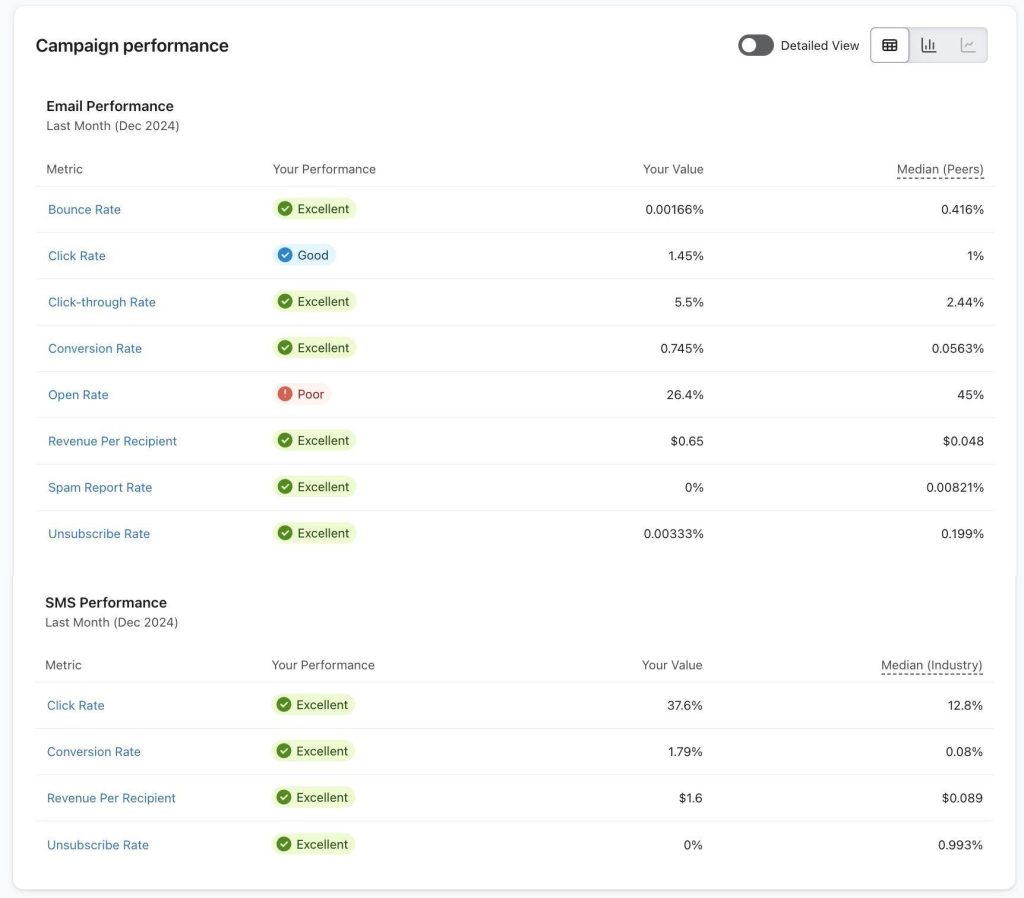
- Campaign and flow performance metrics
- Industry benchmarks and segment growth summaries
- Revenue breakdowns (can be by product, segment, and time period)
- Custom reports that’ll be based on five pre-built templates
On revenue attribution, Omnisend lets you set custom windows per channel, with sales attributed to the send date by default, switchable to order date.
Klaviyo offers three attribution models: last-touch, first-touch, and linear, with default windows of 5 days for email and 24 hours for SMS.
A/B Testing and Optimization
For any campaigns you launch, testing is a must. You’ll need to determine what works better for your conversion (or what resonates more with your audience) and optimize from there. Klaviyo lets you test subject lines, sender names, send timing, email content, … and even the CTA style within your campaigns and flows.
Omnisend allows you to test content elements like subject lines, sender names (and email addresses), plus the main email content. For now, it doesn’t allow you to A/B test different send times. You may have to split your contacts if you really want to know which time works the best for a specific group.
Deliverability and Sender Reputation
Omnisend has the basic features to help you achieve a solid inbox placement. It processes authentication through SPF, DKIM, and DMARC, monitors sender health, and tracks bounce and spam rates (by domain). It also offers dedicated IPs for brands that send high-volume emails.
Klaviyo includes all of that and more. For example, it has a dedicated Deliverability Hub and Google Postmaster Tools integration. It also allows you to set automated sunset flows for unengaged subscribers and create a branded sending domain.
You get more control over the health of your sender reputation, which is important once your email volume goes higher.
Who Wins? Klaviyo wins this by a landslide. Its reporting, testing, and deliverability tools are more detailed. They can help you become more confident with your campaigns.
7. Shopify Integrations and Platform Support
Shopify integration is one of the most important factors you have to consider. That’s because it can affect your marketing campaigns and your automation performance.
Shopify Data Sync and App Ecosystem
The good news is that Klaviyo and Omnisend allow you to sync customer data, orders, products, carts, and purchase events directly from Shopify (and other ecommerce platforms).
Omnisend connects with 200+ apps. Some examples are Facebook Ads, TypeForm, Squarespace, and Reviews.io.
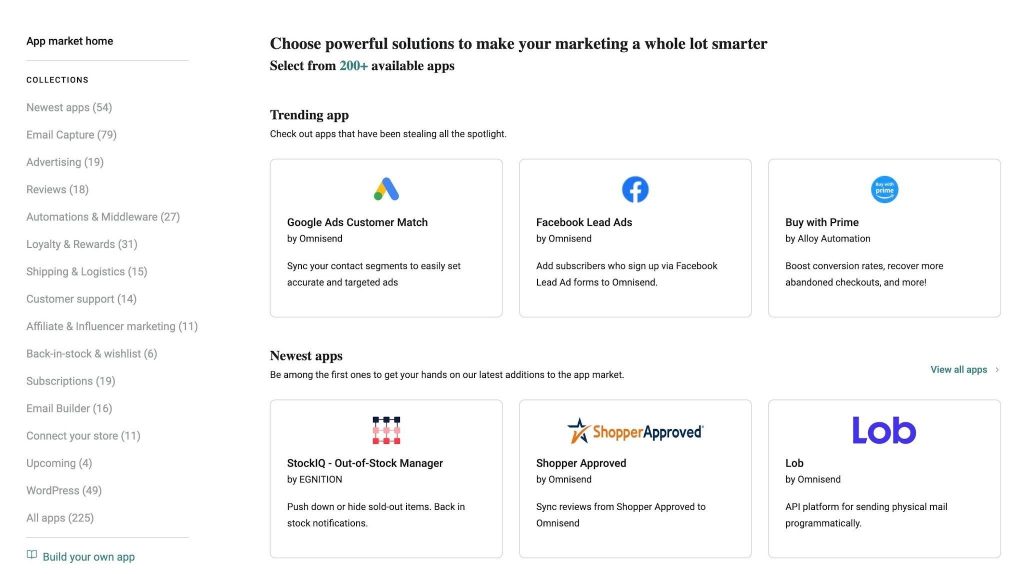
But Klaviyo provides more connections with over 350 native integrations. Yes, most e-commerce platforms are included on the list, but so are CRMs and ad platforms like Facebook and Google Ads. It also integrates well with post-purchase tools (order tracking, reviews, etc.) and even with an analytics tool.
For stores with a more complex tech stack, Klaviyo has a broader ecosystem, which gives a practical advantage. Like more accurate data sync and more useful automation.
How well a platform connects with your Shopify store affects everything from segmentation accuracy to automation performance.
AI Features and Workflow Assistance
AI has been turning the ecommerce marketing space on its head, and both Omnisend and Klaviyo have been keeping up.
Omnisend’s AI covers the everyday tasks: writing subject lines, generating email copy, building forms, and recommending products, all available on every plan, including free. For smaller teams, this alone can cut campaign prep time significantly, without needing to learn anything new.
Klaviyo’s K:AI is built for teams that want more from their AI.
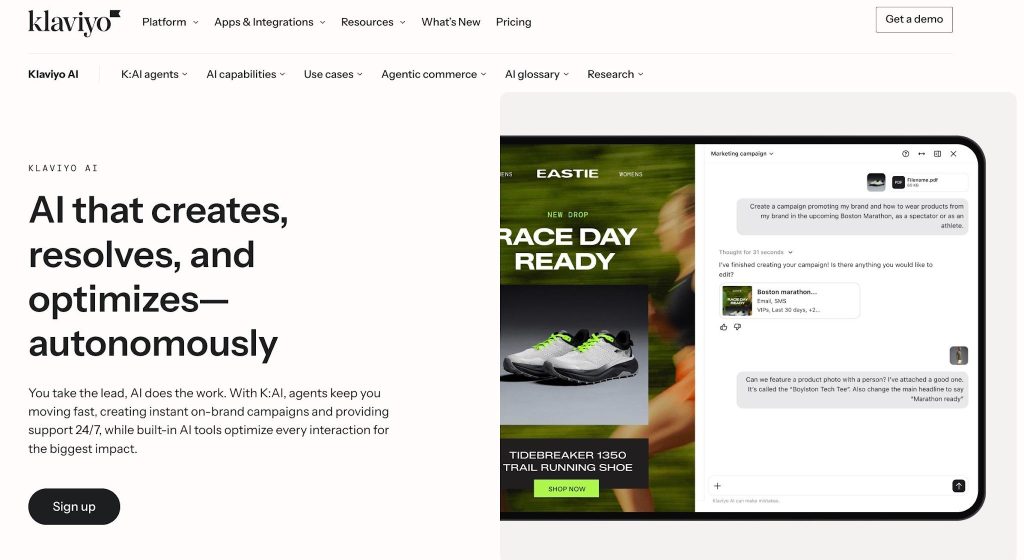
Its Composer builds full campaigns and flows from a single prompt, while predictive tools like churn risk scoring and CLV help you decide who to target and when.
Most of these advanced features require a paid plan, so the depth you get depends on what you’re willing to invest.
Customer Support and Learning Resources
Omnisend provides 24/7 live chat and email support on every plan, including free, along with the Omnisend Academy covering workshops, guides, and learning resources.
Klaviyo offers email support for the first 60 days on free plans, then requires a paid plan for live chat and email support access.
For smaller teams, Omnisend’s always-on support is a clear advantage. As your automation complexity grows (and it will), having reliable support access without upgrading your plan makes a real difference.
Who Wins? Klaviyo, as it offers better integrations and advanced AI features. But for the customer support part? We have given that to Omnisend.
Which Platform Is Better for Your Shopify Store?
By now, you have a pretty clear picture of what each platform does well. Here’s how to make the final call based on your store’s situation.
Choose Omnisend If You Want a Simple Multichannel Marketing App
Omnisend is the better fit for small to mid-sized Shopify stores that want to get up and running without a steep learning curve.
If you’re managing a lean team, working with a tighter budget, or just getting serious about email and SMS marketing, Omnisend gives you a solid starting point.
The free plan is generous, paid plans start at $16/month, and you get multichannel support across email, SMS, and web push right out of the box. Plus, the 24/7 live chat support on every plan (including free) is a real advantage for teams that don’t have a dedicated marketing specialist on hand.
Choose Klaviyo If You’re Ready to Grow Using Detailed Data and Analytics
Klaviyo makes more sense for Shopify stores that are scaling and need deeper control over their data. If you’re working with a large contact list, running complex customer segments, or function better with advanced analytics to make marketing decisions, Klaviyo’s advanced tools are worth the higher price.
Its predictive analytics, 60+ pre-built flows, 350+ integrations, and native two-way SMS put it ahead for data-driven teams.
The trade-off is a steeper learning curve and a more involved pricing structure, so it works best when you have the team and budget to get the most out of it.
Final Recommendation for Ecommerce Brands
The better choice really comes down to where your store is right now. Omnisend is the more practical option for brands that want simplicity, affordability, and multichannel coverage without a lot of configuration.
Klaviyo is the stronger pick for stores (particularly those already generating consistent revenue) that are ready to invest in advanced segmentation, deeper reporting, and more precise customer targeting. Both are solid platforms.
The question is how much complexity you actually need right now.
Still comparing platforms? Read our Attentive vs. Klaviyo comparison next.

Content Specialist
I’m passionate about creating SEO-friendly content that also resonates with readers. I take data and insights and turn them into actionable, practical ideas. My mission? Helping websites drive organic traffic and grow sustainably.