Free returns help you win sales, but every return costs you money: return shipping, inspection, repackaging and the margin you lose when an item can’t be resold at full price. US shoppers were expected to send back about 16% of everything they bought in 2025, close to $850 billion in merchandise, according to the National Retail Federation and Happy Returns.
That’s why more online retailers charge a restocking fee on some returns. This guide covers what a restocking fee is, how much to charge, what the law allows and how to charge one without scaring off buyers.
What is a restocking fee?
A restocking fee is a charge that an online store deducts from a customer’s refund when they return an item. It covers part of the cost of getting that item back on the shelf.
Retailers charge restocking fees for a few reasons:
- Labor: someone has to inspect, test, repackage and re-list every returned item.
- Return shipping: if you pay for the return label, the fee offsets part of that cost.
- Lost value: items damaged in transit or opened by the customer often can’t be resold at full price.
- Impulse purchases: a fee makes shoppers think twice before buying something they aren’t sure they want.
- Return abuse: some shoppers order several sizes or colors, keep one and send the rest back. A fee discourages that habit and other forms of return fraud.
The trade-off is that a restocking fee can also put buyers off. The goal is a fee that covers your real costs without making customers hesitate at checkout.
How much is a restocking fee?
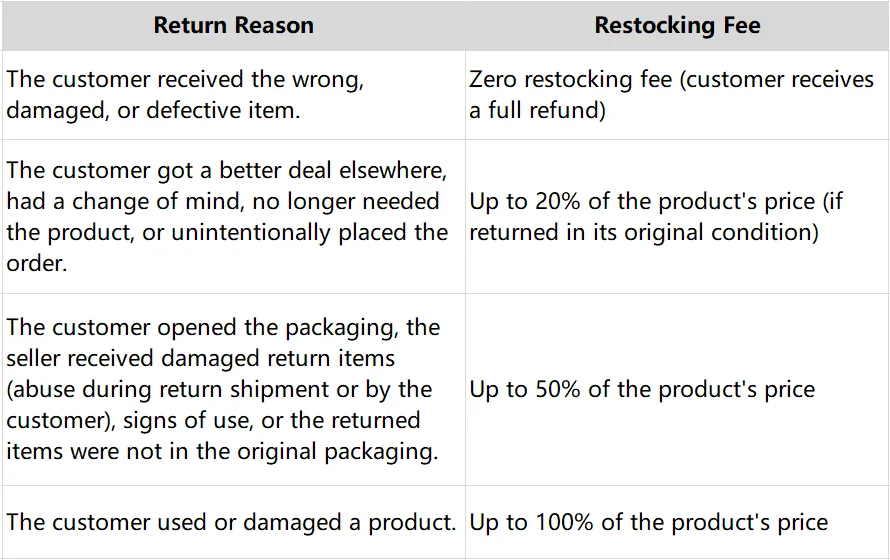
Most restocking fees are a percentage of the item’s purchase price, usually 10% to 25%. Where you land depends on the product’s value, your margins, the return reason and how expensive the item is to inspect and resell. Electronics, for example, often carry higher fees than apparel because each return needs testing.
Example: a customer returns a $100 dress. With a 20% restocking fee, you keep $20 and refund $80.
7 things to consider before charging a restocking fee
Set the fee too high and you lose customers. Set it too low and it won’t cover your costs. Weigh these seven factors first.
1. Local laws and regulations
There’s no federal US law that caps restocking fees, but consumer protection laws vary by state and country. Most require you to disclose the fee clearly before the sale, and some limit when you can charge one. Restocking fees can also be taxed: in Washington state, for example, they’re subject to business and occupation (B&O) tax. Check with legal counsel before you add a fee to your policy.
2. Conversion rates
Shoppers can’t touch or try on products online, so many read the return policy before they buy. A high or hard-to-find restocking fee can make them abandon the purchase. Keep the fee low enough that it never becomes the reason someone doesn’t buy.
3. Profit margins
A restocking fee rarely covers the full cost of a return. Build expected returns into your pricing so products that get returned often carry enough margin to absorb what the fee doesn’t. Knowing your return rate by product category helps you price for it.
4. Return processing costs
Add up what a return actually costs you: return shipping, reshipping replacements, inspection, repairs, cleaning, repackaging, admin time and relisting. A fair restocking fee is based on that number. You won’t recover all of it, but you’ll know what a reasonable fee looks like. A clear returns management process makes these costs easier to track.
5. How you communicate your return policy
Hidden fees break trust. State the restocking fee in your return policy, including the percentage, which items it applies to and which conditions qualify for an exchange, a partial refund or a full refund. Customers who know the terms before they buy are more likely to come back.
Learn more: How to Write a Return Policy: A Complete Guide
6. Customer feedback
Ask customers about their return experience. Feedback tells you whether your return window is too short or your fee feels unfair, and acting on it builds trust. Review your return reasons regularly too. Many returns can be prevented before a fee ever comes into play, so it’s worth knowing how to reduce returns at the source.
7. Brand reputation
Customers who think your fee is fair keep buying and recommend you. An unreasonable fee leads to negative reviews and fewer repeat customers. Set a fee that protects your margins without hurting how people see your brand.
How to charge a restocking fee without hurting sales
A separate line item labeled “restocking fee” can feel like a penalty. These four approaches recover return costs in a way customers find easier to accept.
1. Deduct it from the refund
Base the refund on the return reason and the item’s condition. If you shipped the wrong item or a defective one, refund in full or send a replacement. If the customer changed their mind or the item shows signs of use, issue a partial refund minus the restocking fee.
2. Charge for return shipping
Return shipping is one of the biggest costs in any return. When the return isn’t your fault, ask the customer to cover it, either by deducting the label cost from the refund or by letting them buy a label from an approved carrier. Make sure every return has a tracking number so you know when it’s on its way back.
3. Offer exchanges
An exchange keeps the sale. For example, if a customer returns a $200 item and their refund after the restocking fee would be $170, offer an exchange for any item worth up to $170 at no extra charge. The customer gets something they want, and you keep the revenue and give them a reason to browse.
4. Offer store credit instead of refunds
Store credit keeps the money in your store and brings the customer back. With a cash refund, the full amount leaves your business, and you still have to pay to resell the item, often at a discount.
Charge restocking fees automatically with CWILL Returns & Exchanges
Calculating restocking fees by hand gets hard once return requests pile up. CWILL Returns & Exchanges applies them for you:
- Set a fixed return fee or a percentage-based fee (1% to 100%) by return reason or return solution.
- Show the fee on the customer’s screen before they submit a return request, so there are no surprises.
- Automate refunds and exchanges, and edit return instructions so customers know exactly what to expect.
See how it would work for your store. Book a demo with our team, or install CWILL Returns & Exchanges from the Shopify App Store.
Restocking fee FAQs
Amazon doesn’t charge a restocking fee on most items returned in their original condition within the return window. It can deduct part of the refund when an item comes back damaged, used or missing parts. The amount depends on the product category and the item’s condition, so check Amazon’s current return policy for specifics.
You don’t need a special tool. Multiply the item price by your restocking fee percentage. For a $150 item with a 15% fee, the fee is $22.50 and the refund is $127.50. A spreadsheet works well if you need to calculate fees for many orders at once.
There’s no federal US law on restocking fees. Each state has its own consumer protection and refund rules, and many require retailers to disclose their refund policy, including any restocking fee, before the sale. Check the rules in each state where you sell and talk to legal counsel before you set your policy.
In most cases, yes, as long as you follow a few rules. Include the fee in your return policy with clear terms, disclose it before the sale and keep it in line with what returns actually cost you. Don’t charge it if the fee wasn’t disclosed, if you shipped the wrong item, if the item arrived damaged or defective, or if the order arrived later than promised.
No. The FTC’s Cooling-Off Rule gives buyers three days to cancel certain sales made at their home or at a temporary location, such as a hotel or convention center. Online purchases aren’t covered; they fall under your return policy and state law.

Content Director | 9+ years decoding B2C & B2B eCommerce, obsessed with SaaS and retail storytelling
Words are my weapon—crafting killer copy, decoding trends, and turning data into gold. When not strategizing: Coffee addict, pun enthusiast, and book lover. Ready to level up your eCommerce game? Let’s chat. ☕️