Key Takeaways
- Online return rates average around 30%, roughly three times higher than in-store returns.
- A self-service returns portal reduces friction for the 60% of customers who prefer solving issues themselves.
- A clear, plain-English return policy is one of the highest-ROI improvements you can make today.
E-commerce returns management is what separates stores that absorb returns and stay profitable from ones that let them quietly drain margins.
The average online return rate runs around 30%, nearly four times higher than in physical stores. That’s not necessarily a sign something is wrong. Customers can’t touch, try, or see products before buying, so some returns are simply part of the territory. What matters is what happens after they arrive.
We’ve helped thousands of businesses optimize their return processes and improve their post-purchase experience. This guide covers everything you need to know: what e-commerce returns management is, how it works, and the strategies that protect your margins while keeping customers coming back.
What Exactly is E-Commerce Returns Management?
E-commerce returns management is how you handle products that customers send back to your online store. It includes your return policies, customer service, logistics process, and more.
Unlike basic return processing (which is reactive), returns management is more strategic and proactive. You build systems that prevent issues and make the whole experience better for both you and your customers.
Here are some differences between these two approaches:
Here’s how the two approaches differ:
| Without a returns strategy | With e-commerce returns management |
|---|---|
| Every return lands in someone’s inbox to review manually | Return requests are approved and labeled automatically |
| Customers wait days to hear back | Customers get confirmation and a label within minutes |
| Each return gets handled differently depending on who’s working | Staff follow a consistent checklist from receipt to restocking |
| Return rates climb and you can’t pinpoint why | Data shows you exactly which products to fix and how |
| Inventory counts drift further from reality with every return | Stock levels update in real time as returns are processed |
The Impact of Returns on E-Commerce Businesses
The data is clear: not managing returns properly quietly drains your margins. While you’re focused on driving sales, returns are leaking revenue through costs and lost inventory.
In 2025, consumers returned nearly $850 billion in merchandise. That’s nearly the GDP of the Netherlands flowing back through supply chains that many merchants lack the infrastructure to handle.
The Direct and Indirect Costs of Returns
Returns hit your bottom line in two ways.
Direct costs are the obvious expenses:
- Refunds deducted from sales revenue
- Return shipping costs (especially if you offer free returns)
- Transaction fees such as credit card processing
Indirect costs are what we call “hidden profit killers.”
Unlike direct costs, they’re harder to see on a spreadsheet but they compound quietly over time.
The clearest example is customer churn. According to the NRF, 71% of shoppers say they are less likely to return to a retailer after a poor return experience. And 80% of shoppers will tell friends and family about the experience on their way out.
How to Build a Returns Process That Works
Successful online sellers optimize their entire reverse logistics process rather than just processing returns as they arrive. Here are four ways to rethink your approach:
Build a Self-Service Returns Portal
Having a customer service team on standby is important, but most customers (over 60%) prefer to handle simple issues on their own.
Imagine a customer named Lucas who bought a medium polo shirt but didn’t realize your sizing runs large. With a self-service portal, Lucas can log in and process his return immediately. Without one, he’d have to email you, open a ticket, exchange messages, and wait hours or days just to get instructions.
Pro Tip: Add clear FAQs and simple instructions directly to your portal or order page. Answer questions like “What condition should items be in?” and “How long do refunds take?” Customers who know what to expect upfront won’t contact support for basic questions.
Automate Return Authorization and Label Generation
Many merchants spend hours manually reviewing return requests and matching orders. Switching to auto-approval for standard returns is a straightforward way to cut admin time and satisfy shoppers with a faster process.
Here’s what automated authorization looks like in practice:
- Create clear auto-approval rules (for example: returns within 30 days for unworn items) based on your policy
- Generate return shipping labels with detailed packaging instructions automatically
- Send confirmation emails with tracking information the moment a return is approved
Shopify-friendly tools, such as CWILL Returns & Exchanges, can handle all this automation for you.
Standardize Receiving and Inspection
Ever walked into a warehouse during peak return season? It’s chaos. Returned packages everywhere, and staff playing detective, trying to figure out what’s inside each box.
We’ve seen this happen dozens of times with our clients. The best solution we’ve found? Implementing return shipment tracking and RMA scanning systems. So, when packages arrive, staff scan the code and instantly see contents, return reasons, and processing instructions.
Here are the best practices we recommend for quick inspection and verification:
- Create standardized checklists for different product categories: For example, check for stains, tears, and missing tags (for clothing). Test functionality and check for physical damage (for electronics).
- Train staff to identify minor defects: A tiny scuff on a phone case might not matter, but missing parts definitely do.
- Set clear guidelines: Determine when items can be returned to regular inventory versus clearance or disposal.
Speed up Refunds and Exchanges
How long does it take for you to handle refunds? Speed matters more than you think when managing refunds and exchanges.
37% of Americans would rather visit a dentist than wait for a slow refund. Delayed refunds create anxiety and lead to negative reviews. Fast processing turns frustrated customers into loyal ones.
So what can you do? Set up refund triggers that automatically process payments once returned items pass inspection. For exchanges, create new orders immediately so customers don’t wait for replacement items.
You can also offer store credit as an alternative option. It gives your customers immediate purchasing power instead of waiting for bank processing times (which can take forever).
Pro Tip: Send automated updates throughout the process to keep your customers informed. Let them know when you receive their return request, when the inspection is finished, and when refunds are processed.
How to Reduce Your E-Commerce Return Rate
If you can stop returns from happening, you protect your sales and enhance customer satisfaction. Here are three strategies for reducing your e-commerce return rate:
Write a Clear, Plain-Language Return Policy
One of our clients received a complaint that their return policy read like a legal contract. It put them in messy situations, and they lost customers because of it.
Your return policy should be in plain English, detailed, and placed in visible spots like your website footer and product pages. If you do this, you can enhance customer satisfaction and lessen return queries.
Take Nordstrom’s return policy, for example. They clearly state their timelines (refunds in 3-5 business days) and how exactly their process works.
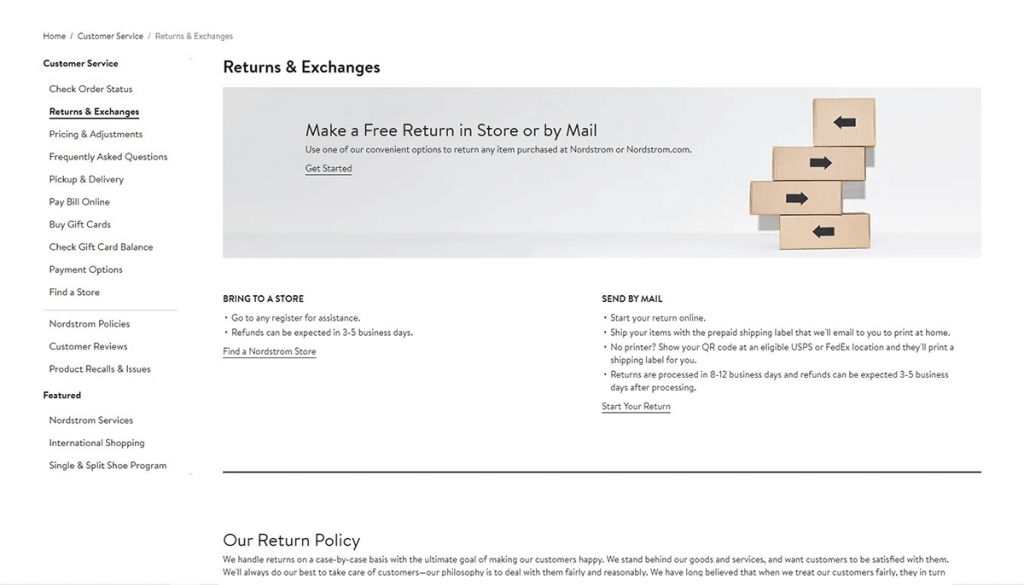
If you don’t know how to create a clear and transparent return policy, you could use this checklist:
- How long customers have to return items
- What condition items need to be in
- Who covers return shipping costs (you or the customer)
- How long refunds take to process
- Whether you offer exchanges, refunds, or both
Follow the above closely and you’ll be surprised how it’ll change your e-commerce returns management.
Improving Product Information and Accuracy to Minimize Returns
Accurate descriptions and high-quality images prevent most “not as described” returns. If your customers get exactly what you promised, they (most likely) won’t send items back due to mismatched expectations.
Some popular brands demonstrate this well:
- Wayfair: Provides close-up images from different angles, along with descriptions of actual sizes that include measurements overlaid on the furniture.
- Dyson: Features videos of the actual items on their product pages.
- Nike: Keeps it simple but provides close-up images from various angles, including the sole and top view.
Use Return Data to Drive Continuous Improvement
Returns data is your business’s health report card. It tells you exactly what’s going wrong and where to fix it.
Start by tracking return reasons by product category, identifying your top 10 most-returned items, and looking for seasonal patterns. If winter coats are frequently returned for being “too thin,” you know to update your product descriptions or find a better supplier.
Use this data to improve product descriptions, adjust sizing charts, or discontinue problematic products altogether. Some brands create “return heat maps” showing which products need the most attention.
Pro Tip: Set up monthly returns data reviews and act on what you find. Data without action is just expensive spreadsheet storage.
How Returns Management Software Works: The Role of a Returns Management System
A returns management system (RMS) automates the entire workflow from start to finish.
Here’s how it works: when a customer initiates a return, the system checks whether it meets your policy criteria (time limits, product conditions). If approved, it instantly generates return labels, sends confirmation emails, and updates your inventory management system. The customer gets an immediate response instead of having to wait 24+ hours for approval.
The system also handles backend processes by tracking returned packages in transit and updating return status automatically. It syncs with your online store, keeps inventory counts accurate, and helps prevent overselling.
Key Features to Look for in E-Commerce Returns Management Software
Now that you know what a good returns management process is, it’s time to learn the must-have features that can make it all possible:
- Return fraud prevention: About 15% of all returns turn out to be fraudulent. That’s a huge problem. This feature alerts you to suspicious patterns and serial returners who abuse your return policy.
- Auto-approval workflows: Why spend hours reviewing return requests when software can handle them? This feature processes simple returns automatically while flagging complex cases for your team.
- Integration capabilities: The returns tool should connect with your store, inventory system, and shipping carriers. You don’t want to deal with bad connections that make you do everything twice.
- Notification features: Automated emails and status updates keep customers informed throughout the return process. Without this, your support team gets flooded with “where’s my refund” questions (and nobody has time for that).
- Analytics and reporting: Which products get returned most often and why? This data helps you spot expensive patterns before they get worse.
- Flexible return and exchange methods: Your customers want options besides basic refunds. Tools that support store credit, gift cards, direct exchanges for different sizes, or refunds to original payment methods give them enough choices.
- Customizable pages: Your return page should match your store’s vibes (not like a third-party site). Go for a tool that allows you to do that easily. Plus, make sure it offers editable return policies so you can set rules for different product categories.
If you use software that has these features, you’ll spend way less time handling returns and keep your customers happy with quicker responses.
CWILL Returns & Exchanges: Your All-In-One Return Management Solution
If you’re ready to streamline your return process, CWILL Returns & Exchanges covers all the features above and more. Our self-service portal allows your customers to manage their returns and choose from store credit, exchanges, or standard refunds.
Book a demo with us to learn how our app works.
FAQs
E-commerce returns management is the system a business uses to handle products that customers send back. It covers return policies, customer service workflows, logistics, inventory handling, and refund or exchange processing. Returns management is proactive: you build systems that reduce return rates, automate approvals, and improve the experience for both your team and your customers.
Online return rates average around 30%, compared to roughly 8.9% for in-store purchases. Return rates vary by category. Apparel tends to run higher, while categories like consumables or digital goods run lower. A well-structured returns management strategy can significantly reduce your rate over time.
A strong return policy should cover: how long customers have to initiate a return, what condition items need to be in, who pays for return shipping, how long refunds take to process, and whether you offer exchanges, store credit, or both. Write it in plain language, and place it prominently in your website footer and on product pages.
A returns management system (RMS) is software that automates the return workflow from start to finish. When a customer initiates a return, the system checks it against your policy, generates a shipping label, sends a confirmation email, and updates your inventory—automatically. It also tracks returned packages in transit and syncs status updates to the customer. The result: fewer manual reviews, faster resolutions, and more accurate inventory counts.