Key Takeaways
- FedEx and UPS publish nearly the same ground delivery times and size limits: both deliver ground packages in 1–5 business days and accept packages up to 150 lb.
- FedEx Home Delivery runs on Saturdays and Sundays at no extra charge, while UPS doesn’t deliver on Sundays.
- FedEx Ground Economy and UPS Ground Saver can hand packages to USPS for final delivery, cap packages at 70 lb, and include less coverage than standard ground services.
- Use our tracking benchmark to check your own orders: across 442.7 million packages from 1,687 carriers tracked through TrackingMore by CWILL, 89.9% returned at least one tracking update and 84.2% reached a final status.
Choosing between FedEx and UPS is a close call: both carriers deliver ground packages in 1–5 business days and accept packages up to 150 lb. The choice usually comes down to whether you promise Sunday delivery (only FedEx Home Delivery offers it), how residential and holiday surcharges hit your orders, and the rates you negotiate.
Because the gap is small, the better carrier for your store depends on how each one performs on your own routes, so it pays to test both. While you test, you can check each carrier’s tracking against a benchmark from the 1,687 carriers TrackingMore by CWILL tracks. Below, we compare 2026 rates and surcharges, delivery speed, size limits, and claims, then show how to run that test.
FedEx vs UPS at a Glance
FedEx and UPS are fairly evenly matched on price, speed, and size limits; the differences come down to surcharges, weekend delivery, and how each carrier performs on your routes.
| FedEx | UPS | |
| Best for | Stores offering weekend delivery | Stores that want one ground service for homes and businesses |
| Ground delivery time | 1–5 business days (contiguous US); 3–7 to Alaska and Hawaii | 1–5 business days |
| Weekend delivery | Home Delivery on Saturday and Sunday, no extra charge | Saturday Ground residential, no extra fee; no Sunday delivery available |
| 2026 residential surcharge | Ground and Home Delivery: $6.45 | Ground: $6.50 |
| Max weight and size | 150 lb; 108 in length; 165 in length + girth. Express: 119 in length | 150 lb; 108 in length; 165 in length + girth |
| Included coverage | $100; $4.95 for $100.01–$300, then $1.65 per $100 of value over $300 | $100 (unless you declare more) |
| Economy service | Ground Economy: typically 2–7 business days; may be handed to USPS | Ground Saver: Ground time plus about 1–2 days; delivered by UPS and USPS |
Rates and Surcharges: Where FedEx and UPS Differ
FedEx and UPS charge similar base rates, so the difference in price comes from surcharges (the fees added for home delivery, rural addresses, peak season, and fuel). All the amounts below are list rates, the carriers’ standard published prices as of October 5, 2026.
Most merchants shipping at volume pay less because they’ve negotiated volume discounts with a sales rep.
Sample 2026 Ground Rates
On base list rates, FedEx Ground is equal to or slightly below UPS Ground in eight of these nine cases, never by more than 13 cents. The exception is a 10 lb package going to the farthest zone, where UPS is 9 cents cheaper.
| Package | Zone 2 (near) | Zone 5 (mid) | Zone 8 (far) |
| 1 lb, FedEx Ground | $11.99 | $14.00 | $15.01 |
| 1 lb, UPS Ground | $11.99 | $14.10 | $15.03 |
| 5 lb, FedEx Ground | $14.06 | $18.53 | $21.69 |
| 5 lb, UPS Ground | $14.19 | $18.65 | $21.72 |
| 10 lb, FedEx Ground | $15.85 | $20.46 | $26.38 |
| 10 lb, UPS Ground | $15.91 | $20.46 | $26.29 |
FedEx Ground and Home Delivery standard list rates from the FedEx Standard List Rates guide (effective January 5, 2026, updated June 1, 2026). UPS Ground daily rates from the UPS 2026 Rate and Service Guide (updated September 7, 2026). Base rates only, before residential, fuel, and other surcharges. Negotiated rates will be lower.
2026 Rate Increases
FedEx and UPS each raised list rates by an average of 5.9% for 2026. Both have also announced another average 5.9% increase for 2027: FedEx effective January 4, 2027, and UPS effective December 21, 2026.
Residential and Delivery Area Surcharges
Most ecommerce orders go to homes, so the residential surcharge applies to almost every package. Delivery area surcharges apply to rural and hard-to-reach areas.
| 2026 List Surcharge | FedEx | UPS |
| Residential, ground | $6.45 (Ground / Home Delivery) | $6.50 (Ground) |
| Residential, express / air | $6.95 | $7.00 |
| Delivery area, residential | $6.60 | Ground $6.55; extended $8.85 |
Holiday Demand Surcharges
Both carriers add surcharges during the holiday season, with the highest amounts in the weeks before Christmas, when demand peaks.
| 2026 Holiday Surcharges | FedEx | UPS |
| Additional handling period | Sep 28, 2026 – Jan 17, 2027 | Sep 27, 2026 – Jan 16, 2027 |
| Peak weeks | Nov 23 – Dec 27 | Nov 22 – Dec 26 |
| Ground residential, per package | $0.50 from Oct 26, rising to $0.80 at peak | $0.50 from Oct 25, rising to $0.75 at peak |
| Additional handling, per package | $8.80, rising to $11.85 at peak | $8.75, rising to $11.90 at peak |
If your products are heavy, long, or oddly shaped, the carrier may charge an additional handling fee, and that fee also rises during the peak holiday weeks, which some merchants don’t plan for.
Fuel Surcharges
Both carriers add a fuel surcharge as a percentage of the shipping charge, and both reset it every week based on US fuel price indexes. For the week of October 26, 2026, the surcharge was 29.00% for FedEx Ground and Home Delivery and 29.50% for UPS Ground. Because the percentage changes weekly, check each carrier’s current rate before comparing quotes.
Dimensional Weight
Both carriers bill bulky, light boxes by dimensional (DIM) weight: length × width × height in inches, divided by a set number, billed at whichever is higher, actual weight or DIM weight. FedEx divides by 139 for US shipments, and UPS uses 139 on daily rates (166 on retail rates), so the same box gets the same billed weight from either carrier at daily rates. When you compare quotes, check box sizes, not just package weights.
Delivery Speed and Reliability: Ground, Overnight, and Weekends
Published ground times match for both carriers. The differences are in Alaska and Hawaii transit times, the delivery times each carrier lists for overnight services, and Sunday delivery.
Ground Services
When comparing FedEx Ground vs UPS Ground, the advertised times are the same: 1–5 business days within the contiguous US. FedEx adds a longer window of 3–7 business days to Alaska and Hawaii. UPS doesn’t publish a separate ground window for Alaska and Hawaii, so check transit times for those addresses before you promise a date.
FedEx splits its ground network in two: FedEx Ground for business addresses and FedEx Home Delivery for homes. UPS uses UPS Ground to cover both. Since most Shopify orders go to homes, the comparison that matters for most stores is FedEx Home Delivery vs UPS Ground.
Overnight Options
FedEx lists the time of day each overnight service delivers. UPS offers Next Day Air and 2nd Day Air, and lists their delivery times on ups.com.
| Service | Delivery By |
| FedEx First Overnight | 8–9:30 a.m. |
| FedEx Priority Overnight | 10:30 a.m. to businesses; noon to homes |
| FedEx Standard Overnight | 5 p.m. to businesses; 8 p.m. to homes |
| UPS Next Day Air | Varies by destination |
| UPS 2nd Day Air | Varies by destination |
Delivery times vary by destination ZIP code, so check the time for your customers’ addresses before you promise a delivery window at checkout.
Saturday and Sunday Delivery
| FedEx | UPS | |
| Saturday | Home Delivery, no extra charge | Ground residential, no extra fee |
| Sunday | Home Delivery, no extra charge | No Sunday delivery |
| Weekend coverage | 98% of the US population on Saturdays; nearly two-thirds on Sundays | N/A |
Both carriers deliver to homes on Saturday at no extra charge. Only FedEx delivers on Sunday. UPS orders in transit over the weekend wait until Monday. Keep in mind that FedEx’s Sunday delivery reaches nearly two-thirds of the US population, so not every customer will get a Sunday drop-off.
On-Time Delivery Rates
Shipping analyst ShipMatrix reported December 2025 peak-season on-time rates of 97.2% for UPS and 95.3% for FedEx. On-time rates show whether packages arrived within the promised window, not what customers saw in tracking along the way: a package can arrive on time while its tracking page shows “not found” for days.
These are network-wide figures for December, the busiest month, and cover all service types, not ground alone.
Tracking Tools: FedEx Delivery Manager vs UPS My Choice
Both carriers offer free accounts that send your customers delivery alerts. FedEx Delivery Manager sends alerts by email, text, phone, or app, including photo proof of delivery, and lets customers redirect a package to a FedEx retail location for free; other changes, like rerouting to another home, cost extra. UPS My Choice lets customers get delivery alerts and photos, see an estimated delivery time, and change the delivery date or location, with paid upgrades for confirmed two-hour delivery windows.
Size Limits, Insurance, and Claims
Size limits and included coverage are the same for both carriers. The difference is in claim deadlines: how long you have to ask the carrier to pay for a lost or damaged package.
Weight and Size Limits
| FedEx | UPS | |
| Max weight | 150 lb | 150 lb |
| Max length | 108 in (Ground); 119 in (Express) | 108 in |
| Max length + girth | 165 in | 165 in |
| PO boxes | Standard shipments can’t go to PO boxes | Not delivered by UPS; Ground Saver can deliver |
Both carriers’ economy services (FedEx Ground Economy and UPS Ground Saver) cap package weight at 70 lb. This means heavier orders require standard ground service, which merchants should keep in mind if they routinely ship heavier goods.
| FedEx | UPS | |
| Included coverage | Up to $100 per package | Up to $100 per package |
| Cost of extra coverage | $4.95 for $100.01–$300, then $1.65 per $100 of value over $300 | Charged by declared value |
Claim Deadlines
| FedEx | UPS | |
| Damaged package | Within 60 calendar days of the ship date | Within 60 days of scheduled delivery |
| Lost package | Within nine months of the ship date | Notice within 60 days of scheduled delivery |
FedEx gives you much longer to report a lost package. With UPS, report missing orders within 60 days of the scheduled delivery date, since that’s when UPS must receive notice of a claim.
Economy Services That Hand Packages to USPS
Both FedEx and UPS offer a cheaper, slower service for light packages going to homes: FedEx Ground Economy and UPS Ground Saver. To keep costs down, both can hand the package to USPS for the last leg of the trip from the local facility to the customer’s door.
So a customer who chose a FedEx or UPS shipping option may see a USPS carrier drop off their order, or USPS updates in their tracking, and wonder what happened. Another thing to note is that FedEx Ground Economy coverage ends once the package is handed to USPS. Because USPS can take over the final leg, both economy services can deliver to PO boxes, which FedEx Ground and UPS Ground can’t.
| FedEx Ground Economy | UPS Ground Saver | |
| Delivery times | Typically 2–7 business days | About 1–2 days longer than UPS Ground |
| Who delivers? | USPS, FedEx, or another delivery service | UPS or USPS |
| Max weight | 70 lb | 70 lb |
| Included coverage | $100, only until handed to USPS | $50 |
| PO boxes | Yes | Yes |
International Shipping: A Quick Note
Both carriers ship worldwide: FedEx serves more than 220 countries and territories, and UPS more than 200. If you ship abroad, compare the two in the countries you ship to most, and ask each carrier how duties and customs brokerage fees are billed so customers aren’t surprised at delivery.
How to Compare FedEx and UPS on Your Own Orders
Published rates and delivery times only go so far. Before you move most of your volume to one carrier, test both on your own orders.
The Metrics to Track
Track these separately for each carrier:
- Transit time by region: how long orders take from first scan to delivery, broken out by where they’re going. A carrier can be faster overall and still slower to the regions you ship to most.
- Delivery exceptions: how often packages hit a problem, such as a bad address, damage, a weather delay, or a return to sender. You will probably hear about these from your customers first.
- “Not found” or stuck tracking: how often a tracking number returns no information, or sits on “label created” or “in transit” with no new updates.
- “Where is my order?” tickets: how many support requests each carrier’s orders generate. These tickets can be time-consuming and costly. Check this every month: a handful of tickets is normal, but they shouldn’t become routine.
Test Both on One Region for a Month
To get a fair comparison, split your orders in a way that removes other differences. For example, ship all orders to one region with FedEx and all orders to a similar region with UPS for a month, or alternate carriers on orders to the same region. Then compare the four metrics above for each carrier.
Benchmark Your Tracking Against 1,687 Carriers
Use our benchmark as a baseline for tracking. Across 442.7 million packages from 1,687 carriers tracked through TrackingMore by CWILL, 89.9% returned at least one tracking update, and 84.2% reached a final status, the point where tracking ends, such as delivered or returned to sender. Treat these as a reference point rather than a target, since they cover every carrier and include international shipments.
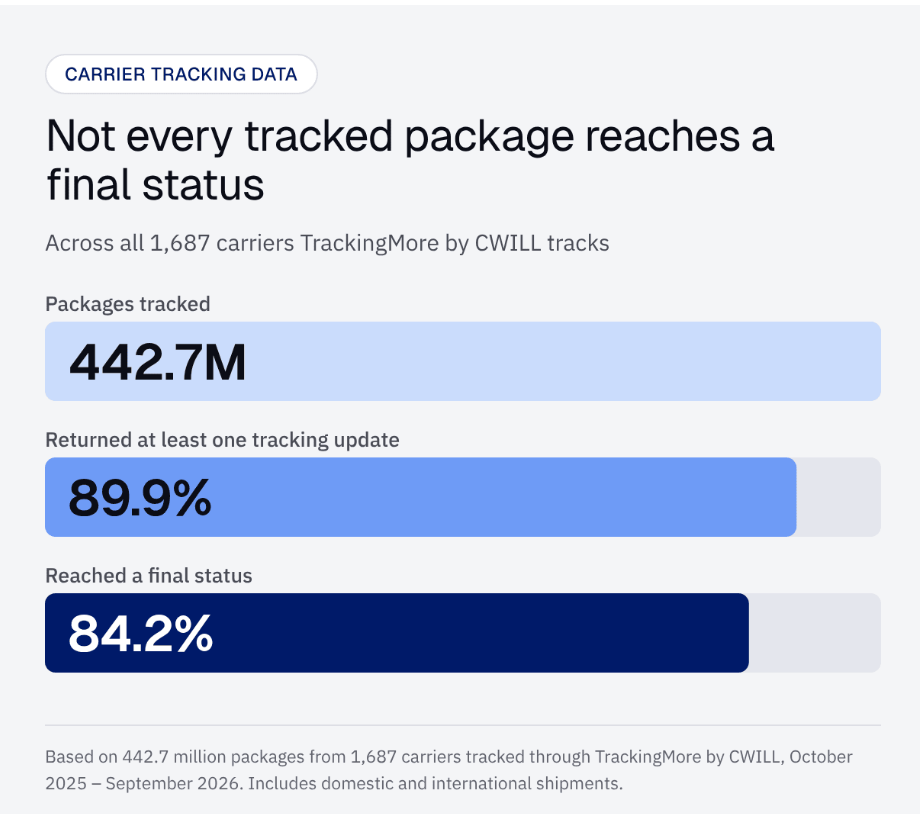
Based on 442.7 million packages from 1,687 carriers tracked through TrackingMore by CWILL, October 2025 – September 2026. Includes domestic and international shipments.
A tracking number that never updates looks like an order that never shipped, and one that stops partway looks lost, even if the package is still moving. Those are the orders that tend to turn into “where is my order?” emails.
What to Check If a Carrier Falls Short
If FedEx or UPS comes in well below the benchmark on your orders, check whether the gap follows the carrier or the service. Compare FedEx Ground with FedEx Ground Economy, and UPS Ground with UPS Ground Saver, before you blame the carrier, since the economy services pass the last leg to USPS and tracking can show unexpected USPS events or go quiet during the handoff. Then look at what happens before the first scan: if labels are printed days before pickup, customers who click the tracking link may see “not found,” which doesn’t mean the package is lost.
Once a package is in transit, watch for delivery exceptions. During a free trial, one CWILL customer told us their new tracking setup “instantly revealed a returned-to-sender exception” on an order they hadn’t spotted. The package was already on its way back, and no one had noticed.
For both carriers, the simplest fix is timing: send the shipping confirmation once FedEx or UPS has scanned the package, not when the label prints, and show a “preparing your order” message until then.
FedEx or UPS: Which Carrier Is Best for Your Store?
Neither carrier wins outright. Here’s where to start, based on what matters most to your store:
- You promise weekend delivery: FedEx. Home Delivery runs on Saturdays and Sundays at no extra charge, while UPS doesn’t deliver on Sundays.
- You care most about on-time delivery at peak: UPS. ShipMatrix reported a 97.2% on-time rate for UPS in December 2025, compared with 95.3% for FedEx.
- You ship light packages to homes or PO boxes: compare FedEx Ground Economy and UPS Ground Saver. Both are cheaper and can deliver to PO boxes, but they include less coverage.
- You ship at volume: use both. When you negotiate with both carriers, each knows you can move volume to the other, and if one has delays in a region or during peak season, you can shift orders without opening a new account in a hurry.
Whichever carrier you start with, run a month-long test on one region, compare the four metrics against the benchmark, and move more volume only when your own numbers back it up.
To see transit times, exceptions, and tracking status for FedEx and UPS side by side, try CWILL Order Tracking free.
Common FAQs on FedEx vs UPS
Many companies use FedEx for weekend delivery. FedEx Home Delivery runs on Saturdays and Sundays at no extra charge, while UPS doesn’t deliver on Sundays. FedEx also gives you longer to report a lost package: you can file up to nine months after the ship date, while UPS must receive notice within 60 days of the scheduled delivery date.
There’s no public data showing which carrier handles packages more carefully, because neither FedEx nor UPS publishes damage rates. Both include up to $100 of coverage per package and let you declare a higher value. If damage is a concern, other metrics like damage exceptions, damage claims filed, and customer reports of damaged orders can help.
Neither FedEx nor UPS publishes loss rates. ShipMatrix’s December 2025 peak-season on-time rates, 97.2% for UPS and 95.3% for FedEx, measure late packages, not lost ones. To compare loss on your own orders, track lost-package claims by carrier for a few months.
Across 442.7 million packages from 1,687 carriers tracked through TrackingMore by CWILL, 89.9% returned at least one tracking update and 84.2% reached a final status. If your own share is well below those numbers, check when labels are created and when tracking numbers go out to customers. Treat these as a reference point rather than a target, since the benchmark covers every carrier and includes domestic and international shipments.
Neither is consistently cheaper. On 2026 list rates, FedEx Ground and UPS Ground are within 13 cents of each other for 1, 5, and 10 lb packages in zones 2, 5, and 8, and their residential surcharges differ by 5 cents ($6.45 vs $6.50). Which costs less depends on where your customers live, when you ship, and the discounts you negotiate.

Freelance Writer & Editor
Grace Gallagher is a writer and editor with 10+ years of experience covering health, wellness, lifestyle, and culture. Her work has appeared in Health, Verywell Health, Verywell Mind, Parents, Romper, Healthline, and more. She has also written for brands including Hims & Hers, Moon Juice, Vital Proteins, and Veracity Self-Care.
Grace holds a BA from Hobart and William Smith Colleges and an MFA in creative writing from Hunter College.
You can visit her website or connect with her on LinkedIn for more information.