Do you want to make your returns process smoother for your Shopify customers?
Happy Returns offers efficient and accessible return options with its 8,000+ drop-off locations and item verification system, but many merchants still look elsewhere for different reasons.
Some want budget-friendly options for smaller businesses with budget constraints, while others are okay spending more as long as they get global shipping support or advanced automation features.
So, we’ve tested and picked 10 Happy Returns competitors to help you find the right software for you. Read on to check them out.
5 Factors to Consider in a Happy Returns Alternative
Before we reveal the return management apps, let us share with you the factors you need to consider. That includes your budget, business requirements, integration, customer support, and scalability.
Here’s how to evaluate the software options based on the following:
1. Pricing Structure that Fits Your Budget
It’s important to determine how much you can spend on the returns platform. Happy Returns doesn’t disclose its pricing plans on its site. And while Capterra mentioned that it costs $500/month, it’s still not as detailed as needed, and that makes it tough to compare it with the alternatives.
What you can do is compare the pricing of each alternative we’ll mention and look for the most budget-fitting (or cost-effective) platform for you.
Besides the cost, here are some other factors you need to check:
- Volume-based vs. flexible pricing: Does it charge per number of returns or offer monthly limits that work better for your business?
- Free trial or free plan inclusion: Could you test the features first at no cost before committing to the paid plans?
- Transparent pricing: Make sure that the alternative you choose doesn’t have any hidden costs to avoid surcharges.
- Solution offered: The alternative should also help you solve one or multiple problems you have (so you get what you paid for). That could be reduced return costs, better automation, or easier exchanges that keep more revenue in your pocket.
2. Return Features for Your Primary Needs
If you want to start right away, pick specific features that you really need, and find a tool that offers them best.
For more efficient return management, we suggest that you also look for a platform that:
- Supports popular carriers like DHL, USPS, UPS, FedEx, etc.
- Offers intuitive interfaces for you and your customers
- Includes must-have tools that improve and streamline returns like exchanges, return options, return protection, automation, data and analytics, etc.
3. Simple Integration With Your Existing Tools
Integrations will save you many hours of moving and collecting data. So, when choosing a returns platform, make sure that it’s easy to connect with your tech stack. Some of the usual requirements are:
- Ecommerce platforms: Shopify, WooCommerce, BigCommerce
- Customer service tools: Zendesk, Gorgias, Helpdesk
- Marketing apps: Klaviyo, Yotpo, Mailchimp, and other email marketing tools
- Inventory management: TradeGecko, Cin7, NetSuite
- Payment processors: Stripe, PayPal, Square
4. Room to Grow With Your Business
Can the platform handle your business as it expands? Happy Returns works well for high-volume retailers, but it’s mostly useful for US merchants. So what if you’re a growing business planning to sell internationally? You’ll need something more flexible.
Good thing, there are many great options from our alternatives that work well for businesses at different stages and markets.
It’s important to look for platforms that:
- Allow you to increase return volumes while still being budget-friendly
- Support upgrades and adding new carriers as you grow
- Process returns internationally (or wherever your customers are)
- Offer flexibility for different business types, such as small startups, mid-sized brands, and large enterprises
- Let you customize workflows without needing a developer on your team
5. Reliable and Accessible Customer Support
You should also look at how fast the platform’s support can respond to your questions and technical issues. Good customer support offers:
- 24/7 and multi-channel assistance (chat, phone, email, support ticket, etc.)
- Free demos and walkthroughs
- Detailed and accessible documentation
Great! You now know what to look for (and consider) when choosing the right Happy Returns alternatives. It’s time to talk about the platforms.
Top 10 Happy Returns Alternatives and Competitors
Here are the 10 alternatives to Happy Returns that offer different strengths in return and exchange management:
| Name | Key Features | Carriers | Ratings |
| CWILL Returns & Exchanges | Unified dashboard, branded portal, proactive notifications, flexible exchange, custom return rules | 17+ | 4.9 |
| ClickPost Returns Plus | Self-service portal, automated workflows, store credits | 500+ | 5.0 |
| Loop Returns | Instant exchanges, “Shop Now” catalog, warranty claims | 21 | 4.6 |
| AfterShip Returns Center | Global drop-off, policy automation, label generation | 62 | 4.6 |
| Return Prime | Product recommendations, smart exchanges, automated workflows | 11 | 4.9 |
| Yanet | Branded portal, flexible policies, multi-language support | Not specified | 4.8 |
| ReturnGO | Exchange-first portal, custom rules, revenue retention | 50+ | 4.9 |
| Narvar Shield | Fraud detection, revenue protection, reverse logistics | 1000+ | 4.5 |
| parcelLab Returns & Exchange | Return volume forecasting, flexible return methods, return analytics | 550+ | (No rating available from Shopify) |
| ReturnLogic | Return Guard protection, policy automation, warranty management | Indirect via 3PLs | 5.0 |
#1 CWILL Returns & Exchanges & Exchanges

The first on our list is CWILL Returns & Exchanges. It’s a powerful and unified return management app for Shopify users. This platform helps avoid revenue loss with multiple exchange options and editable eligibility rules.
Unlike Happy Returns, which is mainly for the US market (with a bit of coverage in Canada and the UK), CWILL Post-Purchase is more ideal for cross-border returns. It supports more languages and partners with popular carriers like USPS, DHL, UPS, and FedEx to handle return shipping worldwide.
The platform comes with an all-in-one return management dashboard where you can track all requests, set custom policies, and monitor return patterns for valuable insights. Your customers also get a branded (and reliable) return portal for self-service returns and exchanges.
Carriers: 17+ available carriers. But merchants can submit a form to request additional ones.
Key Features:
- Return Dashboard: Handle all return and exchange requests from one place and sync the data directly with your Shopify admin in real-time.
- Branded (Self-Service) Return Portal: Give your customers access to a customized return page where they can start returns and exchanges on their own.
- Proactive Notifications: Send automatic (and timely) updates to your customers from the return confirmation until exchange delivery or refund completion. Plus, your team can also receive alerts if there are any issues.
- Flexible Exchange Options: Let your customers swap items for different sizes or colors, or upgrade to higher-value products by paying the difference.
- Custom Return Rules: Allows you to define which items can be returned, set duration limits, and create different policies for product types.
- Return Protection: Offer customers an optional return service they can purchase during checkout that covers return shipping costs if they need to send items back later.
Pros
- Cost-effective alternative
- Offers easy onboarding and a user-friendly interface
- Provides flexible return methods and exchange options
- Supports 21+ languages (English, Spanish, Arabic, German, French, Chinese, and more).
- Offers 24/7 support and a help center for its users
Cons
- Currently works with Shopify and Shopify Plus only
- Limits the max return quota to 1,500/month for the Professional plan
Best for: SMBs and D2C Shopify store owners who process around 60 to 1,500 returns a month.
Integrates with: Shopify, Shopify Plus, Yotpo, Gorgias, and Klaviyo
Pricing: CWILL Returns & Exchanges offers tiered plans starting at $29/month for 50 returns. It also has a free plan (up to 6 return requests/month) and a 14-day free trial for the paid plans.
#2 ClickPost Returns Plus (or ClickPost Shopify Returns)
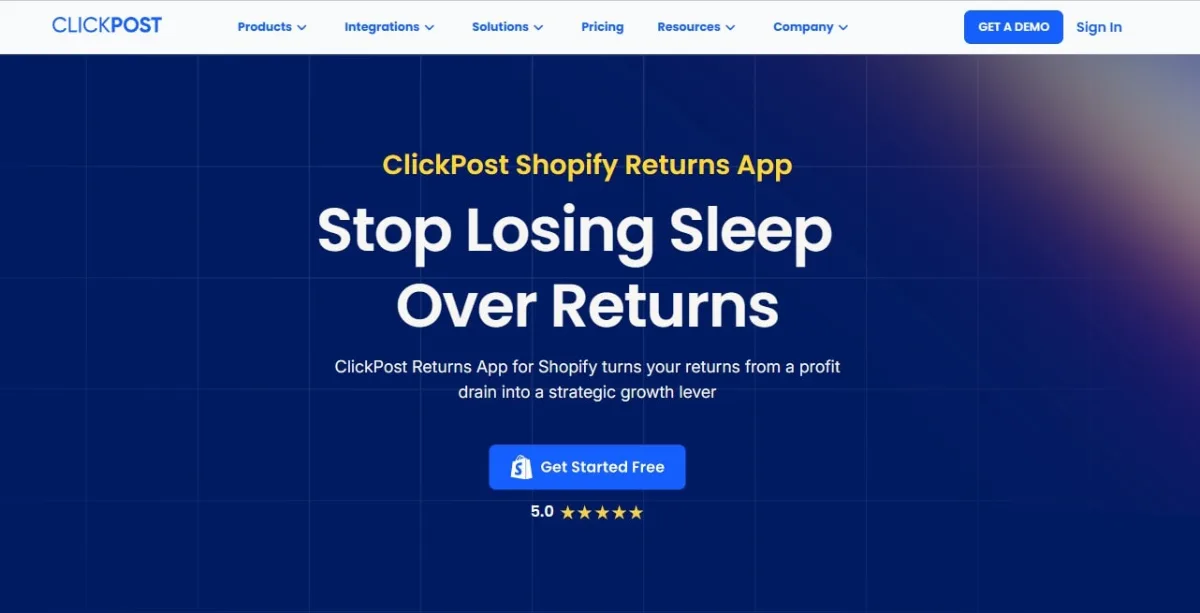
ClickPost Returns Plus is a viable alternative for managing returns in ecommerce businesses. It lets you automate return approvals, offer store credits (in addition to the usual refund option), and give customers a branded portal where they can handle returns on their own.
The platform also provides real-time tracking and insights (about return patterns) from its dashboard.
Carriers: 500+
Key Features:
- Branded Self-Service Portal: Allow customers to process returns with an in-brand return page so your team can handle fewer manual return requests and improve customer satisfaction.
- Automated Return Workflows: You can set up rules that automatically approve routine returns or note suspicious ones for review based on your criteria.
- Store Credit Options: Improve your order value by offering customers store credits instead of cash. Some online shoppers prefer this since they can use the credit immediately for their next purchase.
Pros
- Broad carrier integrations
- The free plan covers up to 100 returns per month
- Offers a comprehensive but easy-to-set-up dashboard
Cons
- Limited integration options with other Shopify apps
- Advanced features like Waybill and label generation are only available in the main ClickPost platform
Best for: Small to medium-sized online stores that have 100-225 returns monthly.
Integrates with: Shopify
Pricing: ClickPost offers a usage-based pricing model. Its Basic plan costs $49/month (includes 225 returns), but you get access to a free plan for up to 100 returns per month, with additional returns charged at $0.40 each.
#3 Loop Returns
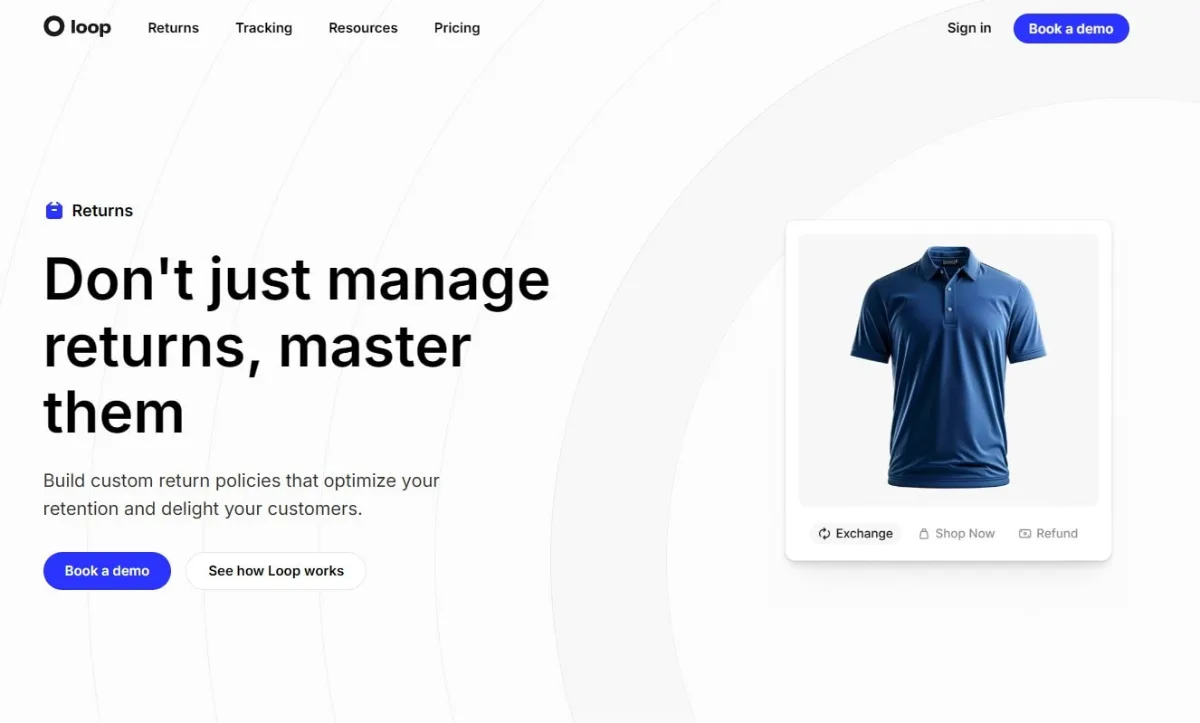
Loop Returns is one of the Happy Returns alternatives that helps you focus on customer retention.
You can turn refunds into item exchanges and future purchases thanks to its quick exchange and bonus credit offers. Loop is a good platform candidate if your main focus is to reduce the instant refunds you process monthly or yearly.
Carriers: 21
Key Features:
- Instant Exchanges: Send replacement items to customers before they even ship back their returns by holding their payment information as security.
- Shop Now Integration: Let your customers exchange their items for anything in your entire product catalog. With this, you can break free from traditional rules (only swap color and size) and open a way to earn more revenue.
- Warranty Claims Management: Deal with product warranties and defect claims through the same system as regular returns, with automated workflows.
Pros
- Allows offline returns with Loop POS for seamless integration
- Provides fraud detection and other safety features to limit returns abuse
- Has a dedicated onboarding and support team for users
Cons
- Most advanced features like bonus credit, shop now, and instant exchanges are not available on the Essential plan
- It’s more expensive than other alternatives like CWILL Post-Purchase and ClickPost
Best for: Medium to large Shopify stores that handle high return volumes and want to focus on making the return process a new way to get more revenue.
Integrates with: Shopify, Klaviyo, Gorgias, and over 120 other Shopify apps
Pricing: Loop uses subscription-based pricing starting at $155/month. It’s free to install, but it doesn’t offer a free trial for the paid plans.
#4 AfterShip Returns Center
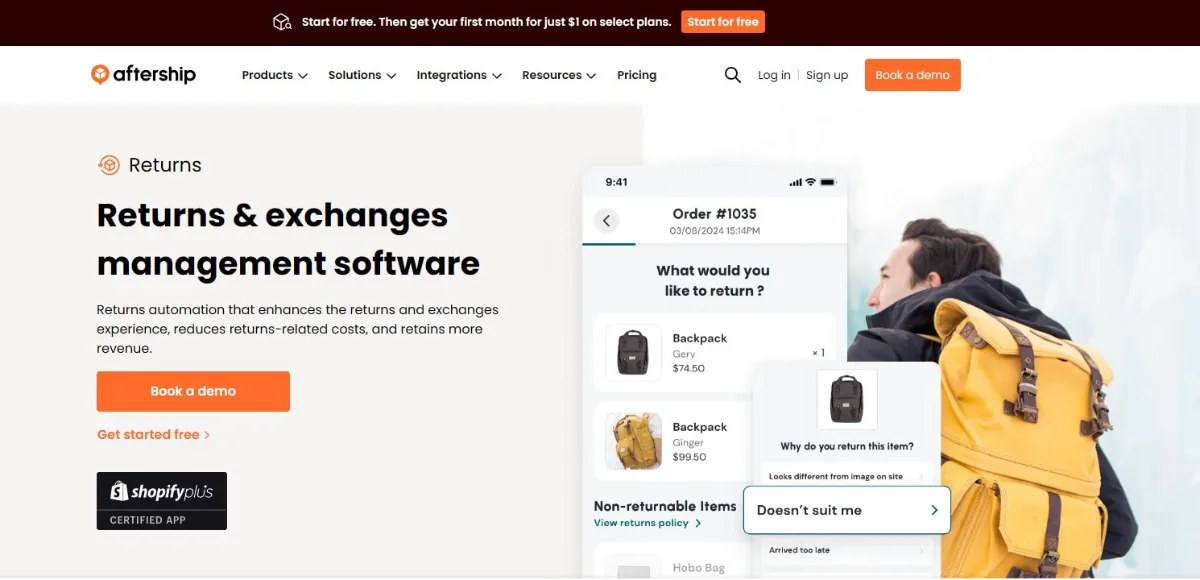
AfterShip Returns Center is a popular ecommerce returns platform that offers a huge network of drop-off locations worldwide and complete reverse logistics management.
It also supports automated return policies with conditional rules, and that’s pretty useful if you deal with different types of products (or complicated return scenarios).
Carriers: 62
Key Features:
- Global Drop-Off Network: Allow your customers to return items offline through an extensive drop-off network (300,000+) worldwide, including Happy Returns locations in the US.
- Automated Return Policy Rules: Set up conditional resolutions and stackable routing rules so you can create different policies for various product types and apply them automatically.
- Multi-Carrier Label Generation: Automatically generate return labels (and in the same dashboard) with over 62 integrated carriers.
Pros
- Connects with Shopify and other leading ecommerce platforms
- Provides a complete returns management dashboard
- Mobile app available for iOS and Android
Cons
- Limited carrier connections based on your plan (Essential only gets one carrier, Pro has 3, and Premium gets 5)
- You have to pay more for priority customer support
Best for: Small to medium-sized businesses and growing brands that manage 20 to 1000+ returns per month and use ecommerce platforms other than Shopify.
Integrates with: 70+ apps and integrations, including Shopify, Salesforce, Magento, BigCommerce, Klaviyo, Gorgias, Attentive, and Yotpo.
Pricing: AfterShip’s usage-based pricing starts at $11/month for 20 returns per month. It also offers a free plan for up to 3 returns monthly and a 7-day free trial for paid plans.
#5 Return Prime: Return → Revenue
Up Next: Return Prime. Like most Happy Returns alternatives on our list, it’s a Shopify app that helps you keep more sales when customers want to return items. It provides tools to show product recommendations, offer store credits, and automate exchanges.
Carriers: 11
Key Features:
- Wonder Revenue Booster: Show customers relevant product recommendations during their return journey to encourage additional purchases
- Wonder Smart Exchanges: Automate the exchange process with algorithms that suggest similar or upgraded products.
- Wonder Bot Automations: Create specific workflows that handle product returns, exchanges, and refunds using rules you set up.
Pros
- Affordable return platform
- Ideal for cross-border returns and exchanges
- Really useful if your goal is to make more sales while managing returns
Cons
- Limited user seat
- Free plan is limited to five returns/month
Best for: Shopify merchants (especially growing D2C brands) that manage 60 to 450 returns a month.
Integrates with: 100+ apps, including Shopify, Klaviyo, Zapier, and Yotpo.
Pricing: Return Prime is a quota-based app with a free plan available. Paid plans start at $19.99/month for 60 returns. You can try them for free for 15 days.
#6 Yanet: Returns and Exchanges
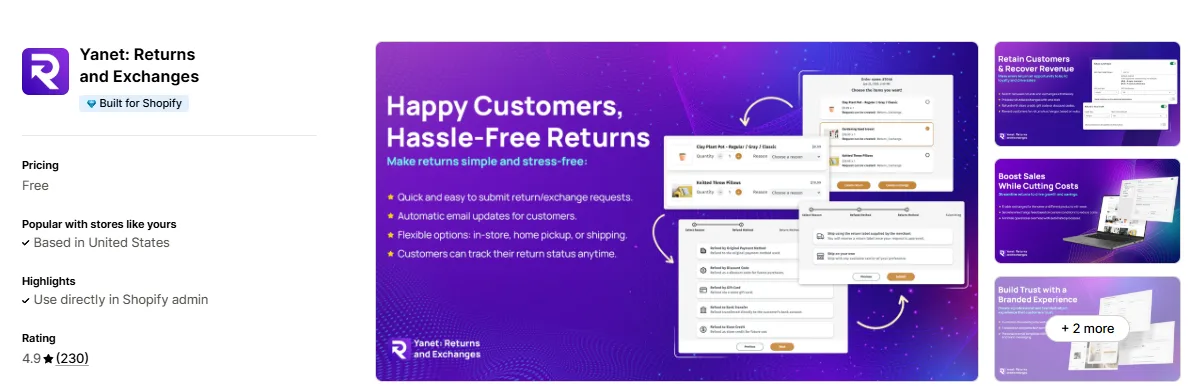
Yanet is one of the free alternatives for Happy Returns. With it, you can create different return rules for various products, offer customers a branded portal to submit requests, and send updates with automated notifications.
Carriers: Not mentioned
Key Features:
- Customizable Return Portal: Give customers a branded portal where they can submit return requests and monitor their status in real-time.
- Flexible Return Policies: You can easily create return rules and add time limits, conditions, and approval processes.
- Multi-Language Support: Expand internationally and serve customers in other countries with support for 15 languages, including English, Spanish, German, Italian, and Chinese.
Pros
- It’s great for new and small ecommerce businesses
- You can use it for free
- It’s easy to set up and still offers some customization
Cons
- Only works for Shopify stores
- Limited app integrations compared to other platforms
Best for: Small businesses and budget-conscious Shopify merchants who only need basic return management solutions.
Integrates with: Shopify, EasyPost, and Shippo
Pricing: Yanet is a free-to-install Shopify app. It doesn’t offer any paid plans.
#7 ReturnGo Returns
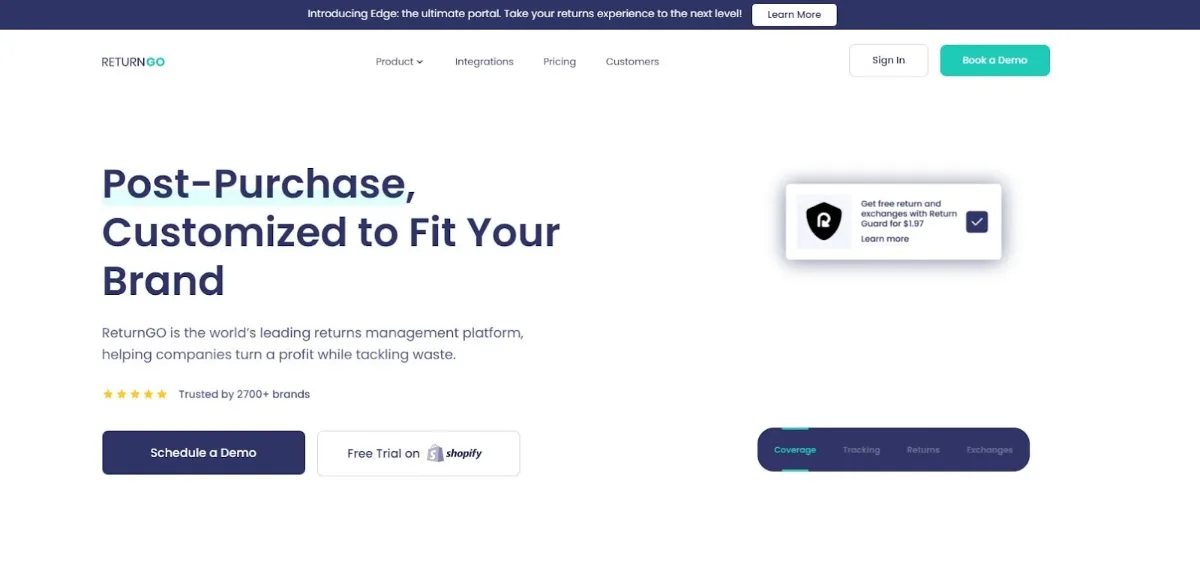
ReturnGO is a return management alternative that provides more advanced ways to handle returns (way beyond the usual exchange and store credit). It provides you with a strategic advantage by offering more flexibility. Plus, they create a better customer experience since people get options that actually work for their situation.
Carriers: 50+
Key Features:
- Advanced Return Flexibility: Offer your customers refreshing options, such as “keep the item,” “donate the item,” or “ship it back later,” as part of your return policies.
- Custom Policy Builder: Provide distinct return rules based on product categories, customer history, purchase amounts, or specific promotions (i.e., “Buy X Get Y” bundles).
- Return Analytics and Insights: Track return patterns, reasons, and trends to understand why customers return specific products.
Pros
- Flexible return policies with unlimited customization options
- Free Return Guard coverage option for customers at checkout
Cons
- The setup process can be complicated for new users
- Confusing pricing structure with different rates for Shopify and the website
- Limited to English language support
Best for: Mid-to-large Shopify stores that handle around 1,000-5,000 annual returns and want more return capabilities
Integrated with: Shopify, Magento, Gorgias, Klaviyo, Yotpo, and ShipBob
Pricing: ReturnGO’s usage-based plans start at $23/month for Shopify stores (20 returns included) but $147/month for other platforms. All plans include a 14-day free trial.
#8 Narvar Shield
Narvar Shield (or Narvar Returns and Exchanges) is an enterprise-level returns management platform that uses AI technology to identify and protect your revenue from fake return schemes.
Carriers: 1000+
Key Features:
- IRIS™ AI Fraud Detection: Uses artificial intelligence to monitor suspicious return behaviors and alert you of fraudulent returns that can hurt your business.
- Revenue Protection Tools: Automatically offer customers exchanges or store credits through personalized suggestions and incentives.
- Optimized Reverse Logistics: Helps you cut down shipment costs by routing returned items through the cheapest shipping paths.
Pros
- Saves you money on shipping costs by finding the best routes for the items
- 2-in-1 solution (fraud prevention and returns management)
- Offers more advanced technology to prevent fraud than other competitors
Cons
- Complicated setup (you may need to ask for a developer’s help)
- Pricing plans aren’t available on the site
Best for: Large-scale retailers and enterprises with high return volumes and that can invest in premium solutions.
Integrated with: Shopify, BigCommerce, Salesforce, Klaviyo, Zendesk, and SAP systems
Pricing: Custom enterprise pricing only. It doesn’t offer any free trial or rates.
#9 parcelLab Return and Exchange

parcelLab Returns & Exchanges uses AI to provide your customers with personalized return options, guide them toward exchanges, and show you exactly why items are being returned in the first place.
Carriers: 550+
Key Features:
- Return Volume Forecasting: Helps you see when return spikes are coming so your team isn’t caught off guard after big sales or holidays.
- Flexible Return Methods: Let customers choose how they return items, from QR codes to drop-offs to doorstep pickup for high-value orders.
- AI-Powered Return Insights: Shows you which products get sent back the most and why. You can then use those actionable insights to fix issues early and build customer loyalty.
Pros
- Advanced return forecasting
- Allows you to integrate multiple carriers
- Multi-channel (WhatsApp, emails, and SMS) and real-time tracking updates
Cons
- It doesn’t provide public pricing
- It’s not easy to set up
- The returns feature is only available as part of the full post-purchase suite
Best for: Large enterprise retailers (with high volume of returns) that need comprehensive analytics and forecasting capabilities.
Integrated with: Shopify (tracking only), Salesforce, Magento, Zendesk, various warehouse management systems
Pricing: parcelLab has custom enterprise pricing that starts around €2,400/month (according to Capterra). No free trial or free plan available.
#10 ReturnLogic
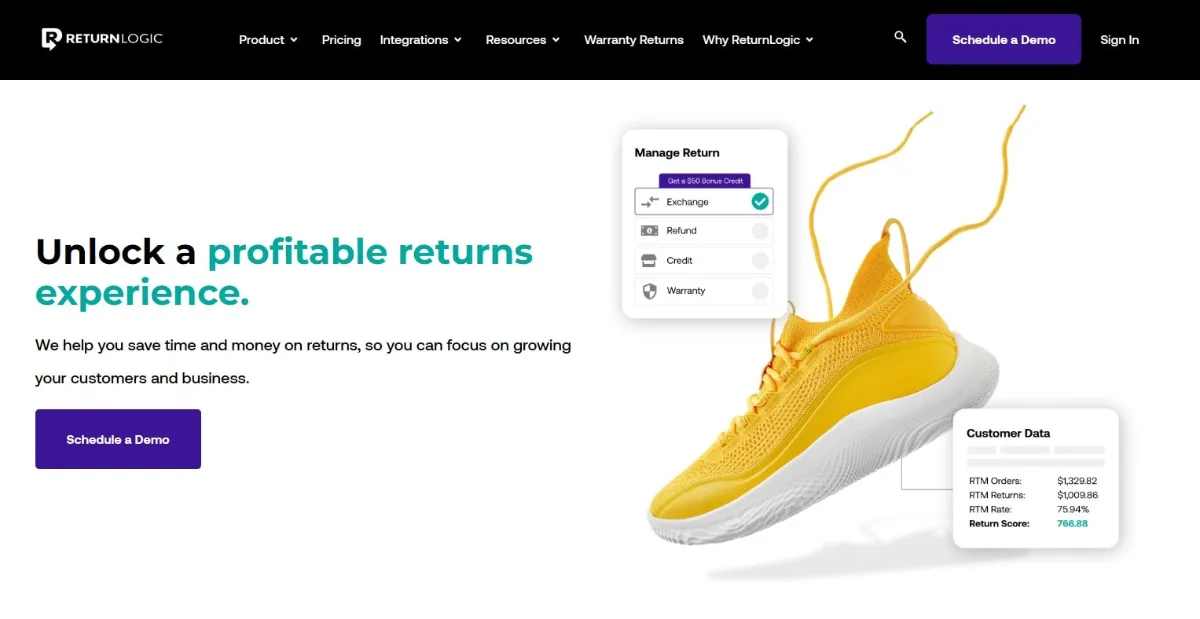
Let’s end our list with another strong alternative: ReturnLogic. It covers returns management across customer support, warehouse visibility, and analytics, enabling businesses to turn return operations into revenue opportunities.
Carriers: No direct carrier integration (only connects with 3PL and shipping platforms)
Key Features:
- ReturnGuard Protection: Let your customers add return protection at checkout, and it allows you to generate revenue while also covering return shipping costs.
- Automated Holiday & Shipping Policies: Create seasonal return rules and connect with tools like Shippo or EasyPost to cut down manual tasks during peak periods.
- Warranty Returns Management: Handle warranty claims in the same system as your regular returns management (no more extra hassle).
Pros
- Dedicated customer success manager for onboarding and support
- Flexible pricing with both usage-based and subscription options available
Cons
- The subscription plan is quite expensive
- Doesn’t offer much app integration
Best for: High-growth retail brands and mid-sized businesses looking to turn returns into revenue opportunities while reducing operational costs.
Integrated with: Shopify, BigCommerce, 3PLs, Shippo, EasyPost, and major shipping carriers
Pricing: ReturnLogic offers both usage-based ($0.25-$3.90 per return) and subscription-based ($299/month) plans. But it doesn’t have a free trial.
Tips for Choosing the Right Happy Returns Alternatives
Now that you know all the Happy Returns alternatives, it’s time to choose one to use. When doing that, we suggest focusing less on who has the longest list of features and more on what actually fits your business.
For example:
- If you’re running a small store, look for something quick to set up and light on cost. A simple self-service portal will also save you from extra support work.
- If you’re handling a few hundred returns each month, flexible policy rules and broad carrier coverage matter more.
- If you’re at the enterprise level, focus on advanced features. Fraud detection, return forecasting, and deeper exchange workflows can help you protect revenue and keep operations steady.
To help you better, we created this “summary table” that maps the top alternatives to different business types:
| Business Type | Recommended Solutions | Why It’s a Good Fit | Pricing Model |
| Small businesses/ Startups | CWILL Post-Purchase, Return Prime, Yanet | Easy setup, low cost, branded self-service portal, basic automation | Free plan or low-cost monthly. Trials available where noted |
| Mid-sized ecommerce stores | CWILL Post-Purchase, ClickPost, AfterShip | Flexible policy rules, strong carrier coverage, basic to advanced reporting | Tiered monthly or usage-based. Free plans and trials available |
| Large enterprises | Loop Returns, parcelLab, Narvar Shield | Exchange focused revenue retention, forecasting, and analytics, fraud detection | Subscription or custom enterprise pricing. No free trial for some tools |
| High return rate businesses | CWILL Post-Purchase, Loop Returns, ReturnGO, ReturnLogic | Exchange incentives, flexible return options, fraud and policy controls, and actionable analytics | Subscription or usage-based. Custom quotes for some vendors |
| DTC brands | CWILL Post-Purchase, Return Prime, Loop Returns | Branded return experience, exchange incentives, and tools that keep revenue in your store | Monthly subscription. Free plan or trial available for some tools |
| Cross-border ecommerce | CWILL Post-Purchase, AfterShip, Return Prime | Multi-language support, global carrier and drop off options, cross-border friendly policies | Usage-based or tiered monthly. Free plans and trials available |
Final Words
That’s the ten great alternatives for Happy Returns! Now, it’s time for you to pick one that’s ideal for your business size, return volume, and budget. But we suggest you get started with CWILL Returns and Exchanges for free.
Happy Returns Alternatives FAQs
Yes, because Happy Returns is now part of UPS. Most people in the U.S. live within 10 miles of a UPS Store, so you’ll likely find a nearby spot to drop off your items.
Which retailers use Happy Returns?
Some known retailers that use Happy Returns are Gymshark, Allbirds, and Revolve. Other brands like Everlane, Lands’ End, and Fabletics also rely on the service to make box-free, label-free returns easier for their customers.
No. Happy Returns is its own service, but it was acquired by UPS in 2023. UPS provides the network, and Happy Returns is a platform for managing returns.
Happy Returns allows you to drop off items in person without needing a box or label, whereas standard returns typically require you to package and mail items yourself. Retailers save money because returns are collected together and sent back in bulk, rather than one package at a time.

Content Specialist
I’m passionate about creating SEO-friendly content that also resonates with readers. I take data and insights and turn them into actionable, practical ideas. My mission? Helping websites drive organic traffic and grow sustainably.