Acquiring new customers is getting harder (and more expensive) than ever. And while bringing new buyers is important, you can only grow sustainably by taking care of your existing customers. Klaviyo flows has the power to help you with that. If you can set the email and SMS automation, you can use customer data to increase repeat purchases, build loyalty, and increase lifetime value. In this article, we’ll show you 16 of the best Klaviyo flows for customer retention. We’ll also explain how each one works and share tips to help you get better results.
What Makes a Klaviyo Flow Useful for Customer Retention
Klaviyo flows allow you to create automated emails or SMS messages that trigger based on real customer behavior. It can be purchase history, browsing activity, or a change in loyalty status.
Unlike a one-time (or one-off) campaign that ends after a set period, a flow stays active and works the moment a customer takes a specific action.
Because of its time-based triggers, flows are effective for customer retention. If a customer left items in their cart, they get a reminder before the interest fades. Or when a loyal buyer places their fifth order (which is a big deal for most brands), they can automatically receive a reward for reaching this milestone.
What’s even better about Klaviyo flows is that you can set them to cover all stages of the customer journey: before the first purchase, during checkout, and long after the order ships.
Best Klaviyo Flows for Ecommerce Customer Retention
If you want to create a more solid customer retention strategy, check out these 16 Klaviyo flows. We’ve included flows for new subscribers, active buyers, loyal customers, and inactive ones.
1. Welcome Series Flow
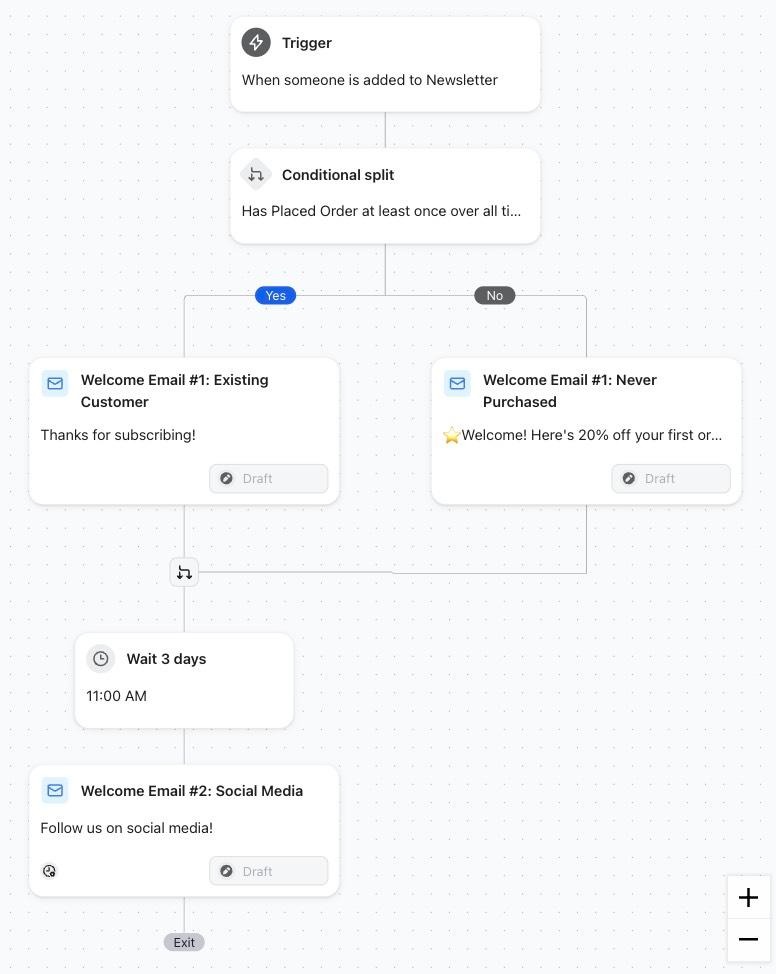
A welcome series flow engages your new subscribers right off the bat. Klaviyo’s built-in templates let you create a sequence of emails (or SMS) that activates once someone joins your list.
Each email in this flow can contain different content. You can share your brand story or talk about the founder’s mission. Other possible content is to introduce your best-selling products and pair them with a discount to push the first purchase.
Providing a link to your social media channel or your website is also a great way to build a connection outside of the inbox.
The welcome series flow is the best time to educate your prospects and set expectations. A new subscriber can better understand your brand’s value and products… before they even place their first order.
2. Browse Abandonment Flow
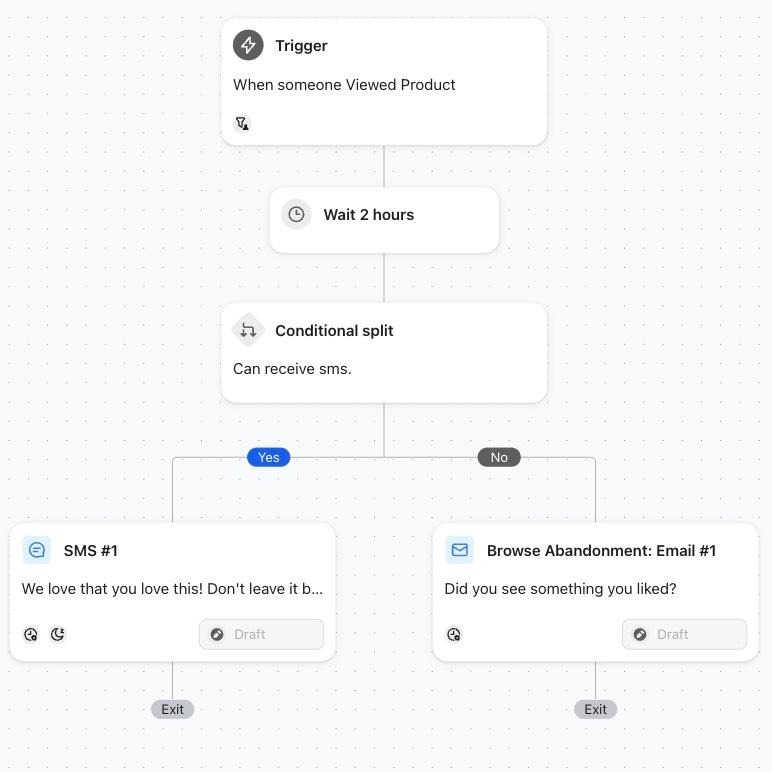
Some customers will check your products but won’t do anything and simply exit. Klaviyo’s browse abandonment flow is designed to bring back these shoppers before their interest fades.
This flow needs “Viewed Product” tracking to work and gets activated when someone browses a product page. Dynamic product details like images, product names, and prices allow you to make the message more personal.
You can also insert a time delay (maybe a few hours or a day) before sending the follow-up email or SMS to give a little “breathing room”.
Let’s say one shopper viewed a pair of running shoes from your store. Sending a reminder after three hours with the details and link of that exact product might be enough for them to complete the purchase.
3. Abandoned Checkout Reminder Flow
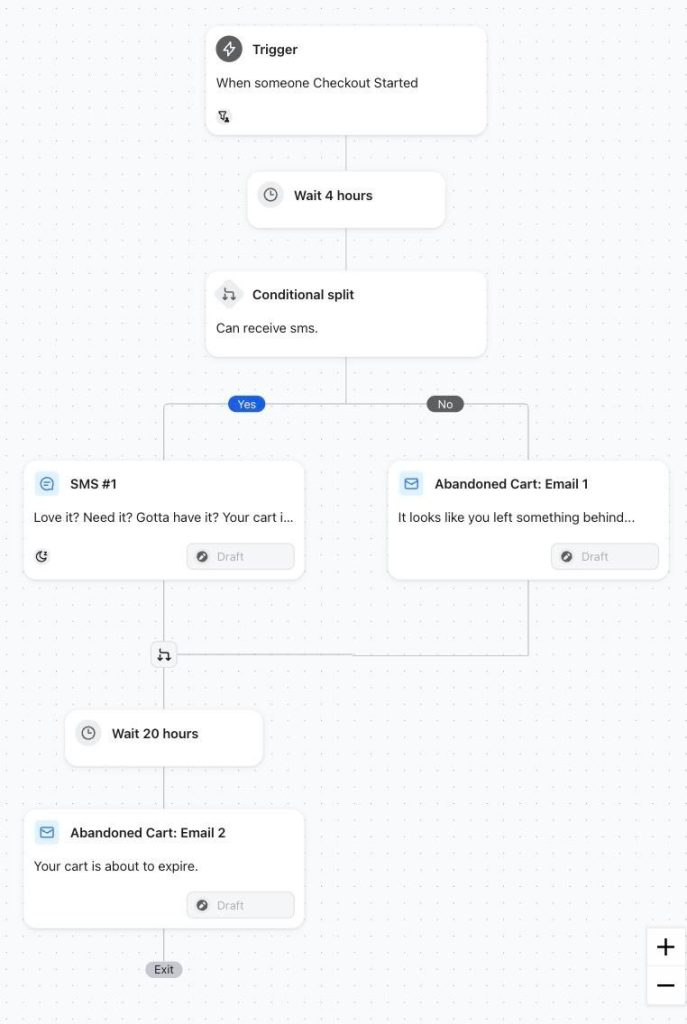
The abandoned checkout reminder flow is for shoppers who added items to their cart and started checkout, but never finished the purchase. It can be because they got distracted, didn’t have their card nearby, or just needed some more time.
We call the target buyers here “high-intent” because they already showed real buying interest. This flow is very important to help them move and act on that decision before the moment passes.
Your emails in this flow can include:
- A cart reminder showing exactly what they left behind
- Direct language like “your cart is about to expire.”
- Trust signals like reviews, return policies, or guarantees
- A discount (optional and should be one of the last emails in the sequence)
Among the Klaviyo flows we have here, abandoned checkout is one of the most effective for recovering lost revenue. And while there’s also no “exact” number of emails to be sent here, Klaviyo mentioned that 2-3 emails will be ideal.
4. Post-Purchase Follow-Up Flow
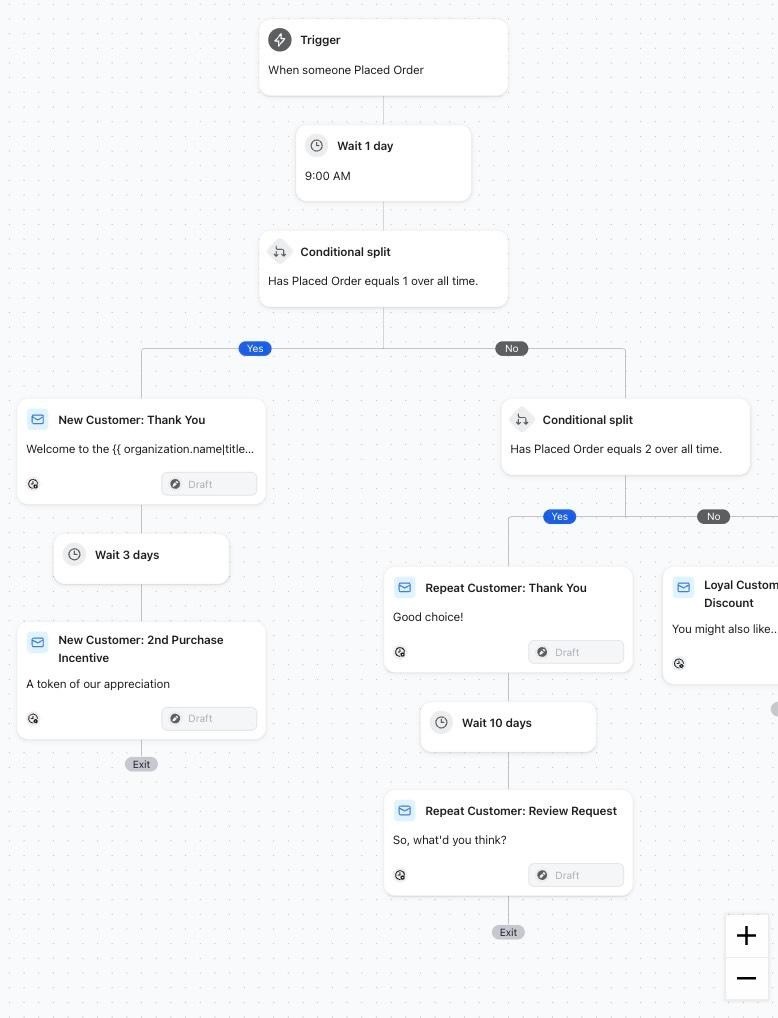
Next is the post-purchase follow-up flow: a series of emails that get sent after a customer places an order. This flow is powerful, as these emails are timed during the period when customers are the most attentive (as they have to check for delivery updates).
Klaviyo’s post-purchase follow-up flow covers thank-you emails (for new and existing customers), an incentive for a 2nd purchase, cross-selling for loyal members, and review requests for second-time buyers. It also places condition splits and time delays to make sure each customer gets the right message at the right stage of their order.
If you want to improve your customers’ after-sales experience, whether they are new, existing, or loyal customers, you should definitely set up this flow.
5. Cross-sell and Recommendation Flow
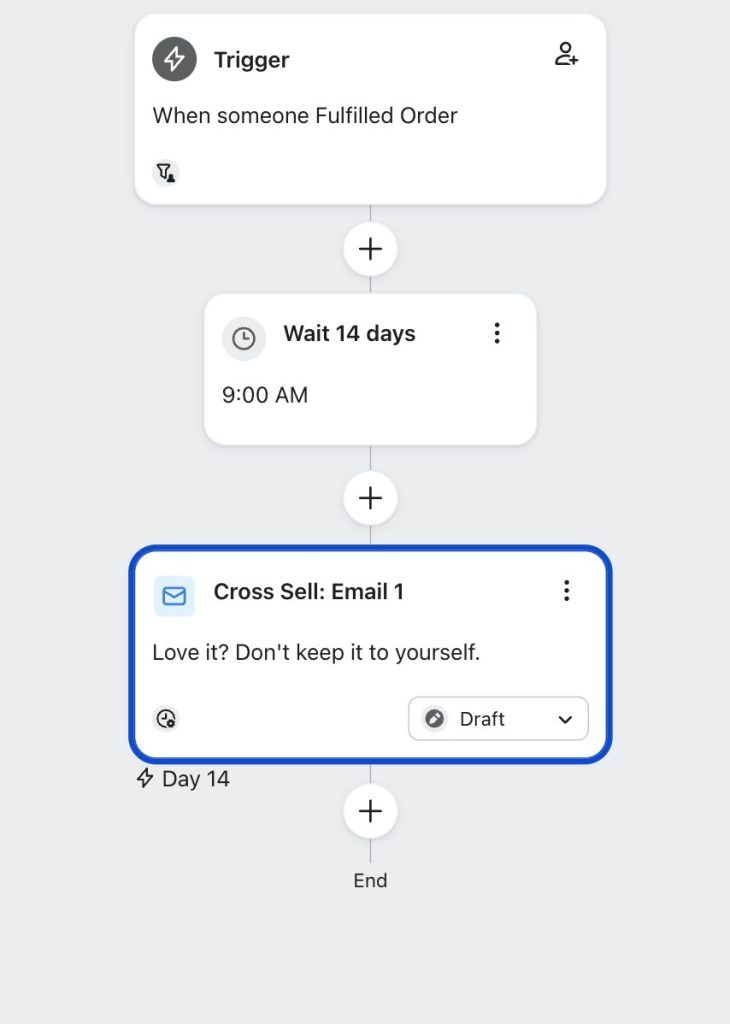
The cross-sell and recommendation flow allows you to send a product recommendation to your customer. But what makes it effective is that it provides suggestions relevant to your customer’s past purchase and browsing behavior. The chances of them actually clicking and buying go higher.
And since it also comes with a product review request, you get two things done in one email: collect feedback for social proof and promote relevant products.
In Klaviyo, this flow is triggered by “Fulfilled Order” or when an order is shipped and leaves the warehouse. The software sets a default 14-day delay (which you can adjust) to give customers enough time to receive and use their order first.
After that, Klaviyo sends an email with “complementary” product suggestions from dynamic product feeds (filtered by category or collection). So, you can suggest a phone case to someone who just bought a new gadget or a vitamin C serum to a customer who ordered collagen supplements.
6. Replenishment Reminder Flow
Works best for: existing customers
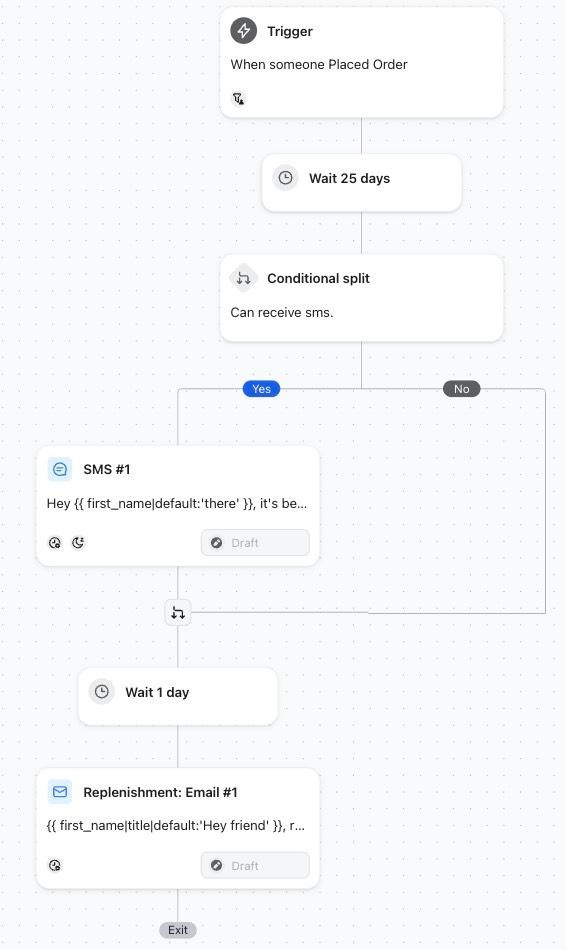
The replenishment reminder flow is a solid email marketing tool if you sell consumable or “repeat-use products”. We’re talking about makeup, cleaning supplies, pet food, or skincare items that customers run out of (eventually) and need to reorder.
Before you create this flow, you need to get the following data:
- Purchase frequency: how often a customer reorders the product
- Reorder window: the estimated time before they run out
- Product lifecycle: how long the product lasts based on average use
This allows you to time your messages better (as you based it on your product longevity). And send it just in time for restocking.
7. Review Request Flow
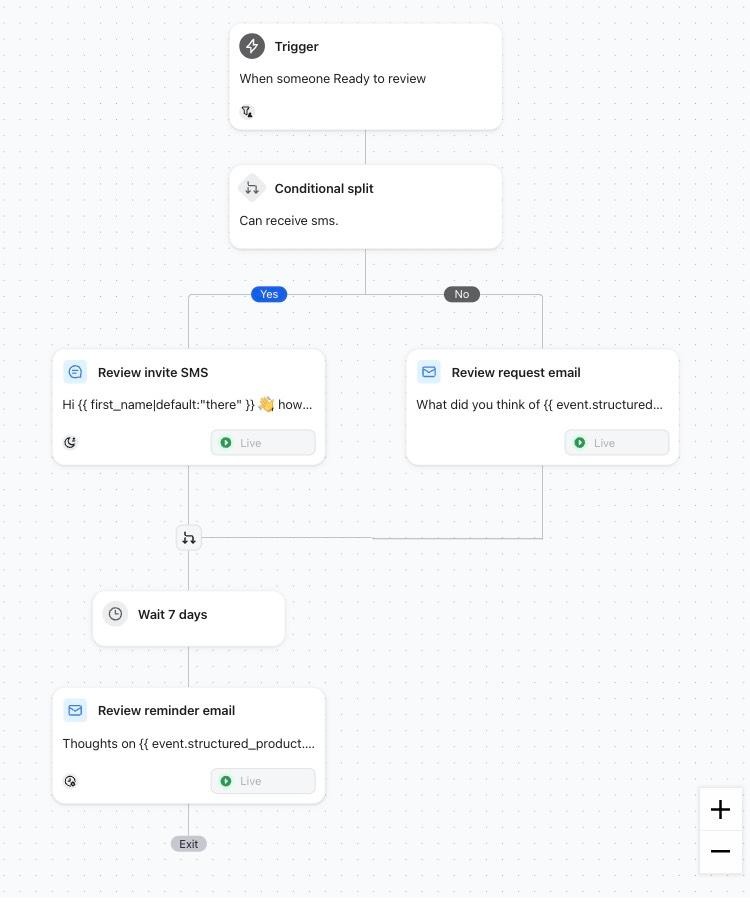
The review request flow collects customer feedback a few days after the order is delivered, so they have time to use and experience it first.
With Klaviyo’s built-in flow, you get to send a personalized message (via SMS or email) referencing the product your customer bought. And then, if you don’t receive any response, the software will send another message after seven days.
In flows like this, you can use simple CTAs like “Leave a review” or “Share your thoughts.” It makes it easier for customers to take the next action. And the reviews you’ll get here will allow you to build trust with future shoppers.
8. Loyalty Member Welcome Flow
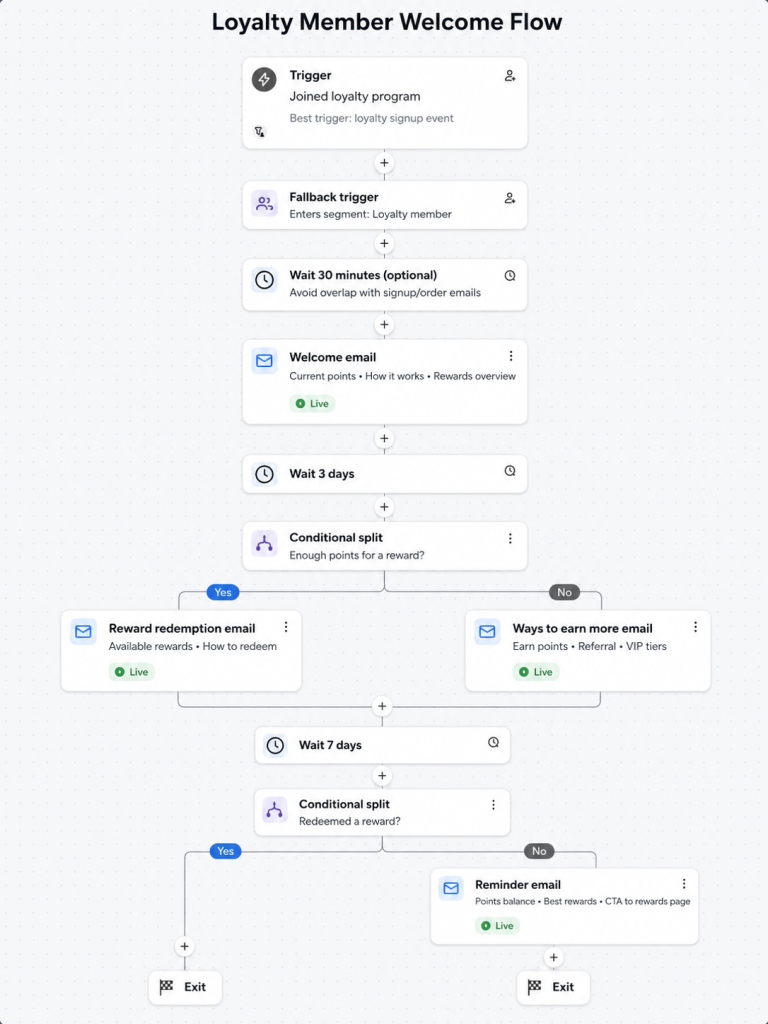
The next few flows are all about loyalty, and the first one is the loyalty member welcome flow. It gets activated when a customer joins your loyalty program.
This flow introduces new members to everything about the program, like:
- Current points
- How to earn more
- How to redeem points
- What rewards are available
It’s very important to set up this flow, as it’ll reduce the confusion and hesitation from your loyal members. They’ll be more motivated to take action (buy more, post on social media, refer your businesses, etc.) so they can redeem their rewards… and that will bring you more sales.
Learn how to build a better loyalty experience with Klaviyo loyalty programs.
9. Points Earned Flow
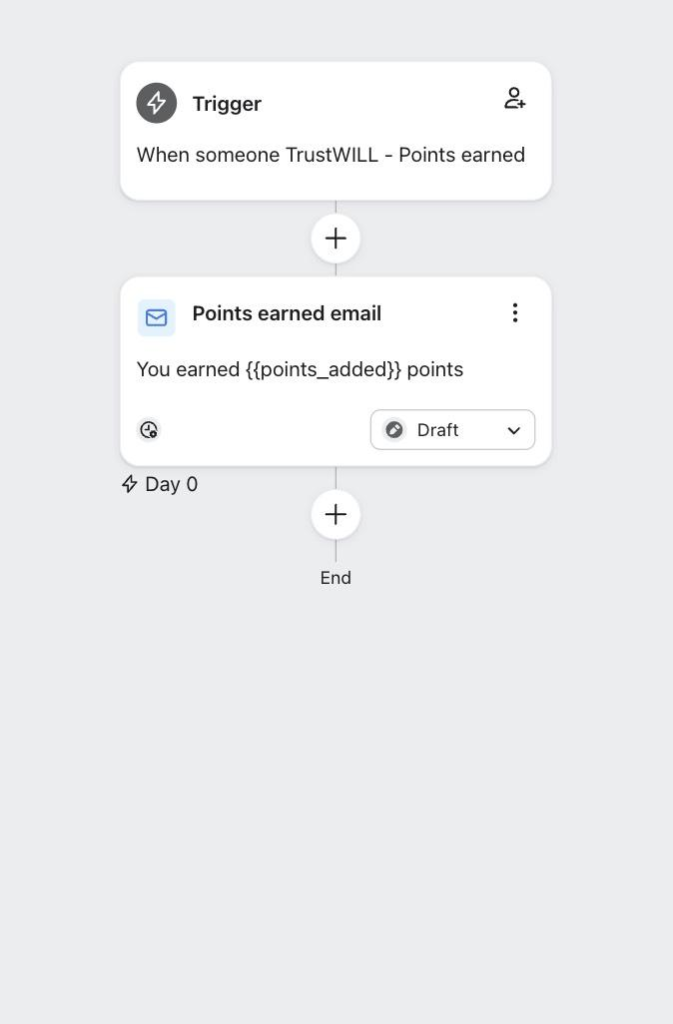
The points-earned flow allows you to show your loyal customers their rewards progress. After welcoming them to your program, it’s important to keep them aware of their points (to motivate them to spend more).
Imagine that your customer is already at the 1,250-point mark. Then, they ordered three new items that earned them 250 points. This email marketing automation will show them their new balance for every valid purchase they make. Plus, you can also show what reward is waiting for them at their next milestone.
This retention flow allows points to be more visible. Of course, not everyone has the time to check their account every time they make a purchase. Getting proactive updates like this lowers the chances of expired (or unused) points.
10. Points Expiry Reminder Flow
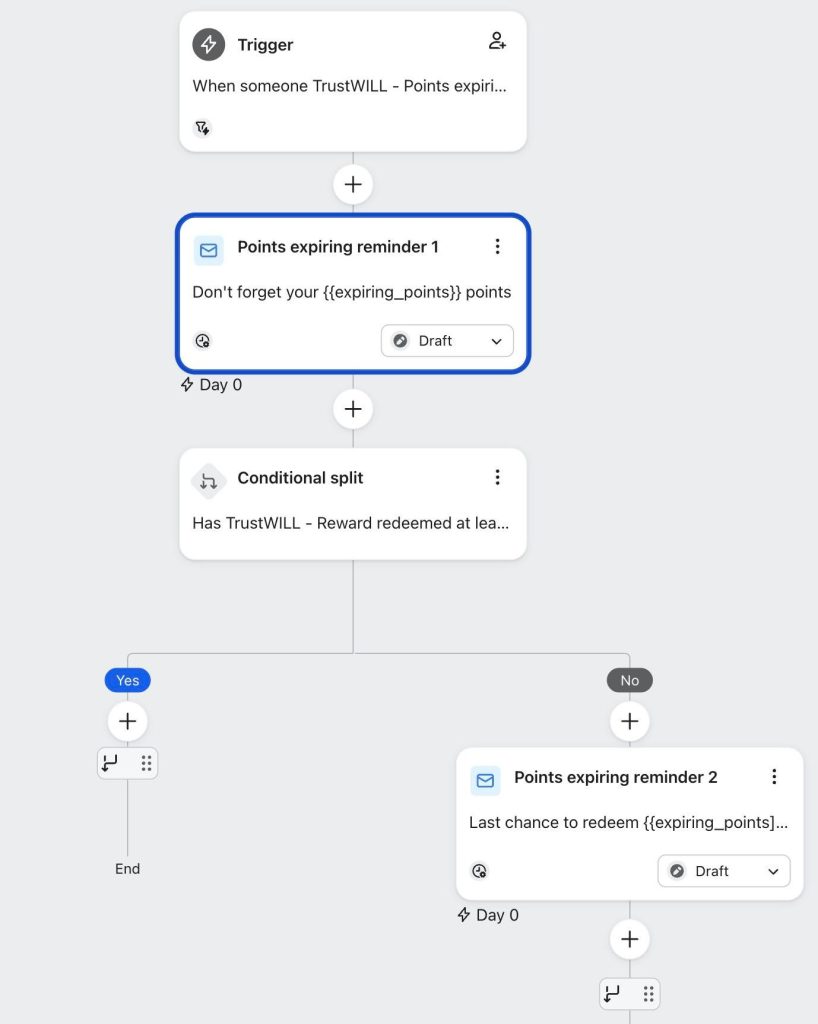
It’s not enough to remind customers about the points they’ve earned; you also have to let them know when those points are about to expire. The points expiry reminder flow is simple, but it can actually re-engage inactive subscribers who haven’t visited your store in a while.
You can make this email more effective by including the exact number of points expiring and the deadline. Then, follow it with a direct redemption CTA (such as “Claim your reward” or “Use your points now”) that takes them to your rewards page.
One thing we suggest here is to use a warm tone. Points expiring can feel like a warning to your customers, but you can make it sound like “a gentle reminder” to make them feel that you care about their satisfaction.
11. Unused Reward Reminder Flow
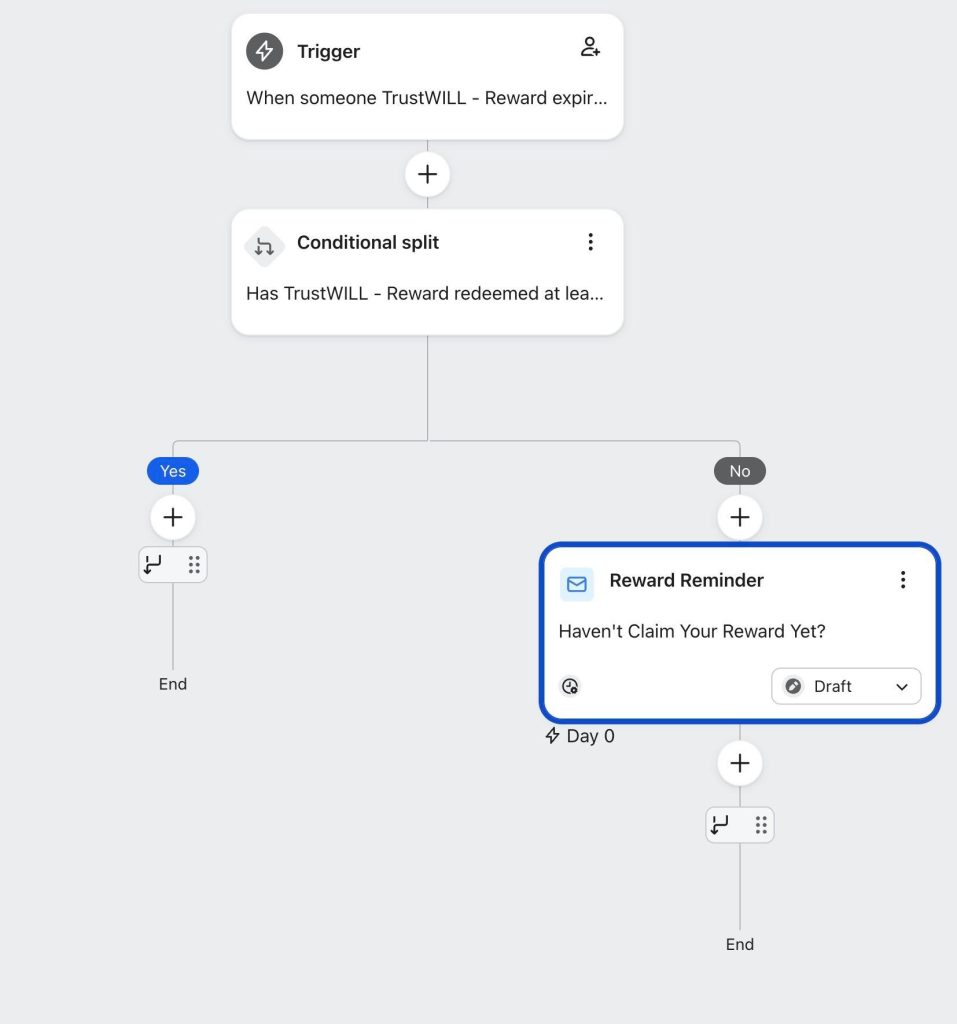
What if your customers still don’t use their rewards even after receiving them? Some customers claim a reward code but forget about it. There can be many reasons, like a busy schedule, second thoughts, or simply not knowing the redemption terms.
The unused reward reminder flow allows you to send a follow-up email with their reward code, the expiry date, any conditions they need to know before redeeming, and a direct CTA like “Use your reward now” that takes them straight to your store.
Let’s say a customer earned a free shipping reward after reaching 500 points, but never checked out. Three days before it expires, a short reminder email with their code and expiry date is often all it takes to turn that claimed reward into a completed order.
12. VIP Tier Upgrade Flow
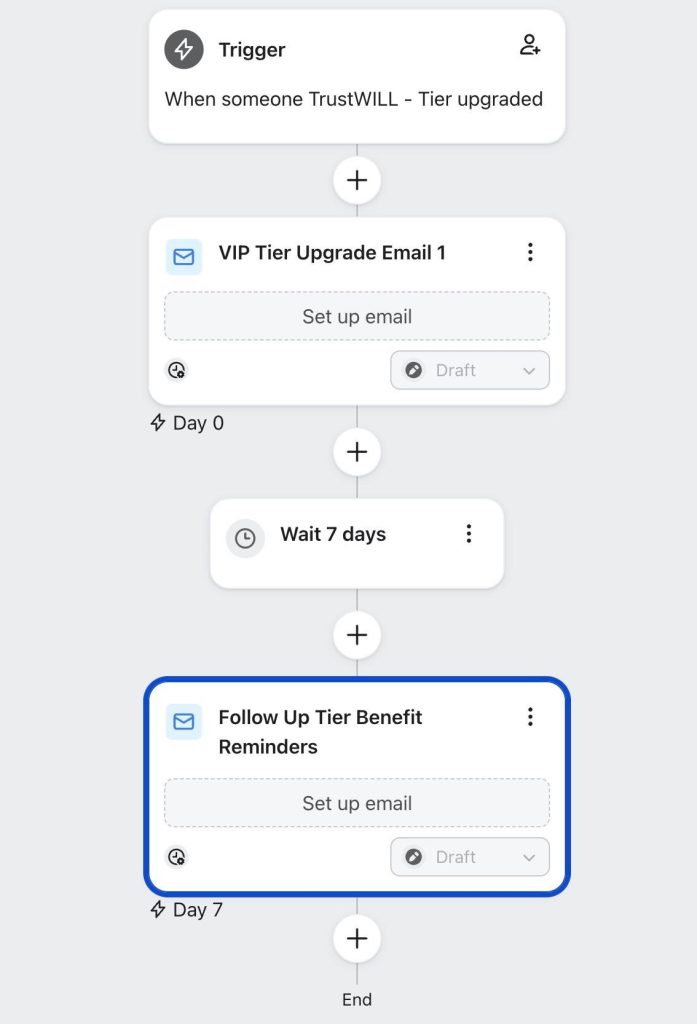
The VIP tier upgrade flow gets triggered when a customer reaches a new tier in your loyalty program. It’s one of the more effective ways to recognize your high-value customers, specifically the ones who keep coming back and spending more.
This email can include their new tier status and a breakdown of what comes with it. That can be early access to new collections, exclusive discounts, or higher points multipliers.
VIP tier upgrade flow works because customers who feel recognized tend to stay loyal. A buyer who just hit your top tier and gets a personalized upgrade email knows your brand sees their effort. And that feeling (more than any discount) is what keeps high-value customers close to your brand.
13. Birthday Reward Flow
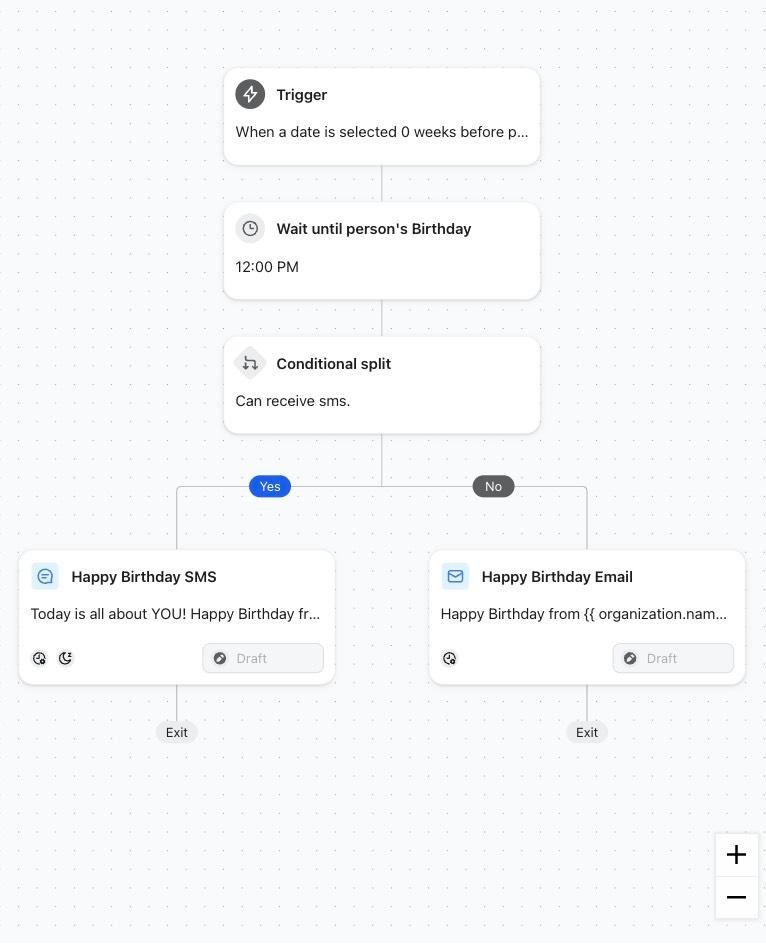
Among this list, the birthday reward flow is one of the most “personal” touches you can use for retention. But remember that this can only work if you collect birthday data as a custom profile.
The time delay feature can help you send the message exactly on your customer’s birthday. Then, besides a short message, you can include a digital “gift” in the form of a discount, free shipping, or bonus points. If you want to level it up (and if it’s possible), you can even provide early access to a new collection.
Remember that this email will be sent on your customer’s special day. So, better keep it warm and simple (and avoid aggressive selling).
14. Referral Invite Flow
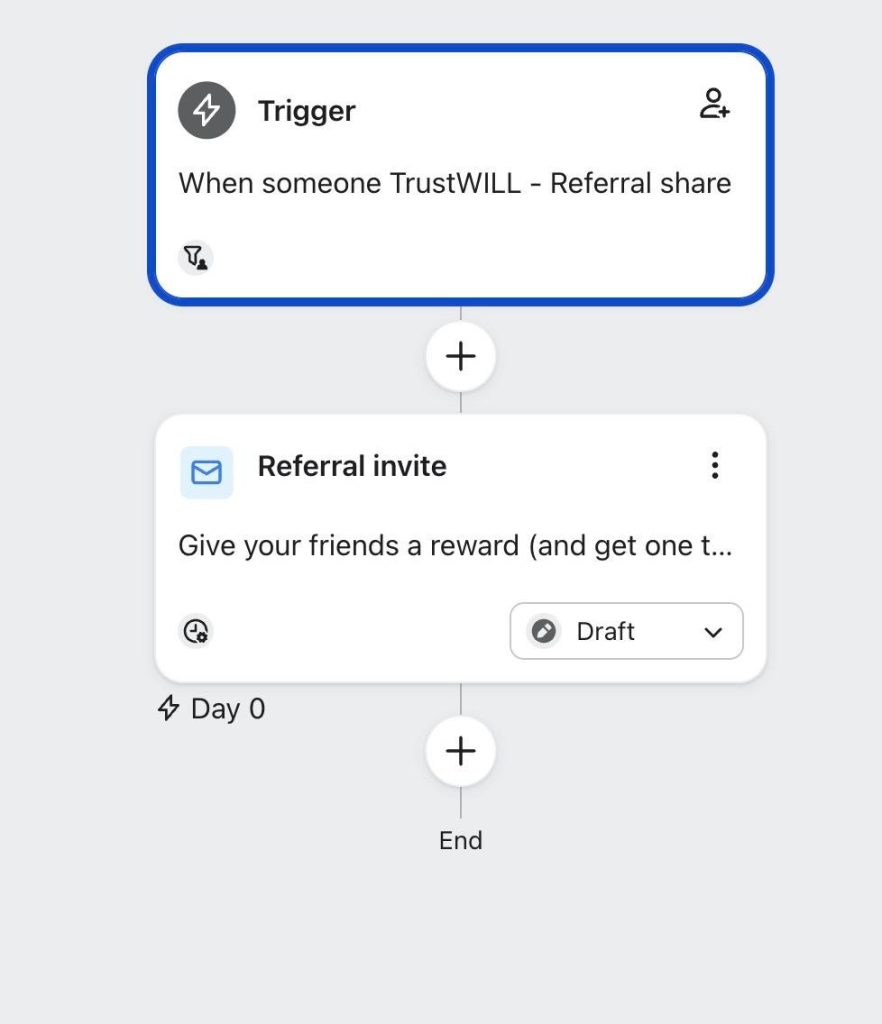
The referral invite flow sends loyal customers a personal invite to share your brand with their friends and family. It’s one of the few retention flows that also brings in new customers at the same time.
The email typically includes:
- Their unique referral link to share
- A short prompt explaining how the referral works (so there’s no confusion)
- Rewards for the friend who uses it, like a first-purchase discount
You also have to keep the process simple here to avoid any friction. Because, let’s be honest, most customers won’t bother referring a friend if it takes too many steps or feels complicated.
15. Referral Reward Flow
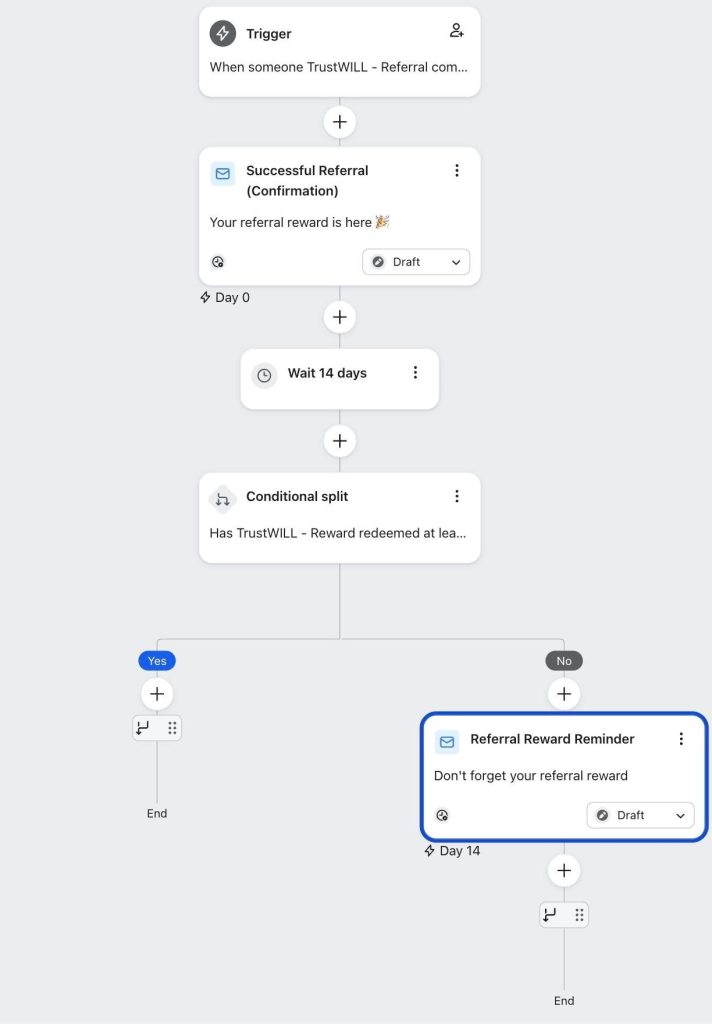
So, if you have the referral invite flow, you also have to set up the referral reward flow to close the loop. This gets activated when a customer’s referral is successful, and their friend completes a purchase.
Since this email confirms something positive, you can include their earned reward here. Quick updates about their referral status and a coupon code, bonus points, or store credit also go well in this message.
What’s great about this flow is that it gives customers a concrete reason to share again. They already know the process works, and they got rewarded for it. All they need to do is share their referral (which is also super accessible to them).
For more inspiration on building effective referral programs, take a look at our guide on Customer Referral Programs.
16. Customer Win-Back Flow
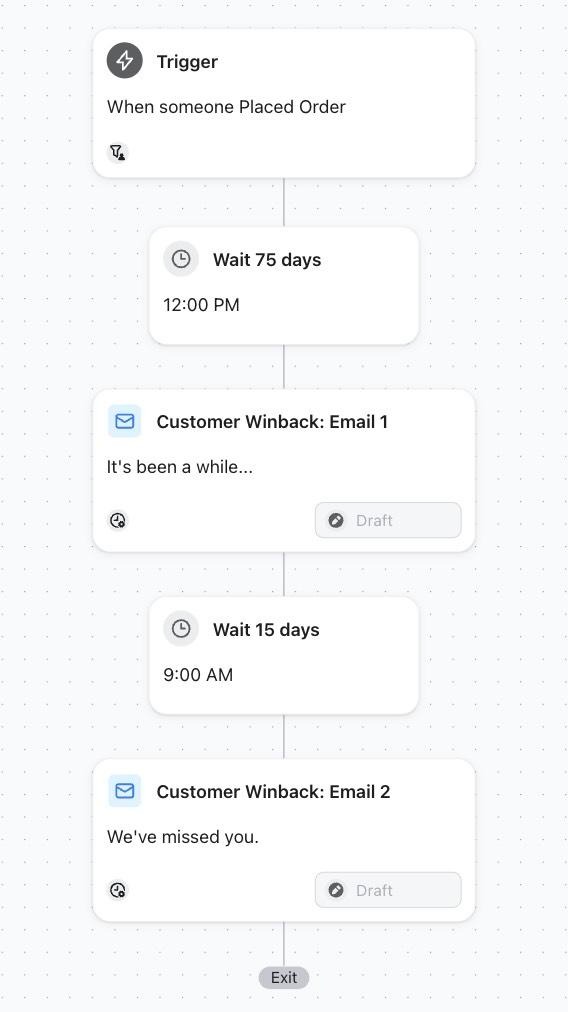
Of course, retention doesn’t only apply to active customers. You also have to make sure that it reaches the lapsed ones. A win-back flow is made exactly for that “revival” mission.
Win-back can only work if you wait long enough to confirm that a customer has actually gone inactive. Klaviyo’s common win-back setup often starts with a 75-day delay after the last purchase, followed by another email about 15 days later if the customer still hasn’t purchased.
That means the second touchpoint lands around 90 days after the last order. Treat these numbers as a starting point, then adjust them based on your average time between orders or product replenishment cycle.
How to Prioritize Klaviyo Flows for Your Shopify Store
We shared 16 Klaviyo flows, but that doesn’t mean that you have to set up everything at once. You can assess which ones you’ll need based on your current status, order volume, and how much of your retention strategy is already automated.
1. Essential Flows for New Shopify Stores
If your store is still new, we suggest you focus on the “early stage” flows. What are those? They are the welcome flow, browse abandonment flow, abandoned checkout flow, and post-purchase flow.
These flows handle the most common situations a new store faces. You can use them to encourage customers’ first purchase, communicate with your buyers after checkout, and even recover sales from almost-buyers.
If you’re successful with this, you’ll receive more revenue and build better customer relationships (from day one).
2. Retention Flows for Growing Ecommerce Brands
The next batch of flows is useful for customer retention. We all know how much more sales they can bring compared to new ones, so medium to large ecommerce brands need to keep them in check.
During this stage, these flows become more relevant: replenishment reminders, cross-sell recommendations, review requests, and win-back flows. Each one has a role in your retention strategy and works for different types of customers (especially for existing and inactive buyers).
If you’re not sure which flow you should focus on first, use this guide:
| Flow | Retention Goal |
| Replenishment Reminder | Repeat purchase |
| Product Review Request | Trust and social proof |
| Cross-Sell Flow | Increase order value |
| Win-Back Flow | Re-engage inactive customers |
3. Advanced Flows for Loyalty and Referral Programs
Your efforts shouldn’t end with your customers ordering twice or thrice. The goal is to make it recurring, and advanced flows like loyalty (rewards, VIP flow, etc) and referral automation can help you get there.
For example, a VIP tier upgrade email makes a customer feel like their spending is being noticed (so they spend more). Then a points expiry reminder gives them something concrete to act on and place their next order sooner.
Besides that, flows like referral invites do double duty. They keep your existing customers engaged while also bringing in new ones through people they already trust.
How to Use Customer Data in Klaviyo Retention Flows
Customer data like purchase behavior, engagement history, lifecycle stage, and loyalty data can make your Klaviyo flows more targeted and relevant to each of your customers. Here’s how you can use each one.
1. Segment Customers by Purchase Behavior
Your customer’s purchase history tells you a lot about what kind of email they should receive next. And in Klaviyo, you can use that data to group customers into segments and send more relevant messages to each one.
Segmentations allow you to limit “one-size-fits-all” types of emails that can weaken your marketing strategy. You get to create more effective email flows as you target the ideal customer based on their behavior.
If you need help with basic segment ideas, we suggest starting with first-time buyers, repeat buyers, inactive customers, and VIPs.
2. Personalize Emails by Lifecycle Stage
After segmenting your customers, you have to “map” your messages to each stage of the customer lifecycle. Here’s what you can follow:
- Awareness: Often, new visitors (or subscribers) are in this stage, and the welcome flow will be the best flow for them.
- Consideration: Some will become potential customers and start to browse your products. You can set up browse abandonment emails to keep their interest.
- Purchase: Once you get them as new customers, post-purchase and thank-you flows can take over to continue communication after sales.
- Retention: Existing customers can become returning ones if you prepare flows like replenishment reminders, cross-sell suggestions, and loyalty updates.
- Advocacy: To make repeat buyers loyal customers, you can keep them engaged with referral and VIP flows.
With clear communication (and purpose), you get to push your customers to the right track and guide them forward with your brand.
3. Add Loyalty Data for More Relevant Retention Flows
Besides the usual customer data we mentioned, loyalty data gives your Klaviyo flows more context about each customer that purchase history alone can’t provide.
Data points like a customer’s points balance, tier name, available rewards, upcoming birthday, and referral URL can be pulled from your loyalty platform and used to send more targeted emails. A customer who just hit your VIP tier needs a completely different email from someone who hasn’t redeemed their points in months.
If you want to sync and access this data to Klaviyo, you can use a loyalty app like CWILL Loyalty & Referral for that.
With this integration, you can trigger points earned, rewards, VIP upgrades, and referral flows automatically.
You also get access to over 11 live attributes, like points balance, tier status, and days since last redemption. So, your segments stay accurate and up to date.
On top of that, some of the flows we mentioned above are available with this integration. So, you get to enjoy pre-built flow templates (and smart data sending).
Tips to Improve Klaviyo Retention Flow Performance
Before we end this post, we want to share some tips to improve your retention flow performance over time.
Let’s start with A/B testing, as it’s the most effective way to monitor what works in your flows. You can test the following:
- Subject lines: “Your points are expiring” vs. “Don’t let your rewards go to waste.”
- Timing: sending a cart reminder after 1 hour vs. 4 hours
- CTAs: “Redeem your points” vs. “Claim your reward.”
- Offers: 10% off vs. free shipping
- Email content: a short text-based email vs. a visual product-focused one
One issue with multiple flows is that some of your customers or subscribers will be enrolled in more than one at the same time. Setting up suppression rules and exit conditions prevents them from receiving too many emails at once (which might make them unsubscribe).
And for our last tip: offers discounts in moderation. We know how attractive they might look, but some customers want to hear about your brand story, loyalty perks, or product education just as much as they want a deal.
Final Thoughts
That’s all for the best Klaviyo flows that you can use to build a stronger customer retention strategy for your Shopify store.
As you can see, each flow serves a specific purpose and works best when it’s backed by the right customer data.
And if you want your loyalty flows to work properly, investing in a solid loyalty app like CWILL Loyalty & Referrals will do wonders for your brand and customer retention.
FAQs About Best Klaviyo Flows for Customer Retention
What Klaviyo flows are most important for customer retention?
The most retention-focused flows are post-purchase, win-back, replenishment, review request, referral, and loyalty flows. They focus less on getting the first sale and more on keeping customers engaged, bringing them back, and rewarding them for staying.
How many Klaviyo flows should a Shopify store start with?
You can start with around 3-5 Klaviyo flows first, and they should cover the most important stages of the customer journey. For example, a welcome flow for new subscribers, a browse abandonment and abandoned checkout flow for potential buyers.
You can also add a post-purchase flow and a win-back flow to keep existing customers engaged and bring back the inactive ones.
Are abandoned cart flows considered retention flows?
Abandoned cart flows work as a purchase recovery tool first, but they can also support retention when set up with returning customers in mind. For example, a repeat buyer who abandons their cart can get a more personalized message (like a loyalty reward reminder) and not the usual “you left something behind.”
How can Shopify merchants use loyalty data in Klaviyo?
As a Shopify merchant, you can sync your loyalty data with Klaviyo to create more targeted email and SMS flows. That includes points balance, tier status, available rewards, and referral links. And these can all trigger automated (and more relevant) emails that actually match your customers.

Content Specialist
I’m passionate about creating SEO-friendly content that also resonates with readers. I take data and insights and turn them into actionable, practical ideas. My mission? Helping websites drive organic traffic and grow sustainably.