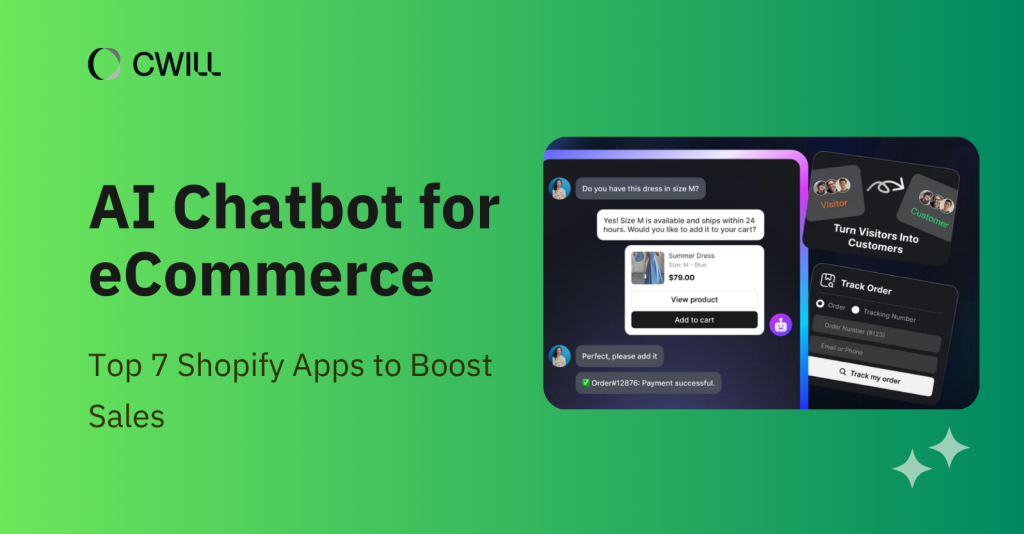
Choosing an AI chatbot for your ecommerce store is no longer just about answering FAQs. The right tool can help shoppers compare products, recover abandoned carts, check order status, and get support without waiting for a human agent.
But not every chatbot is built for the same use case. Some tools focus on Shopify support automation, while others are better for social messaging, enterprise helpdesk workflows, or AI sales assistance.
In this guide, we compare 7 of the best ecommerce chatbots in 2026, including their Shopify fit, AI capabilities, pricing, ratings, and best use cases. Use this guide to find the tool that matches your store size, customer channels, and support goals.
What is an Ecommerce AI Chatbot?
If you own an online store, you must know how crucial it is to have effective customer service. An eCommerce AI chatbot serves as a virtual assistant that engages customers in human-like conversations, powered by artificial intelligence. These chatbots are often embedded in a website or social media platforms and leverage natural language processing capabilities (NLP) to understand and respond to customer queries.
Nonetheless, this is not all. AI chatbots also guide users through the buying process, provide product recommendations, and offer support, all done seamlessly in real time.
Further, they can even assist with cart recovery, cross-selling and upselling, and managing returns and complaints. These features are precious for Shopify merchants who rely on fast transactions and real-time customer support to increase sales.
What is even more astonishing is that they learn from customer interactions to improve responses and predict future needs. This, in turn, leads to efficiency and makes the conversations personalized, thus promoting higher conversion rates and customer loyalty for your online stores.
Why Do You Need an AI Chatbot for Ecommerce? Transforming the Customer Journey
Having understood what ecommerce chatbots are, we will now discuss the several reasons you should incorporate them into your business.
24/7 Customer Service Available
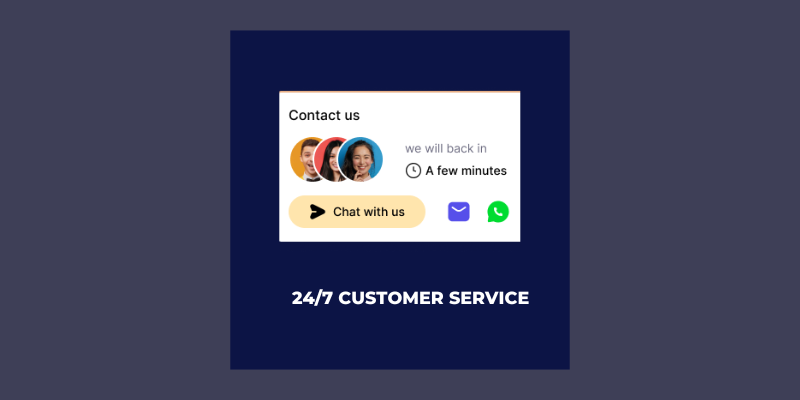
Customers may place orders at any time, and problems may arise at any time. The ecommerce chatbot lets your store respond online 24×7—late-night inquiries and weekend return requests are all handled automatically. Customers don’t have to wait and won’t be disappointed; you’ll see satisfaction improves, and naturally, there are more repeat customers.
Making Shopping a Personalized Experience
Every customer wants to be understood. When the products they see happen to match their preferences, purchasing decisions become faster and easier.
Ecommerce chatbots can help you achieve this: they automatically analyze each customer’s browsing and behavior data and recommend products they are truly interested in at the right time. And what happened? Higher conversion rates, fewer returns, and more satisfied customers. Customers feel you understand them, and you save time on manual sales.
Increase in Conversion Rates
The conversion rate determines how big the business can grow. Shopify merchants benefit significantly from ecommerce chatbots in this area. Chatbots reduce cart abandonment rates by supporting customers during checkout and recommending alternative products. If a customer is not sure about a product, the chatbot can offer an incentive like a discount, pushing them to convert.
Efficiency in Order Management
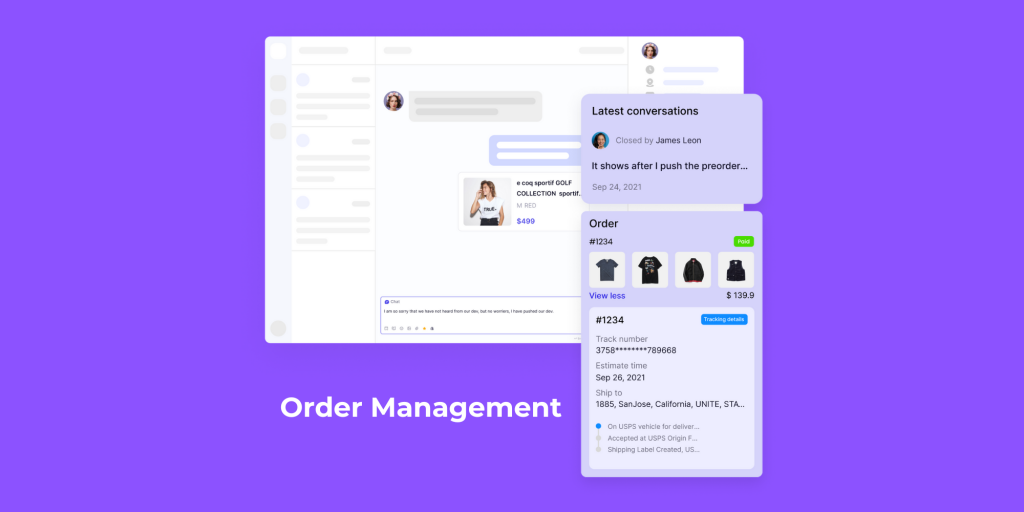
When orders increase, the team easily gets stuck on repetitive responses—customers ask about order status and apply for returns, all of which is manual labor.
E-commerce AI chatbots can help you get these things done: answer “Where did your order go?”; handle return and exchange requests; and synchronize shipping information in real time. Your team can free itself from trivial matters and focus on complex issues that require human attention. The result is a faster response, more satisfied customers, and no need to expand your team.
Cost-Efficiency
E-commerce operates 24 hours a day, but human support teams don’t have to work three shifts. AI chatbots can handle the vast majority of daily consultations, reducing labor costs and training investment and directing saved resources into businesses that truly drive growth.
Better Customer Insights
Stop guessing what customers like. AI chatbots track visitor behavior in real time and automatically summarize product preference patterns, allowing you to allocate your advertising budget precisely to what customers truly want to buy.
Automated Lead Qualification
The sales team’s time should be spent on the fastest customers to close the deal. AI chatbots proactively engage in conversation, assess intent, automatically screen high-potential customers, and refer them to followers, allowing teams to focus on conversion rather than wasting time on low-intent visitors.
7 Best Ecommerce AI Chatbots in 2026
Having read about the benefits of the AI chatbot solution for ecommerce, are you ready to integrate this powerful solution into your business? If so, read on as we take you through the best ecommerce chatbots.
1. Gorgias AI

AI customer service, helpdesk automation, order-aware support
2. Chatty AI Chatbot & Live Chat

AI customer service, helpdesk automation, order-aware support
3. CWILL: AI Chatbot & Live Chat

AI chatbot, live chat, order tracking, product recommendations
4. Fin

Fin AI Agent, ecommerce support, automation workflows
5. Text – AI Agent & Live Chat

AI agents, live Shopify data, cart recovery, sales tracking
6. Tidio

Lyro AI, chatbot automation, live chat, product recommendations
7. SmartBot: Leading AI Chatbot

AI chat, product recommendations, FAQ learning, sales follow-up
Note: The above content comes from the official data of shopify app store, and some of the data may differ for some reasons. You can check the specific Shopify app features & review reports through the “view details” buttons.
1. Gorgias: AI, Helpdesk & Chat
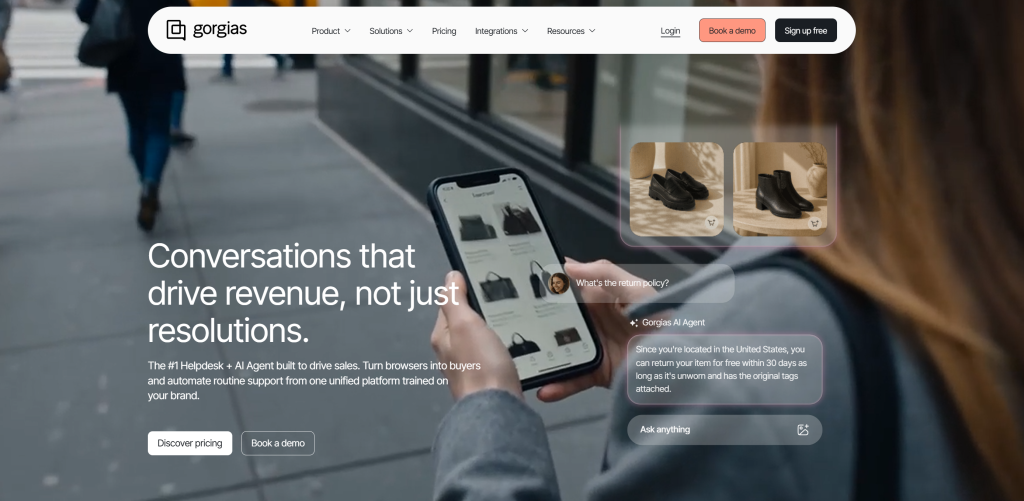
Gorgias is a conversational AI platform offered to e-commerce brands. It provides a customer support solution that integrates help desk, online chat, AI agents, and Shopify customer data, allowing customer service teams to handle all matters on a single workbench. Gorgias’s AI Agent can answer everyday customer queries, support consumers both before and after sales, enhance customer satisfaction, and drive conversions.
Main Features
- AI Agent: Trained on store content, business policies, and Shopify data.
- Unified Help Desk: One inbox integrates multiple channels, including email, chat, social media, voice, and SMS.
- Order information integration: View Shopify customer and order details directly within customer service tickets.
- Automated processes: Handling common requests such as returns and exchanges, order cancellations, and edits.
- Data Reporting: Offers AI performance, automation rates, customer satisfaction (CSAT), and AI-influenced revenue reports.
Pros:
- Strong fit for ecommerce and Shopify support
- Combines AI support with live agent handoff
- Keeps customer conversations and order context in one place
Cons:
- May be more than a very small store needs
- Costs can increase with ticket volume or AI usage
Pricing
A 7-day free trial is available. Plans start at $10 per month and include costs based on the number of work orders.
Best for
Gorgias is ideal for Shopify brands that are growing and need to use both AI support and help desk tools. When inquiries about orders, logistics, and returns and exchanges consume too much of human customer service time, its role becomes especially prominent.
2. Chatty AI Chatbot & Live Chat
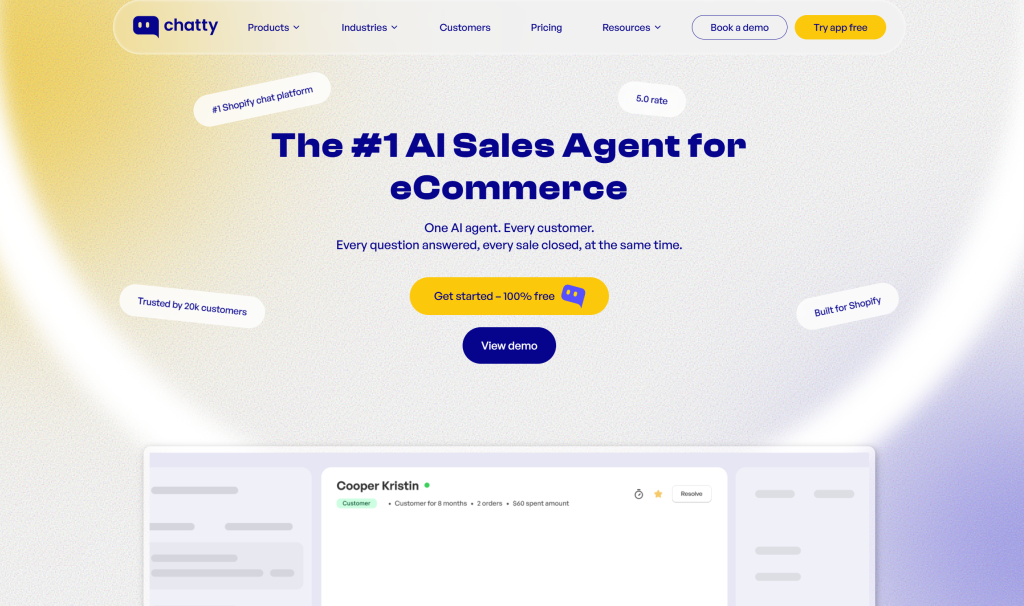
Chatty is an AI chat platform created by Shopify merchants, helping merchants answer customer questions and boost sales even when their operations teams are offline. It offers AI chatbots, live chat, help desks, and all-in-one inboxes.
The AI agent can answer product questions, recommend products, track orders, and solve basic customer service requests, while customer service teams can manage customer conversations across all channels in a single inbox.
Main Features
- AI Chatbot: Answers based on store product data and preset FAQs
- Real-time chat: Provides 24×7 live online sales support
- Multi-channel inbox: Manage conversations across WhatsApp, Facebook Messenger, Instagram, email, and other channels in one inbox
- FAQ Help Desk: Helps businesses build help centers and enables customers to achieve self-service
- Sales automation: Send proactive marketing messages based on visitor browsing behavior
Pros:
- AI combined with large language models to answer product-related questions, recommend products, and track orders
- Integrating AI automation and manual reception into one platform
Cons:
- There may be a learning curve for initial setup
- As AI conversation volume increases, the package fees will also increase accordingly
Pricing
Free packages are available. Its paid package options: Basic ($19.99/month): 50 AI conversations per month; Pro ($68.99/month): 300 AI conversations per month; Plus ($199/month): 700 AI conversations per month, unlimited customer service seats, and a dedicated AI consultant. All paid packages offer a 7-day free trial.
Best for
It is especially suitable for merchants looking to combine AI customer service automation with multi-channel management to reduce the burden of manual inquiries.
3. CWILL AI Chat
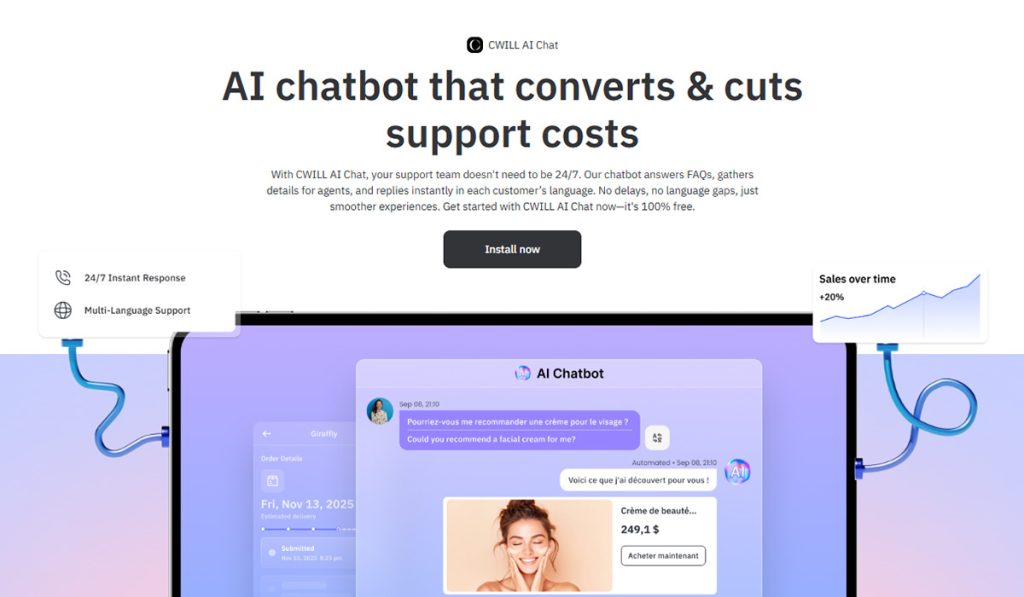
CWILL AI Chat is a free AI intelligent customer service and real-time chat solution for Shopify merchants. It has a built-in AI chatbot that can instantly answer questions about order tracking and product details based on the customer’s language.
You can also boost sales through AI product recommendations and freely customize chat window text and appearance, allowing customer service tools to naturally blend with store style.
Main features
- Real-time order tracking: Customers can check real-time order status by entering their order number to reduce a large number of repeated “Where is my order?” inquiries
- AI Product Recommendations: Proactively recommending related products based on customers’ browsing habits, allowing customers to find suitable products without manual search
- AI automatic FAQ responses: Based on store products, policies, and website content, AI learns and answers frequently asked questions, eliminating the need for human agents
- Real-time chat and Shopify unified inbox: When AI cannot respond independently, it can seamlessly forward to human customer service, with all conversations managed in one inbox
- Multilingual real-time translation: Supports multilingual conversations, automatically translates customer questions, and responds in the customer’s language
Pros:
- Tailored specifically for Shopify e-commerce scenarios, deeply integrating order and fulfillment data
- Completely free to use, with no payment for all core AI features
- It also supports AI customer service and real-time human chat, balancing automation efficiency with human service warmth
- Supports multilingual real-time translation to provide seamless service for international clients
Cons:
- Mainly designed for Shopify and not very suitable for broader enterprise customer service teams
- Compared to professional help desk platforms, advanced customization and feature depth are relatively limited
Pricing
Completely free. CWILL AI Chat is priced as “free” in the Shopify App Store, with all core AI features available for free, without paying based on conversation volume or usage.
Best for
CWILL AI Chat is ideal for small and medium-sized Shopify stores, especially those who need a simple, completely free AI customer service solution to handle common customer inquiries, order tracking, and product recommendations. If you want to provide 24×7 intelligent customer service without increasing operating costs, CWILL AI Chat is an ideal entry-level choice.
4. Fin
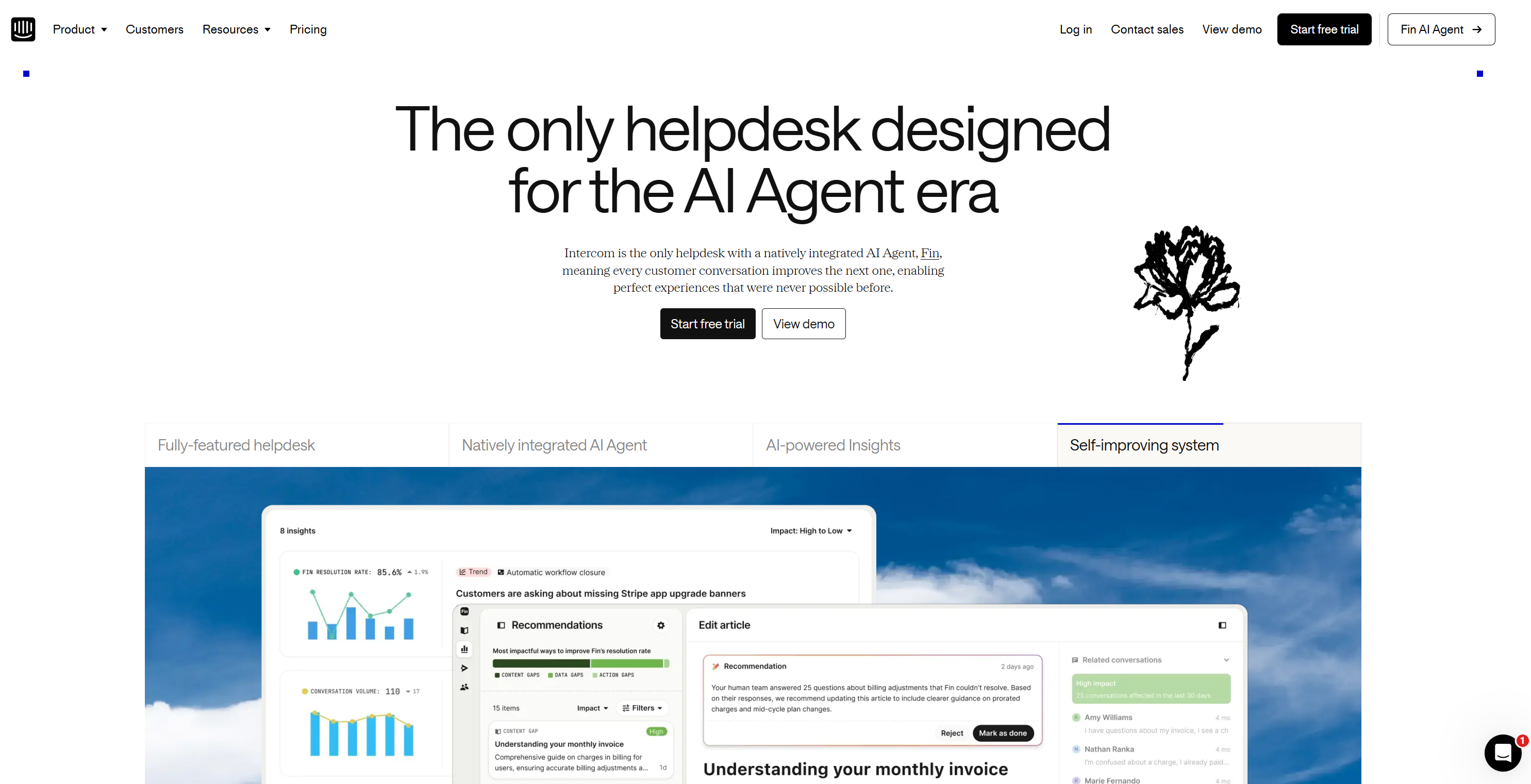
Fin (formerly Intercom) is a veteran player in customer service software. It has entered the e-commerce track through Fin AI Agent, launching Fin for Ecommerce, designed specifically for Shopify merchants. After Fin connects to your Shopify store, you can complete product recommendations, order inquiries, and return processing in a unified chat interface.
Unlike most AI-powered chatbots, Fin covers the entire customer journey—from pre-sale product comparison and purchase recommendations to post-sale order tracking and return processing.
Main features
- Fin AI Agent: Spans three roles: Service, Sales, and e-commerce, automatically switching work modes based on conversational context
- Fin 3 capability upgrades: supports Procedures (multi-step complex workflows written in natural language), Simulations (pre-launch simulation testing), Insights (intelligent analysis and improvement suggestions)
- Product discovery and pre-sales guidance: Proactively inquire about shopping needs, helping customers find suitable options among thousands of products, and conduct product comparisons and recommendations
- Deep Shopify integration: Customer service can directly update addresses, refund, or copy orders directly in the inbox, without redirecting to the Shopify backend
- Cross-channel deployment: Supports web, mobile, Slack, and other channels; voice and Discord channels are open to contract clients
Pros:
- Shopify’s deep integration and advanced workflows in Procedures are clearly ahead of similar products
- Pre-sales and after-sales service all in one place
- A shared inbox centrally manages multi-channel conversations without losing context
Cons:
- Pricing is relatively high, with dual billing based on a monthly fee per agent + AI resolution per resolution
- Setting up and configuring the native Shopify chatbot for more complex
Pricing
Fin does not have a permanent free plan, but it does offer a 14-day free trial. Priced according to the monthly seat fee, divided into three tiers. Fin AI Agent: All plans include Fin but are charged at $0.99/outcome, with a monthly minimum commitment. Additional paid channels: WhatsApp, SMS, email marketing, Phone, etc.
Best for
Expanding mid-to-large e-commerce brands. If your customer inquiry volume is high, you need to incorporate customer service efficiency into your core competency, and your budget allows, then FIN is a strong option
5. Text AI Agent & Live Chat
Text positions itself as much more than just one customer service tool. It is an AI customer service platform designed specifically for Shopify merchants, aiming to make every customer conversation directly drive revenue growth.
Text’s AI agent can directly pull real-time shopping cart data, order history, and customer spending amounts from Shopify, with each response based on real-world transaction scenarios. The shopping cart recovery feature is also deeply integrated into the system.
Its AI agents can automatically reactivate returning visitors based on cart conditions, without merchants manually setting up any marketing activities.
Main features
- Proactive cart recovery: AI Agents detect visitor hesitation signals and initiate conversations to display previously saved cart content
- Intelligent product recommendations: Based on customer needs and purchase intentions, products are directly recommended in the chat window, and product cards are displayed
- Multi-channel unified inbox: covering real-time website chat, SMS, Messenger, WhatsApp, and email, bringing all channel conversations together in one place
- AI Co-pilot: Human customer service receives real-time AI response suggestions, shortening response times and reducing training costs for new employees
- Sales reports: track orders and revenue generated during and after chats
Pros:
- With an AI resolution rate of 74% (industry average is only 59%), it can significantly reduce the burden on human customer service
- Unified multi-channel inboxes, so customer service doesn’t need to switch between multiple backends
- The parent company, Text S.A. (formerly LiveChat Software), has over 20 years of experience in customer service software, with its products serving more than 35,000 customers
Cons:
- Shopify integration requires configuration to fully realize order data pulling capabilities; it’s not ready to use out of the box
- It was just launched on the Shopify App Store in May 2026, with few public user reviews
Pricing
Essential Plan: $25/month; Growth Plan: $99/month; Free trial: Offers a 14-day free trial; Billing is monthly, with charges every 30 days.
Best for
Text is ideal for Shopify brands that manage customer service growth with small teams and want AI to handle everyday issues. Turning customer service from a cost center into a source of revenue.
6. Tidio
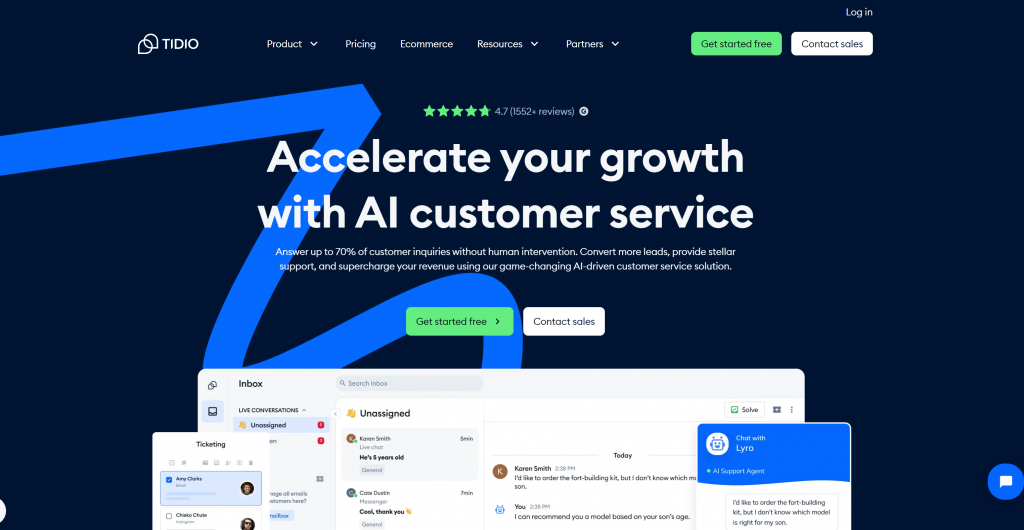
If your Shopify store is inundated with the same customer questions every day, Tidio can help your team reduce some of the burden. It integrates Lyro AI intelligent customer support service, real-time chat, automated processes, and help desk tools into one platform, allowing you to answer common questions, engage in real-time conversations, recommend products, and recover lost shopping carts from the same workbench.
Lyro is pre-trained for e-commerce scenarios and is ready to use out-of-the-box for high-frequency issues such as logistics, return and exchange policies, sizes, and order tracking, capable of handling up to 67% of customer inquiries
Main features
- Lyro AI Agent: Automatically answers customer FAQs and provides uninterrupted service outside of working hours.
- Real-time Chat: Supports live conversations between human customer service and customers, enhancing trust and facilitating transactions
- Automated Flows: A visual workflow builder supporting over 35 pre-built templates for cart retrieval, lead acquisition, follow-up, and referral
- Product Recommendations: Helping customers discover or compare related products during conversations, Lyro remembers every product detail and matches recommendations based on customer specifications
- Multi-channel support: Covers real-time website chat, email, Messenger, Instagram, and other multi-channel conversations
Pros:
- Integrate AI chatbots, live chat, automation, and help desk features on a single platform
- Native Shopify offers rich features, supporting shopping cart data, order history, and product recommendations
- The free plan lowers the entry barrier, making it suitable for small and medium-sized merchants to start and experiment
Cons:
- The quality of AI answers heavily depends on the completeness and richness of the store’s FAQs, product data, and knowledge sources
- The free plan has limited quotas—includes 50 human conversations per month, excluding Lyro AI conversations
Pricing
Free plan: includes live chat and basic automation, suitable for beginners; Paid plan: Starting at $29/month (including live chat/automated processes), Lyro AI Conversation Plan $39/month (including 200 AI conversations); Both paid plans offer a 7-day free trial, with additional quotas required for high conversation volumes
Best for
Tidio is ideal for small and medium-sized e-commerce businesses, especially those looking to boost efficiency through AI automation, real-time chat, and multi-channel support.
7. SmartBot
SmartBot is a sales-centric AI chatbot application designed specifically for Shopify merchants looking to boost sales conversion through automated customer service. Its AI agent can autonomously learn from product data, blog posts, and uploaded files, providing instant and accurate product responses and personalized recommendations. You can also use it for automatic sales follow-up and real-time sales pop-ups, all of which are ready to use out of the box.
Main features
- Autonomous Learning AI: Learn from products, pages, orders, policies, and blog content, providing 24×/7 context-aware support
- Product Highlighting Recommendations: AI automatically extracts product selling points and recommends products in conversations to assist customers in purchasing decisions
- Multi-channel conversation transfer: AI can forward complex conversations to human customer service via WhatsApp or email
- Real-time sales pop-ups: Display real-time purchase notifications to create a sense of urgency in sales
- AI email replies: Automatically handle common customer emails
Pros:
- The free version supports unlimited AI conversations
- Strong automatic learning capability, instantly grabs store pages, product data, and policies right after unboxing, greatly reducing manual training time
- A complete closed loop from customer service to sales, not just FAQs but proactive product recommendations and shopping cart buybacks
- Deep Shopify native integration, supports seamless integration with checkout systems, and Shopify Flow
Cons:
- AI makes mistakes—misreading policies and pushing out-of-stock products, so you have to keep an eye on it.
- Self-study ≠ ignore it; you need time to practice early on to answer well.
Pricing
Free plan: Unlimited AI conversations, supporting up to 50 products; Paid plans: Starting at $30/month (Starter, supports 200 products); Advanced plans $100/month (Growth), $300/month (Pro); All paid plans are available for annual subscriptions, saving 10%–30%
Best for
SmartBot is ideal for Shopify brands that want to combine AI customer service and sales functions while needing unlimited AI conversations. It is especially suitable for stores with large product libraries that need AI automatic product recommendations and after-sales support, and is also a good choice for small and medium merchants to start with free plans to experiment.
How to Choose the Right Ecommerce AI Chatbot
To select the right eCommerce AI chatbot, start by identifying your business needs. Consider whether you want to enhance customer service, increase sales, or automate marketing tasks.
You need to keep in mind whether your e-commerce chatbot requires ease of integration with your existing systems or some customization capabilities. Ensure that it integrates seamlessly with Shopify’s backend to handle inventory, orders, and customer communication efficiently.
Then, the pricing structure must also be kept in mind because it cannot exceed your budget.
Lastly, you need to ascertain if you require an omnichannel chatbot that can smoothly engage with websites, social media, and mobile apps.
Measuring the Success of Your Ecommerce Chatbot
To understand how far the ecommerce chatbot impacts your business, you need to measure the success of your ecommerce chatbot. You can do this by tracking key metrics and KPIs.
They not only assess your chatbot’s performance but also use the data it gathered to suggest means to increase its effectiveness.
Metrics and KPIs for Evaluating Performance
- Conversion Rate: In order to understand how effective your chatbot is in boosting sales, you need to keep track of the number of customers who opt for purchase after customer interactions with your ecommerce chatbot.
- Customer Satisfaction (CSAT): Needless to say, a higher CSAT means more of your customers are satisfied with your chatbot. You can measure CSAT by having your customers fill in surveys and give feedback regarding your chatbot.
- First Response Time (FRT): Your customers’ inquiries need to be responded to quickly. Therefore, you should measure the time taken for your ecommerce chatbot to respond to your customers and their inquiries.
- Resolution Rate: If the resolution rate is high, then your chatbot is capable of answering customer queries without human agents. Thus, you should measure your chatbot’s resolution rate to determine its independence.
- Abandonment Rate: If the abandonment rate of customers’ carts is low, it indicates that your chatbot is doing its job correctly. Hence, you need to keep track of the number of customers who end up abandoning their carts after an interaction with your chatbot.
- Return on Investment (ROI): You need to determine how your chatbot is financially affecting your ecommerce business. You will do this by comparing the capital your chatbot has generated to the cost of its implementation.
Best Examples for Using AI Chatbots in Ecommerce
Several ecommerce chatbot use cases have proven how effective ecommerce chatbot is in its purpose.
1. Sephora
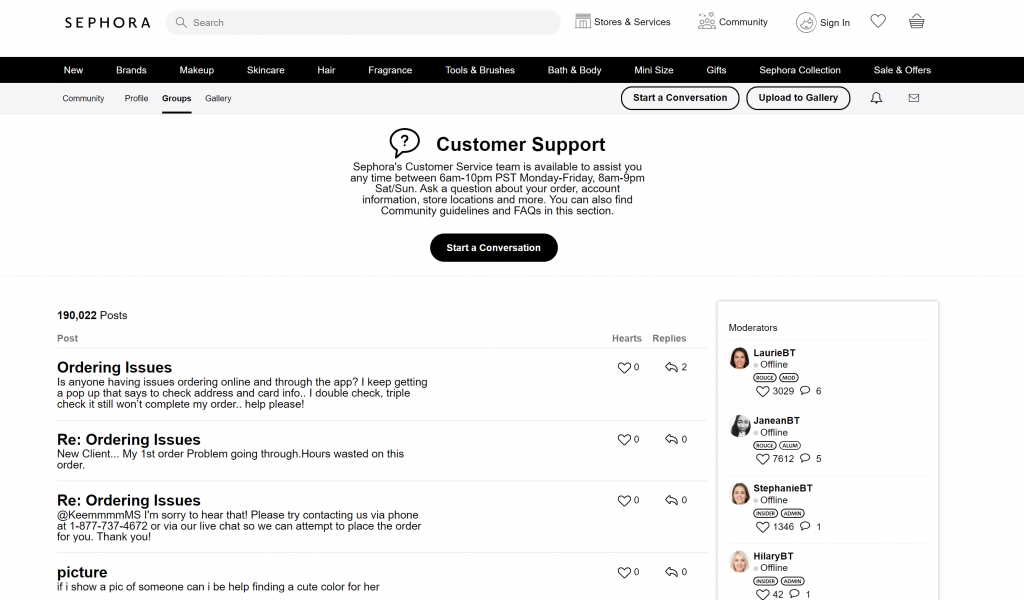
Sephora offers a wide range of products, including skincare, hair care, and makeup. However, many customers hesitate to purchase these products from online retailers due to concerns about compatibility with their skin types.
Sephora overcame this challenge by implementing chatbots for efficient customer service in e-commerce. Their chatbot offers personalized beauty advice, product recommendations, and make-up tutorials to each of their customers.
In addition, customers can even inquire about product details, browse inventory, or book in-store appointments through the chatbot. This has inevitably increased their conversion rates and enhanced customer engagement.
2. eBay
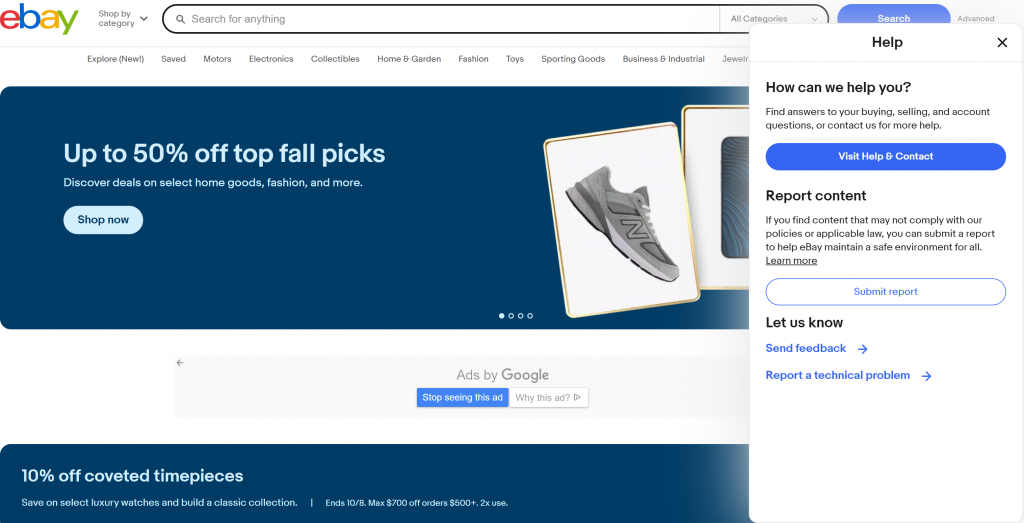
eBay, the multinational ecommerce company, also makes use of AI chatbots to interact with customers and enhance their shopping experience. This chatbot helps customers find products, place bids, and track their orders.
This personalized guide aids customers during the whole process, thereby reducing support costs and cart abandonment and improving customer experience.
Bottom Line: AI Chatbot for E-commerce
eCommerce chatbots are vital AI tools that enhance online shopping and streamline operations. They provide 24/7 availability, personalized experiences, improved conversion rates, and efficient order management.
Given these benefits, it’s time to integrate a chatbot brand voiceover into your e-commerce strategy to elevate customer satisfaction and drive sales.
AI Chatbot for Ecommerce FAQs
Can AI chatbots be used for E-commerce?
Yes, chatbots are generally used in e-commerce businesses. They aid these companies in several ways, such as enhancing customer service, guiding users through shopping, recommending relevant products, and automating various sales and support tasks.
How can AI be used in E-commerce?
AI can be used in e-commerce in several ways. For instance, it can aid in personalization, product recommendations, customer support, and predictive analytics.
How do I Integrate an AI Chatbot on My Website?
You can integrate an AI chatbot by using third-party chatbot platforms that offer simple plugins or APIs for e-commerce platforms like Shopify, WooCommerce, or custom websites. Most solutions provide easy-to-use integration guides.
How much does a chatbot cost for a website?
A chatbot has no fixed price; it can vary widely depending on its features and complexity. Generally, they can be as free as $0 or as high as $500 per month.