Key Takeaways
• Two-sided rewards, where both the referrer and the new customer earn an incentive, are the most effective and widely used referral program structure.
• Program views are the most critical early metric. A referral program with low visibility will underperform regardless of how generous the reward is.
• Who refers matters as much as how many. A generous reward can actually work against you if it attracts the wrong type of advocate.
In the last decade, I’ve helped hundreds of brands build referral programs, and the core structure is simpler than most merchants expect:
- A clear reward
- A way for customers to share a unique link or code
- Software to track referrals automatically
- A promotion plan
Most merchants get the first three right. The fourth is where I find that programs quietly stall.
I’ll walk you through the setup steps, how to choose the right reward structure, and the metrics that actually tell you whether your program is working. I’ll also share a few takes that push back on conventional wisdom because some of the most common advice doesn’t hold up in practice.
What is a Customer Referral Program?
A customer referral program is a structured system that rewards existing customers for recommending your brand to people they know. When a referred friend makes a purchase, both the referrer and the new customer typically receive an incentive (e.g. a discount or store credit).
The key word is “structured.” An occasional customer who mentions your brand to a friend is word-of-mouth. A referral program turns that behavior into something that’s scalable.
How to Set up a Customer Referral Program
Step 1: Set a clear goal. Decide what success looks like before you build anything. Are you trying to grow your customer base, lower acquisition costs, or increase repeat revenue? Your goal shapes every decision that follows.
Step 2: Choose your reward structure. Two-sided is the standard starting point. This is when the referrer gets something, and so does the friend they bring in. It gives both sides a reason to act.
Step 3: Decide on your reward size. A useful starting point is 10 to 20% of your average order value. That range feels meaningful to the referrer without making the reward the whole point. Before you land on a number, know your Customer Acquisition Cost. The reward only makes sense if it stays below that ceiling. A referral program that costs more to run than a paid channel defeats the purpose.
Step 4: Pick a referral app and connect it to your store. You need software that generates unique referral links, tracks who referred who, and issues rewards automatically. For this, consider CWILL Loyalty & Referrals, which integrates with your checkout so referrals are attributed correctly.
Step 5: Build a referral page. Keep it simple. Explain the reward clearly, make it easy to grab a link or code, and make sure it looks consistent with your store. Friction at this step will cost you advocates.
Step 6: Connect the program to your post-purchase flow. The moment after a purchase is when customers are most likely to want to share. Add a referral prompt to your order confirmation page and your first post-purchase email.
Step 7: Build a promotion plan. This is the step most guides gloss over. From my experience, it’s the most important one. (More on that later.)
Types of Referral Programs
There are two ways to think about referral program structure: who receives the reward, and how that reward is delivered.
Referral Recipient Model: Who Gets Rewarded?
Two-sided programs reward both the referrer and the new customer. The referrer gets something for sharing; the friend gets something for following through. This is the standard structure I’d recommend as a starting point for most stores.
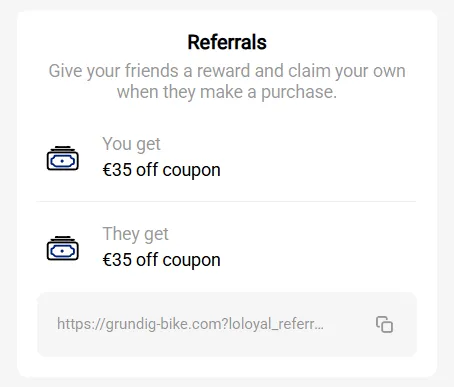
Grundig E-bike, one of our merchants, is a good example of why. They sell bikes between €500 and €4,000 and built their program around a two-sided €35 coupon—the same value for the referrer and the new customer. They also used a flat euro amount rather than a percentage, which at that price point is more tangible. The result was a 30% referral conversion rate and a 50% reduction in customer acquisition costs.
One-sided programs have landed well for me during the holiday season, because the asymmetry plays into the giving mindset customers already have. It feels generous rather than imbalanced. Outside that window, it’s a tougher structure to sustain.
A related tactic keeps the two-sided structure intact but tilts the split: the referred friend gets a noticeably larger reward than the referrer. During the holiday season that asymmetry works in your favor: the offer reads as a gift to the friend rather than an incentive to the sharer, which can feel more on-brand than a straight 50/50 split.
Referral Reward Model: How is the Reward Delivered?
Beyond who gets rewarded, you also need to decide how the reward scales over time. Below are your main model options.
- Standard reward programs offer a flat, consistent incentive every time a successful referral happens. The referrer earns $20, the new customer gets $20. Simple to understand and easy to promote. This is the most common starting point and works well for most merchants getting started.
- Tiered reward programs increase the reward as a referrer brings in more customers. For example, someone who refers five friends might earn a bigger discount than someone who refers only one. The appeal is that it gives your most enthusiastic advocates a reason to keep going.
- Multi-step reward programs issue rewards at multiple points in the referred customer’s journey rather than at a single conversion event. A referrer might earn something when the friend signs up, and again when the friend makes their first purchase. This can improve the quality of referrals since rewards are tied to deeper engagement, rather than a single click.
- Gamified reward programs layer competition or achievement mechanics on top of the standard structure. Think leaderboards and milestone unlocks. These keep your most motivated advocates engaged, but they require more sophisticated tracking and work better for programs with an established, active user base.
Why “Just Make the Reward Bigger” Rarely Works
As you decide on your program’s structure, please keep this in mind: a more generous reward doesn’t necessarily get you more referrals.
When the incentive is high enough, you start attracting people motivated by the payout rather than by a genuine enthusiasm for your product.
There’s a real difference between someone who refers to a friend because they love what they bought and someone working through their contacts list to claim a $75 credit. The first type is the customer you’re building toward. The second shows up in your data as a conversion problem that’s hard to trace back to the source.
Pro Tip: Keep the reward generous enough to recognize the right people but no more than that.
Why Promotion Plans are Critical to a Successful Referral Program
Here’s my honest take after working with referral programs across hundreds of Shopify brands: most underperforming programs have a visibility problem.
Anecdotally, 3 to 8% of people who see a referral program go on to refer someone. ReferralCandy’s July 2026 analysis of 500 established Shopify stores points the same direction: it put the top-quartile threshold at a 4.64% share-action rate, and the top 10% at 13.38%. Worth noting that share-action rate measures share-button clicks against prompt views, so it runs ahead of completed referrals.
That number doesn’t shift dramatically based on your reward tiers or your copy. What can shift your results is the size of the audience seeing the program in the first place.
The math is simple: a program with 5,000 views and a 4% advocate rate outperforms a program with 500 views and a 6% rate every time.
So before you adjust your reward tiers, ask: how many people are actually seeing this?
What Consistent Promotion Looks Like in Practice:
- A referral CTA in every post-purchase email. The moment right after a purchase is your highest-intent window. The customer is happy, the experience is fresh, and that’s when you ask.
- A banner or footer on your store with a clear call-to-action. It doesn’t need to be loud. A persistent, visible reminder converts better than a one-time campaign.
- A mention on your order confirmation page. Customers are already reading this page. Adding a referral prompt here costs nothing and catches them at peak satisfaction.
- Regularly scheduled sends to your customer list. Don’t assume people remember your program exists. A standalone email every few months, especially tied to a seasonal push or reward refresh, brings lapsed referrers back.
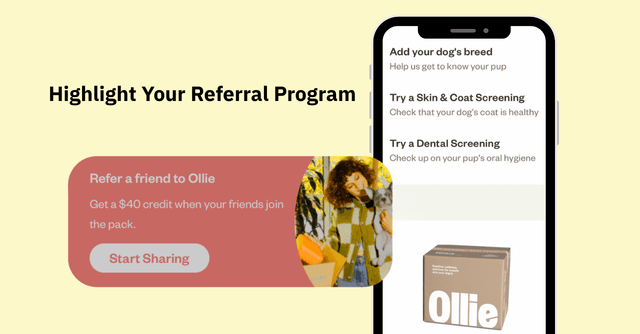
Ollie, a pet food brand, does the promotion piece especially well. Their customer dashboard is below. They put the referral prompt right at the top with the reward and a share button front and center.
How to Read Your Referral Program Results
Here are the four metrics worth tracking from day one, and what each one tells you:
| Metric | What it measures | Why it matters |
| Program views | How many customers are finding the referral program | Your leading indicator—low views means the program will struggle regardless of reward design |
| View-to-advocate rate | Share of viewers who go on to refer someone | Reflects program visibility and how enthusiastic your customer base is |
| Advocate-to-referral conversion rate | Share of advocates whose referrals result in a purchase | Reflects referral quality and how well your offer converts new customers |
| Referral ROI | Revenue from referral-driven sales vs. total reward spend | Useful but incomplete—make sure to factor in the higher return rate on referred purchases before drawing conclusions |
A note on benchmarks:
Once your program is generating data, the instinct is to compare your numbers against industry averages. I’d push back on that.
Industry benchmarks aggregate across businesses in different categories, with different customer bases, and wildly different levels of promotion. A benchmark that reflects a D2C apparel brand with a six-figure email list tells you nothing useful about a small wellness brand running its first referral program.
What matters is your own starting point. Run the program, note your month-one view-to-advocate rate and referral conversion rate, and use those as the numbers to beat. A 5% improvement on your own baseline is worth more than hitting someone else’s median.
Set Up Your Referral Program Today
Referral programs work when you promote them regularly and resist the urge to over-engineer the reward structure before you’ve given awareness a chance.
The merchants I’ve seen get the most out of referrals are rarely the ones with the most sophisticated programs—they’re the ones who stayed consistent.
If you’re building a referral program and want a tool that handles the reward side automatically, consider CWILL Loyalty & Referrals. It’s built for Shopify and DTC brands and generates the referral links and issues the rewards.
Common FAQs on Setting Up a Referral Program
Generate customer referrals by setting up a structured program with a clear reward, a simple share mechanism, and consistent promotion across your post-purchase email, site footer, and order confirmation page.
Two-sided referral rewards where both the referrer and the new customer earn an incentive are the more effective structure for most merchants and are the most widely used. One-sided rewards work well during the holiday season, when a “give more than you get” structure aligns with a gifting mindset.
Not always. Past a certain threshold, larger rewards attract payout-motivated referrers rather than genuine advocates. Those referrals tend to convert at lower rates and return items more frequently.
Start with program views as your leading indicator. Then track view-to-advocate rate (share of viewers who refer someone), referral conversion rate, and referral revenue against reward spend. Those four metrics show you clearly where the program is working and where it isn’t.
A note on how this article was written: This article was developed from a recorded interview with Justin Risso and written with AI assistance. The ideas, recommendations, and firsthand experiences reflected here are Justin’s. The content was reviewed and edited before publication.

Head of Revenue
Justin Risso is Head of Revenue (North America) at CWILL and runs his own Retention Marketing Consultancy, where he works with Shopify and DTC brands on retention, loyalty, and referral strategy. Before joining CWILL, he spent more than a decade in enterprise customer success, including six and a half years at Yotpo working closely with e-commerce brands on reviews and loyalty programs.