Are you looking for ways to build a solid number of loyal customers? E-commerce retention marketing is one of the best ways to achieve that.
Retention marketing is a strategy that will help you retain customers and engage them consistently, after their first buy.
In this article, we’ll cover what retention marketing is, its importance, key channels, and strategies you can start using today.
What is Retention Marketing?
Retention marketing is a strategy focused on engaging existing customers and driving repeat purchases over time. It builds customer loyalty, increases customer lifetime value, and lowers customer acquisition costs.
Often, brands start retention efforts after the first purchase through post-purchase touchpoints. They use customer data and feedback to improve customer experience and build strong customer relationships.
It is a flexible approach for e-commerce brands. There are many types of strategies you can run under it. Plus, you can mix and match whichever works for your store.
Why Retention Marketing Matters for Your E-commerce Business?
Retention marketing matters for e-commerce brands. It builds customer loyalty, drives repeat purchases, and lowers acquisition costs while improving customer experience. Here’s how:
Strengthen Customer Loyalty
Do you know that the average annual churn rate in e-commerce is 70-75%? Retention marketing strategies like loyalty programs help retain customers and increase repeat purchases. They also improve customer lifetime value while keeping existing customers engaged.
Using satisfying rewards, customer data, feedback, and post-purchase touchpoints, brands can boost customer satisfaction and build lasting relationships. These retention marketing efforts turn loyal customers into brand advocates and encourage repeat business.
Reduce Customer Acquisition Costs
Retention marketing is more cost-effective than acquisition marketing because it focuses on engaging existing customers and keeping loyal customers coming back. Using retention marketing strategies like loyalty programs and post-purchase touchpoints boosts repeat purchases, customer satisfaction, and customer lifetime value.
Grundig, a German brand selling electric bikes, cut customer acquisition costs by 50% with our loyalty and referrals app. At the same time, their customer lifetime value grew by 85%, showing how retention marketing efforts turn satisfied customers into brand advocates and support sustainable growth.
Drive Repeat Purchases
50Folds reports that repeat customers usually spend 67% more than new ones. Retention marketing strategies like push notifications, loyalty programs, and personalized offers help increase customer retention and earn recurring revenue.
Tracking customer data from these efforts reveals customer preferences and improves your offers. This makes customer retention marketing more effective, strengthens customer relationships, and supports a higher customer retention rate.
Improve Customer Experience
Retention marketing helps improve customer experience by keeping existing customers engaged and showing them you care. Post-purchase communication updates them on orders, while re-engagement emails remind inactive customers that you value their business.
A great customer experience reduces customer churn, encourages repeat customers, and increases customer retention. It also supports attracting new customers, improving customer retention metrics, and strengthening overall customer loyalty.
Retention Marketing vs. Acquisition Marketing
Retention marketing focuses on keeping existing customers engaged, protecting loyalty, and encouraging repeat purchases. It uses customer data, purchase history, and post-purchase touchpoints to improve experience and build lasting relationships.
Acquisition marketing is all about attracting new buyers. Paid ads, search engine marketing, and influencer campaigns are common strategies, while retention efforts focus on keeping current customers coming back.
You can check the table below for a side-by-side comparison of both approaches.
| Aspect | Retention Marketing | Acquisition Marketing |
|---|---|---|
| Primary Focus | Keeping existing customers | Attracting new customers |
| Cost | Lower | Higher |
| Metrics | CLV, churn rate, repeat purchase rate | CAC, conversion rate, click-through rate |
| Strategies | Loyalty programs, email, SMS, push notifications | Paid ads, SEM, influencer marketing, content marketing |
| Timeframe | Long-term | Short to mid-term |
| Relationship | Existing | New |
How to Calculate E-commerce Retention Rate?
You can compute your e-commerce retention rate with this formula:
((Customers at end of period [CE] − New customers acquired [NC])) ÷ Customers at start of period [CS]) × 100 = Retention Rate
Let me explain that with simple math.
Imagine that you started the month with 1,200 customers. You were able to get 180 new buyers and ended the month with 1,050. So that’s:
(1,050 − 180) ÷ 1,200 × 100 = 72.5% retention rate
72.5% retention rate means you kept almost three-quarters of your original customers.
The computation from here is also useful in getting other related metrics.
- Repeat Purchase Rate: The percentage of customers who came back for a second purchase or more
- Average Order Value (AOV): How much customers spend for each transaction
- Churn Rate: The number of customers you lost within a given period
- Time Between Purchases: How long your customer usually waits before ordering again
What Is a Good E-commerce Retention Rate?
There’s no certain percentage that defines a good e-commerce retention rate. Industry, business model, product type, and other factors can also affect the numbers.
Although 30–40% is commonly used as a benchmark, actual retention rates can range significantly depending on your industry.
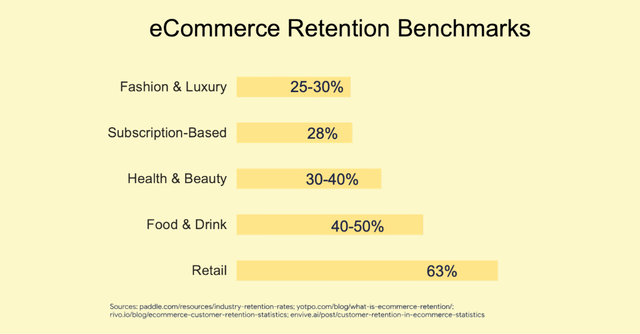
What we really suggest is not to focus on the benchmark… but on your own numbers. It’s best to know what your current status is (say your retention rate is at 20% right now) and set a goal to achieve (increase it to 40% in the first year, then 60% after).
That makes it more personal and effective. Plus, it helps you aim for a “realistic” target that makes sense for your brand’s growth.
Best Marketing Channels to Improve Customer Retention
Email is one of the most common (and direct) ways to keep in touch with customers. It enables in-brand, personalized retention marketing campaigns. That’s why most brands use it for their post-purchase communication and product recommendations.
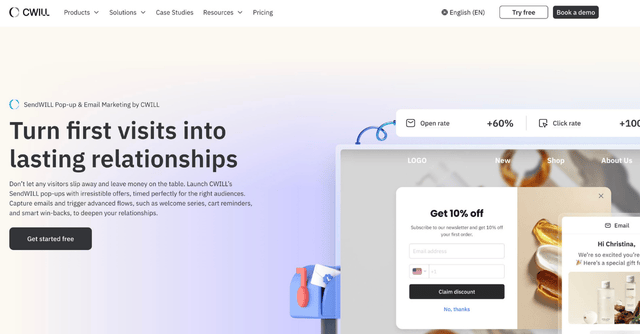
For example, our app SendWILL Pop-up and Email Marketing provides e-commerce merchants with tools to capture emails on-site and send targeted campaigns.
With it, you can automate welcome emails, cart recovery, win-back flows, and post-purchase follow-ups.
SMS
If you want something more high-impact than emails, SMS marketing for retention is that channel. It has a 98% open rate, so it’s perfect for “time-sensitive” post-purchase messages like order and delivery updates, and flash sales.
What does that mean for retention? Your message actually gets seen, almost right away. And you can also add direct links to make it effortless for your customers to take action.
Imagine that you send order updates via SMS, and you want to include a product recommendation. You can provide the status, then mention a limited-time offer on your related collection. Add a link, and the customer can tap it and go straight to that product page.
Push Notifications
Unlike the first two channels, push notifications show up directly on a customer’s screen, even when they’re not actively browsing your store. It literally keeps your brand right at the top of their mind (or screen).
Push notifications allow you to time and trigger messages based on customer behavior. Just look at this example from Sephora:
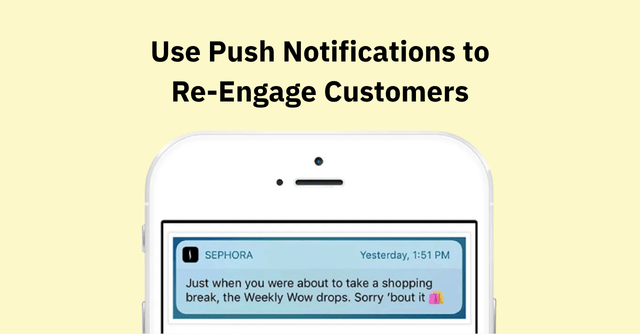
As you can see, the message feels casual and timely, enough to attract customers’ attention. Sephora also uses its push notifications to send product suggestions, limited-time offers, and updates (you can get some ideas from them).
Social Media
Social media has leveled up through the years and is now a great retention marketing channel. Apps like Facebook and WhatsApp allow you to create communities and interact with your avid customers. And do you know how much this can impact retention? MarketingLTB reports up to a 40% increase.
If you’re selling skincare, you can create a private group where customers share their beauty routines and get tips from other users.
As for you, you can share exclusive offers and product updates. Your customers will appreciate how approachable and present your brand feels.
Loyalty Programs
Another retention marketing channel that’s getting more popular is the loyalty program. Queue-it even mentioned that over 90% of businesses already have a loyalty program of their own. Yes, that’s how valued this channel is.
With a loyalty program, you reward your customers whenever they take a certain action for your brand. Points (that can be converted to discounts) and exclusive perks are the most common forms. And they can use this to buy and interact more with your store.
But you’ll need a platform to manage your programs effectively. Loyalty apps like TrustWILL Loyalty and Referrals let you reward purchases, sign-ups, reviews, and referrals in one place.
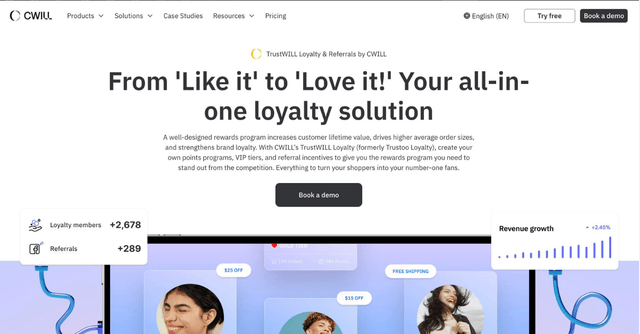
Plus, you can simply set up VIP tiers to give your best customers better rewards the more they stay engaged.
Reviews
What else is more powerful than your own customers’ feedback? They can convince new (and even existing customers) to stick with your brand.
A review like, “It’s my 3rd time buying from Brand Y. Fast delivery and great quality every time,” can boost purchase confidence and increase repeat orders. However, this only works when reviews are authentic; fake feedback damages credibility.
We know that collecting customer reviews can be hard. But there are tools like TrustWILL Reviews & UGC that can solve that issue. This software uses emails and on-site prompts to automatically request feedback. It also allows you to collect photos and videos (for more effective and relatable customer insights).
On-Site Personalization
On-site personalization is considered a dynamic channel. Compared to traditional channels like SMS and emails, it works in real-time, right as your customer is already browsing your store.
What happens is your store adjusts what each visitor sees based on their behavior, past purchases, and browsing patterns.
So, a returning customer will see a different set of product recommendations and offers than a new buyer.
Subscriptions
Last on our retention channel list: Subscriptions. This is more of a business model than a channel, but it deserves a spot here because it naturally keeps customers coming back on a regular schedule, which is exactly what retention is about.
Perks like members-only discounts or free shipping give your customers more reasons to stay. And if you connect your subscription with a loyalty program? Customers can earn more rewards… on top of their regular orders. That’s a whole new level of value that’s hard to walk away from.
Proven Retention Marketing Strategies (With Examples)
Now, it’s time to share some of the best retention marketing strategies. We gained these from years of helping our clients here at CWILL. And we want to share them with you so you can improve your process starting today.
Personalize Customer Communication
Personalized communication is what gives the retention marketing strategy that “human touch” that customers crave.
Although you can automate it, the content still reflects what your customer actually bought, browsed, or cared about. So, it won’t feel like it’s written for everyone… but for that specific buyer. It helps you “win your customers over” even if they receive 20 to 50 emails a day.
But how to reach this personalization? Through the help of customer data, purchase history, and behavior patterns.
With these insights, you can create segmented campaigns, like sending a different email flow to first-time buyers vs. customers who’ve ordered three or more times.
Improve Post-Purchase Engagement
Your post-purchase communication isn’t just for giving updates on the order status. It should also be designed to “engage” even after the delivery is done.
Here are the most important ones to have in place:
- Order confirmation: Reassures customers that their purchase went through
- Shipping updates: Keeps them in the loop on their delivery
- Review requests: Gives them a chance to share their experience
- Replenishment reminders: Nudge your customers to reorder before they run out
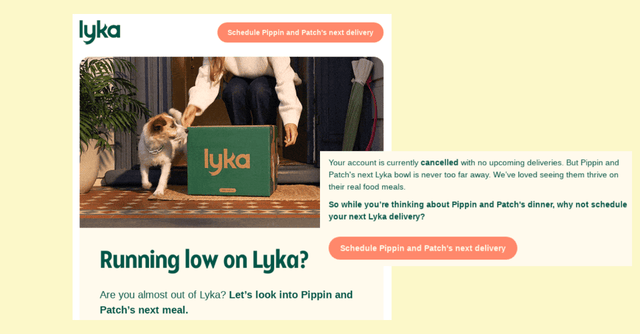
Let’s say that you have a pet food brand. You can set up an automated email 25 days after purchase, reminding customers that their supply is probably running low with a quick reorder link ready to go. Here’s a good example of a “replenishment email” from Lyka:
Build Loyalty and Referral Incentives
Who doesn’t want to get rewarded after spending their money on a brand they like? We have never met one.
Maybe that’s why loyalty and referral programs work so well. Points systems give customers a tangible reason to come back. VIP tiers make them feel like their loyalty is recognized. And referral rewards bring in new buyers through people who already trust your brand.
Take Adidas as a great example.
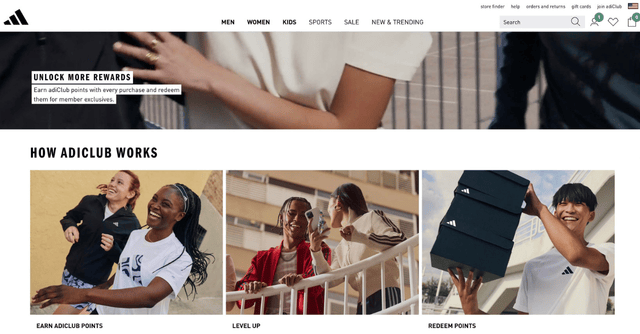
Their AdiClub loyalty program lets members earn points with every purchase, run, and more. The structure and mechanics are simple, but it keeps customers engaged and excited to “unlock” the next reward.
Automate Lifecycle Marketing Campaigns
Automating your campaigns is super important in retention marketing. Handling emails and SMS workflows manually for every customer is just not realistic, especially as your store grows.
With automation, your campaigns run based on what your customers actually do. Think welcome series, cart abandonment flows, and post-purchase sequences. Each one fires at the right moment without you having to lift a finger every single time.
Re-Engage Inactive Customers
Your inactive customers are just as important as the ones who buy from you regularly. They already know your brand, they’ve bought from you before, and they can do it again.
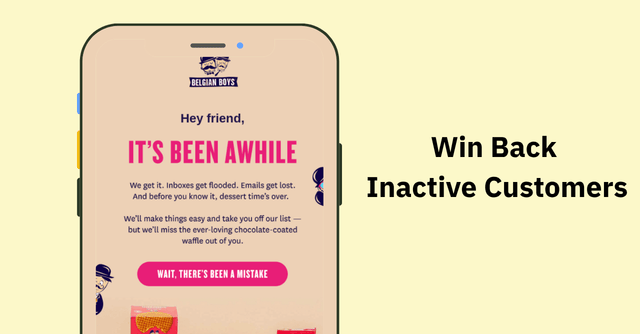
You have to set up campaigns to win them back. For example, a “we miss you” email with a time-limited discount, or a short survey asking why they haven’t been back lately. Like what Belgian Boys made here:
Act on Customer Feedback
It’s not enough to “read” your customers’ feedback. If you want to increase your customer retention, you have to actually act on it.
If multiple customers mention that your checkout process is confusing, fix it. If they keep praising a specific product, highlight it more. Post-purchase surveys and review requests are great ways to collect this feedback regularly.
And when customers see that their input changed something? They’ll surely come back (or even recommend your store to others).
Deliver Excellent Customer Support
Good customer support has a bigger impact on retention than most brands realize. It can improve buyers’ trust in your business.
You can work on your customer support by making it accessible within multiple channels like email, live chat, and social media.
Fast response times matter too. Customers hate waiting for your reply. So you have to deliver in less than 48 hours. Plus, self-service resources like an FAQ page or a help center can help customers find answers on their own (which most people like).
Optimize Customer Retention Marketing Strategies
Remember this: retention marketing is an ongoing process, which is why you have to make sure that you optimize it every chance you get. Here’s what you can do:
- Track the right metrics: CLV, churn rate, and repeat purchase rate are a good place to start.
- Adjust based on data: If something isn’t working, change it. If something is, double down on it.
- Keep testing: Small tweaks over time add up to real improvements in your retention performance.
FAQs About Retention Marketing
What do you mean by retention in marketing?
Retention in marketing uses strategies to keep existing customers engaged and coming back. It builds brand loyalty, reduces churn, and is cost-effective compared to acquisition.
What is an example of an e-commerce retention strategy?
A common e-commerce retention strategy is a loyalty program. It rewards customers for purchases, referrals, or brand interactions with points, discounts, or perks like birthday gifts.
How to retain existing customers?
Retain customers by delivering a great experience at every stage. Use personalized communication, a rewarding loyalty program, listen to feedback, and build a brand community to keep them engaged.
What are the best retention strategies for marketing?
Top retention strategies include personalized communication, enhancing post-purchase experience, and running loyalty or referral programs. Also, automate emails/SMS, re-engage inactive customers, and use customer feedback.

Marketing Manager
Jaelle Lin is the Marketing Manager at CWILL, driving DTC growth on Shopify across retention, loyalty, and post-purchase experience. She works with brands to optimize the entire customer journey from acquisition to order tracking, shipping protection, returns, and lifecycle engagement, helping build sustainable, long-term revenue through customer relationships.