Many eCommerce brands are rethinking traditional returns and exploring returnless refund as a practical alternative. In this article, you’ll learn how returnless refunds work, their benefits and risks, and how you can manage them responsibly for your store.
What is a Returnless Refund?
A returnless refund is a retail practice in online retail and eCommerce where an online retailer gives full refunds to online shoppers without requiring them to send back unwanted items.
Instead of following a traditional refund process that involves processing returns, the retailer simply approves the refund request and lets customers keep the product.
Amazon introduced a returnless refund because they believe it’ll allow sellers to reduce the time and costs spent on reverse logistics. Now, other companies like Walmart, Target, Shein, and Chewy have followed Amazon’s footsteps. Online shopping site Overstock (now Bed Bath and Beyond) also joined the list.
How the Amazon Returnless Refund Works?
The Amazon returnless refund system lets sellers issue refunds without returns, reducing shipping and reverse logistics costs. As a return free refund recently adopted in a growing online marketplace, it reflects changing expectations in shopping online.
Returnless Refund Eligibility Scenarios
Amazon has specific criteria on which items are “approved” for a returnless refund; those include:
- Low-priced and “low-value” items (<€25 / £20 / $25-30)
- “Non-returnable” items
- Products with limited resale value
- Heavy, fragile, and bulky products
- Food and other goods with a short shelf-life
- Items with no active returns service (can be changed by sellers)
If you sell phone cases, perishable snack boxes, or custom-printed t-shirts on Amazon, they fall into these categories. Asking for a return for these items might cost you more than the product itself due to shipping costs when shopping online.
Amazon can also automate the issuing of refunds on your behalf if you fail to assess and take action on the request within four calendar days.
Returnless Refund Decision Factors
Besides response time, Amazon also uses algorithms and policies to check other factors… and decide whether they’ll allow a returnless refund to an item. They assess the product cost and type, return history, and customer feedback.
They do this because they want to provide a seamless return experience for customer satisfaction, while also practicing fairness to sellers.
Amazon gives sellers the freedom to “set rules” and choose which products will qualify for a returnless refund. They can enable or disable this “Returnless Resolutions” through their seller account. But this will only be available if they have good ratings.
Returnless Refund Request Process
Amazon fulfills its promise of making the process “frictionless” for customers. It only takes around 1-2 days to process and a few steps to initiate. Customers can simply:
- Log in to their Amazon app
- Go to their order history.
- Request a refund and provide a reason (defective, wrong size, not as described, etc).
- Check whether the item is eligible for returnless refunds.
- Submit their request.
- Wait for approval.
They can go over this process without asking for customer support.
4 Benefits of Returnless Refunds
Before implementing, it’s clear that returnless refunds lower operating costs, speed up refund requests, boost customer satisfaction, and can benefit the environment.
Lower Costs for eCommerce Businesses
The returnless refund model costs far less than traditional returns. eCommerce companies save on shipping costs, inspections, restocking, labor, and the company’s fulfillment services, helping reduce shipping fees and return shipping costs.
For example, a $70 cabinet return could cost $150 in shipping costs plus warehouse and labor fees. You offer returnless refund options and issue returnless refunds with full refunds.
Sellers on Amazon and SSENSE are making returnless refunds and setting returnless refund rules. Some donate unwanted items to local animal shelters. Profitable customers tend to respond positively, which is why more retailers are adopting this returnless refund model.
Faster Refunds for Online Shoppers
We already know how customers value “hassle-free” and “fast” returns experience, right? Returnless refunds allow you to process and finalize resolutions in just two days.
Many DTC brands extend returnless refunds to the most profitable customers based on prior purchasing and eligibility criteria. Retailers report positive feedback while lowering reverse logistics costs and reducing risks like return shoplifted merchandise.
Improved Customer Loyalty
Companies offering returnless refunds can also increase future sales.
How is that possible? Your customers will remember how you let them skip the “complicated” return process and provide their refund at lightning speed, delivering excellent customer service and often hearing positive feedback. This experience builds stronger trust in your brand, and higher trust typically leads to better customer retention.
Remember that return rates will likely remain high as part of online retail’s nature. Brands that offer a more efficient, customer-friendly refund process therefore have a clear advantage in winning repeat buyers over those that don’t.
Sustainability and Social Impact
Besides sellers and customers, the environment also benefits from returnless refunds through less pollution.
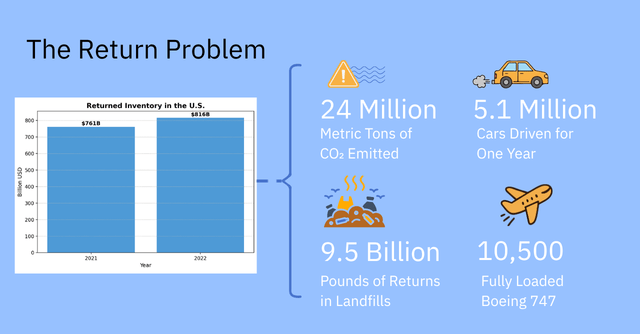
Let me share with you some stats to show how damaging returns are to our environment:
- In 2022, retailer companies sent 9.5 billion pounds of return good to landfills.
- In the same year, returns also emitted 24 million tons of CO2.
So, if more businesses make an effort to reduce returns and apply returnless refunds, we could at least bring these numbers down.
Some brands also pair these efforts with donation calls. If the customer doesn’t like the item anymore, they are encouraged to donate it to a local charity, shelter, or community group instead of throwing it away.
Chewy will always be my favorite brand example for this. Here’s one post on how they processed a return without questions and encouraged the customer (whose dog has passed away) to donate their product to the shelter.
Challenges of Returnless Refund Policy
Since you already know the benefits, now it’s time to learn about the challenges of returnless refund policy to eCommerce companies, sellers, and online retailers.
Seller Risks from Returnless Refunds
Simplifying the refund process doesn’t protect you from all costs. Plus, you can also face some other issues, including:
- Direct revenue loss: Items won’t be returned, and you’ll lose money in the process (as you can’t resell them). And while most items are low-value, the loss can grow as the numbers increase.
- Policy abuse: There won’t be a limit to how often some buyers request refunds. Anyone can initiate a return as long as the item is marked eligible. That can result in repeat refund requests from the same account.
- Refund fraud: Fraud isn’t a new issue. But a return-free refund will make it easier for some buyers to “intentionally” claim damage and get a refund.
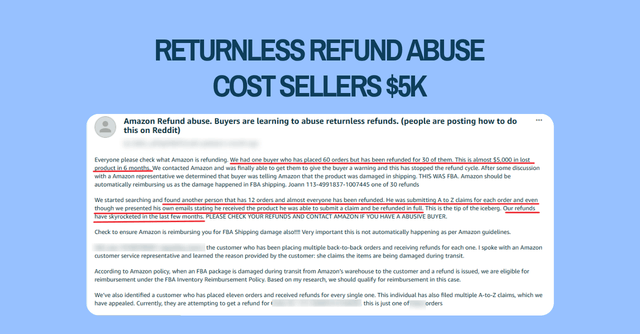
One Amazon seller shared that a buyer placed multiple orders and refunded most of them, which cost her almost $5,000 in losses.
Customer Interaction Challenges
Returnless refund can also lower the chances of you getting feedback from your customers. Some might not bother to tell you the reason. Plus, there’s no item returned, so you won’t be able to inspect it to see what’s wrong.
Say you get a refund request for a leather wallet you believe is in perfect condition. The customer selects “defective item” as the reason, but you can’t reach out to ask what’s actually wrong with it. Is there a scratch you missed? A faulty zipper? Or did they just change their mind and pick a different reason?
Poor reviews can also come rushing in, and it’ll be harder to resolve, especially for third-party sellers and smaller retail companies.
Balancing Convenience and Operational Costs
Returnless refunds do cover costly shipping requirements altogether. But they can complicate inventory tracking and financial reporting. When customers keep items instead of sending them back, you issue a refund while the product is no longer recoverable.
That means you record a sale, then a refund, but there is no physical return to inspect, restock, or assess for resale.
In the long run, frequent returnless refunds make it harder to measure product quality issues, track defect patterns, and evaluate true inventory performance.
So how do you keep things manageable? You need clear guidelines on which products qualify for returnless refunds. Limit them to low-cost items, overstock, or products with little resale value to protect your margins.
You’ll also want to make sure your labor costs and reverse logistics stay under control as your business grows. We’ll cover setting up returnless refund rules next.
How ParcelWILL Powers Returnless Refunds?
ParcelWILL can help you enable returnless refunds for your business. You’ll have control over return reasons, return solutions, and even options that reduce return costs and improve customer satisfaction.
It’s a great app if you want to provide a better overall return experience for your online shoppers. Let me show you the features and what you can do with each:
Customizable Return Reasons
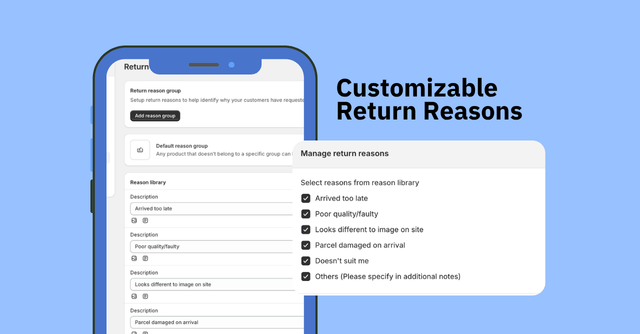
With ParcelWILL, you can set up return reason groups to organize why customers request a returnless refund.
You can create specific groups for certain products, and any unassigned items will automatically fall under a default reason group. Plus, you can also build a reason library with options like:
- “Arrived too late”,
- Poor quality or faulty”,
- “Looks different from image on site”,
- “Parcel damaged on arrival.”
- or Others.
There’s also an option to require image proof uploads, which helps reduce disputes and gives you clearer insight into what actually happened.
This setup is great for understanding your customers’ behavior better. You’ll also manage low-cost items or overstock more carefully, and adjust your fulfillment services based on real data (not assumptions).
Flexible Return Solutions
We believe that returns are not the end of your sales. You can do something about it and turn this negative experience into a new opportunity. ParcelWILL provides three types of returnless refund options to help you with that:
- Refund to original payment method: This is the usual way to refund the money to the customer’s bank or credit card. It’s hassle-free and great for satisfying their request.
- Refund to store credit: The refund you’ll get can only be used in your store. This is a great option because it encourages repeat purchases and loyalty.
- Exchange for different items or variant exchange: Adding an exchange option can allow you to retain revenue, but still improve their shopping experience.
You can also customize the names and descriptions of each option. With these settings in place, you can guide customers toward the most appropriate solution based on the situation.
Green Returns for Sustainability
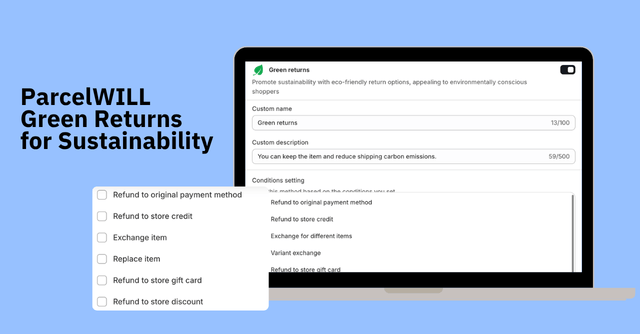
The Green Returns feature gives you control over when and how that option applies. You can set conditions based on specific return reasons, selected return solutions, or logical rules such as “if all conditions are met.”
With the right rules in place, Green Returns allows retail companies to support sustainability goals while keeping operational costs in check.
Conclusion
Returnless refunds can lower operational costs, speed up resolutions, and improve customer experience when used with the right rules. But they also require careful planning to avoid abuse and revenue loss.
If you’re considering enabling returnless refunds, ParcelWILL gives you the control to manage them responsibly. Explore the features and see how it fits your store’s return strategy.
Install it for free (30-day free trial available here).
FAQs About Returnless Refunds
How to get an Amazon returnless refund?
You can get an Amazon returnless refund by initiating a return in the app or website through “Your Orders.” Select “Return or replace items” and choose your reason. If eligible, Amazon will issue a refund without asking you to ship it back.
Is a returnless refund the same as keeping the item?
Yes, it’s exactly the same. Retailers that offer returnless refunds allow you to keep the item while also getting a full refund of the item price.
What are the pros and cons of returnless refunds?
Some pros of returnless refunds include lower shipping and processing costs, quicker resolutions, and improved customer loyalty. Its cons include direct sales loss, fraud risk, and inventory loss.
Which items are eligible for Amazon returnless refunds?
Low-cost items, heavy items, fragile products, and perishable goods are some of the common items eligible for Amazon returnless refunds. Personalized products, hygiene items, and damaged or defective goods may also qualify.

Marketing Manager
Jaelle Lin is the Marketing Manager at CWILL, driving DTC growth on Shopify across retention, loyalty, and post-purchase experience. She works with brands to optimize the entire customer journey from acquisition to order tracking, shipping protection, returns, and lifecycle engagement, helping build sustainable, long-term revenue through customer relationships.