Returns are common in eCommerce, but a return label can make reverse logistics easier, faster, and more organized for both your business and your customers.
In this article, you’ll learn what return labels are, how they work, the types you can offer, and how ParcelWILL can help you automate the entire process.
What is a Return Label?
A return label is a pre-set printed (or digital) return shipping label that allows customers to send back an order to the seller or business. Most often, they are pre-filled with the business’s return address, tracking number, and carrier details.
Unlike the standard shipping label, which is used to send products from the seller to the customer, a return label is used for reverse logistics.
What does a Return Label look like?
Return labels are normally in 4” × 6” (thermal printer) or 8.5” × 11” (standard letter) formats. It also often comes with a return packing slip that’s inside the package, and contains the order number and list of items.
Here’s a great example of a return shipping label from USPS (generated by Shippo):
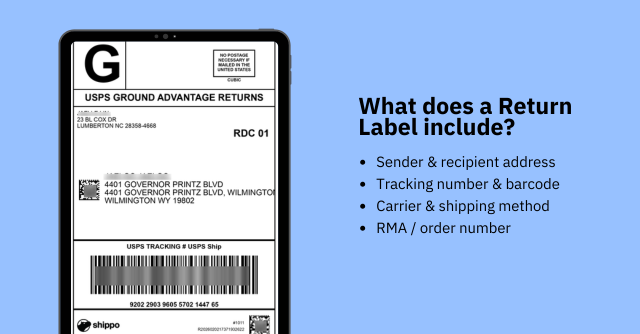
Return labels have the following information printed clearly on the front:
- Sender’s Address: Customer’s name and return address label, which can be personalized address labels to match the business style and add personality.
- Recipient’s Address: Your business/warehouse return address (usually pre-filled).
- Tracking Number and Barcode: A unique tracking number with a scannable barcode that lets you and your customer monitor the package in transit.
- Shipping Method and Carrier Information: The carrier and service level, such as USPS Ground Advantage. This also mentions whether the label is prepaid or not.
- RMA or Order Number: A return authorization or order number that links the package to the correct transaction for faster processing.
Once printed from a computer or device, customers can stick it to the package. The carrier will then scan the barcode and treat it as a new shipment (only this time… to the opposite direction).
For a personal touch, use personalized return address labels or custom return address labels. With logos, graphics, and creative designs (even luggage tag–style for Christmas), you can add personality, stay professional, and make returns more convenient for customers.
How Do Return Shipping Labels Work?
Since return shipping labels are pre-configured, they streamline the returns process. You simply set up the return labels and manage ongoing returns more efficiently.
Setting Up Return Labels for Your Customers
Sellers can create return shipping labels with carriers like USPS, UPS, FedEx, and DHL, or use a shipping platform like Shippo or EasyShip. Both options work, but shipping platforms can give you some advantage, like discounted shipping rates for lower return costs.
Once you choose the carrier or platform, fill in all details. Include tracking number, shipping method, return address labels, and addresses. Plus, verify them before generating the label because it’s better to be safe than to pay twice!
You can offer prepaid return labels for a smoother experience and higher customer satisfaction. Or let customers cover the fee to protect your profit.
PRO-TIP: Always confirm carrier compatibility and clearly show customers where to apply the label to avoid rejected or delayed returns.
Managing Return Labels Effectively
As a merchant, you have to track and manage return packages, so they’ll arrive at your warehouse (or business address) safe and sound. Let’s say one of your customers returns a damaged bag. You have to monitor its shipment all the way.
Here are some actions you have to take:
- For domestic shipments: Check the standard transit scans and confirm delivery.
- For international shipments: Watch out for customs clearance and cross-border updates.
- For returns with no updates: Bring up this issue with the carrier and ask for the current status.
When the item arrives, your team can then scan the barcode (to verify it) and check its condition before approving the refund.
PRO-TIP: Use a returns management platform for better tracking and monitoring of returns. It’ll also allow you to cancel labels or automate some workflows if needed.
Three Ways to Provide Return Labels
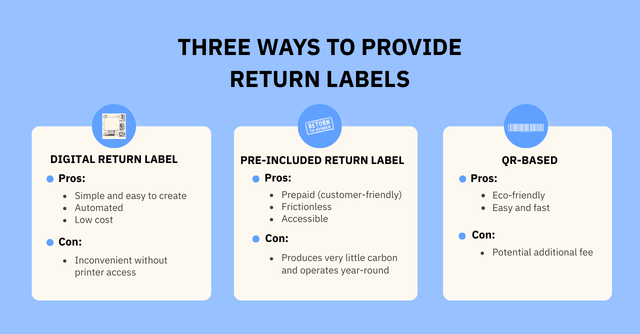
Return labels can be digital, pre-included, or paperless (QR-based). Let us show you the difference between these three:
Digital / Printable Return Label
Digital or printable return labels can be created from the shipping platform or carrier website. Merchants can then send the filled-out version to their customers by email or through a returns portal.
Once received, customers print the return label, attach it to the package, and drop it off at the carrier location.
Digital return label is great because it’s low-cost and automated. The only problem is that it can be inconvenient for customers who don’t own a printer.
Pre-Included Return Label
As its name suggests, pre-included return labels are already inside the original shipment package. So, customers won’t have to request a separate label, and they can initiate the return any time they want (as long as it’s within the allowed “return window”).
There’s no need for them to log in, check email, or print anything. All they have to do is use the return label provided and ship the package.
Pre-included return labels are often prepaid and frictionless. These are definitely plus points for customers!
But the problem is it’s more costly. Unused labels will result in wasted printing expenses, and their numbers can increase during high-volume periods like Thanksgiving and Christmas.
QR Code Drop-Off Return
If you want to be more “eco-friendly,” paperless is the only way. QR-code, drop-off return allows your customers to process their shipment without printing a label.
They can bring their package to the nearest participating carrier location, such as UPS, FedEx, or USPS, present the QR code, and the carrier will scan it to prepare the return shipment.
But there are two types of models:
- Print-at-location: Customers bring their own packaged item, and the carrier prints and attaches the label.
- No-box, no-label: The carrier handles packing and shipping, and groups returns before sending them back.
Drop-off returns are faster and more convenient. But some carriers may charge additional fees for this return service.
Benefits of Using Return Labels
You now know the different types of return labels. Now, let’s discuss their overall benefits. That includes lower support workload, improved customer satisfaction, and faster return processing.
Lower Customer Support Workload
Self-service return labels reduce support tickets like “Where do I send this?” or “Can you email me a return label?”
Imagine a customer wanted to return the wrong-sized cargo pants. If you offer a pre-included return label, they can just grab it from the package, stick it on, and drop it off at the nearest carrier location.
When customers can do this, you’ll see fewer emails in your inbox.
Higher Customer Satisfaction
50Fold’s report found that 92% of customers will come back if you make returns hassle-free.
Return labels help you achieve that by handling address details, postage, and shipping instructions for your customers. Because your returns process is simple, they’ll trust you more and will definitely be more loyal to your brand.
Faster Return Processing
Return labels let you track every return shipment from drop-off to warehouse arrival. Thanks to the barcode and tracking number that match each order.
Because of that, your team can process refunds and exchanges faster. We’re talking days instead of weeks. That also means your customers get their money back quicker, and that can improve their post-purchase experience with your brand.
Better Inventory and Returns Insights
Besides faster processing, you can also get better data because of return labels. Each label captures why customers are sending items back.
You can use this to find what’s going wrong with your products and fix it early. If 30% of your blue jeans are returned as they’re “too small for the size,” you know to adjust sizing or update your product descriptions.
The more you understand why returns happen, the better you can prevent them. Plus, you’ll make more accurate inventory calls and improve product quality (which can save you money in the long-run).
How ParcelWILL Streamlines Your Returns Management
ParcelWILL Returns & Exchanges can help you handle the entire returns process from one platform. It connects your return portal, shipping carriers, and refund workflows so returns get processed automatically.
You’ll have full visibility on domestic and international returns, faster processing times, and way less manual work for your business.
One-Click Carrier Integration for Global Returns
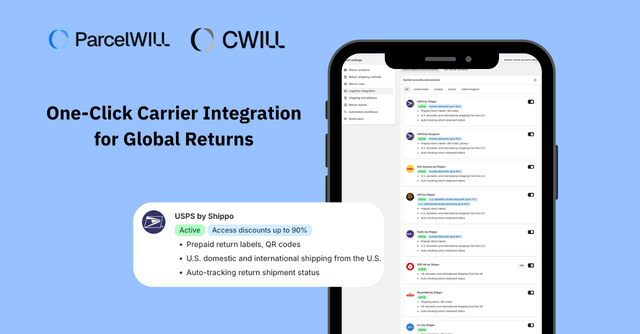
ParcelWILL lets you enable production mode carrier integration by activating their balance. Once live, you can manage manual approvals, auto-approved returns, and refunds from the same balance.
You can simply choose from ParcelWILL’s built-in carrier partners or connect your own carrier accounts. We support USPS, UPS, FedEx, DHL, Royal Mail, DPD, Evri, and more within the U.S., UK, EU, and international shipments.
All carriers deliver prepaid return labels, QR codes, and auto-tracking. So, your customers get a fast and smooth return experience, and you stay in full control of your return logistics.
Smart Return Workflow from Request to Solution
When customers submit a return in our portal, they select the items they want to return, the reason why, their preferred solution (refund, exchange, store credit, or replacement), and how to ship it back (merchant return label, ship on their own, or green return).
Once you approve the request, our app automatically:
- Generates a return label or QR code through your connected carrier
- Sends it to the customer’s account page and email
- Starts real-time tracking of the return shipment
- Updates order and refund status instantly
You can also personalize your return portal with your brand colors and logo to “add personality” to the experience. This way, customers complete their returns in a space that feels familiar.
With branded return portals, automated workflows, and carrier-level tracking, ParcelWILL Returns & Exchanges removes manual steps and turns returns into a scalable reverse logistics system for your eCommerce business.
Conclusion
Return labels help you run a more organized returns process. Your customers get clear instructions on how to send items back, your support team deals with fewer repetitive questions, and you can track every return from start to finish.
If you want to automate label generation, tracking, and refunds all in one place, try ParcelWILL Returns & Exchanges. It’s built for ecommerce businesses that want less manual work and faster resolution times.
Get started today and simplify your returns workflow.
FAQs About Return Label
Are return labels necessary?
Return labels aren’t required, but they are important for smooth and trackable returns. They simplify reverse logistics and help reduce lost packages. Without them, returns can be messy.
What is the difference between a return label and a return slip?
The difference between a return label and a return slip is their purpose and placement. A return label goes on the outside of the package and provides shipment details. A return slip is inside the box and provides the reason for return.
How to provide a return label?
To provide a return label, you simply generate one through a carrier account or shipping platform, then send it to your customer. You can email a PDF, share a QR code for drop-off, or include a printed label in the original shipment.
What is a “labelless” return?
A “labelless” return is a simple, paperless method where your customers don’t need to print a shipping label. Instead, they receive a QR code or a unique code from your return portal and present it at a carrier drop-off point.

Marketing Manager
Jaelle Lin is the Marketing Manager at CWILL, driving DTC growth on Shopify across retention, loyalty, and post-purchase experience. She works with brands to optimize the entire customer journey from acquisition to order tracking, shipping protection, returns, and lifecycle engagement, helping build sustainable, long-term revenue through customer relationships.