Using paid ads to get new customers in 2026 is not so practical. The cost per click is high, and there’s zero guarantee you’ll gain something from it.
One great way to grow without relying on ads is by creating a referral program. With this, you only reward customers after they bring you a confirmed sale. But how do you get started?
In this article, we’ll show you how to build a referral program for your store with a simple app. We’ll also share some proven strategies so you can bring your strategy to the next level.
What is a Referral Program?
A referral program (or referral marketing program) is a simple and organized strategy that encourages existing customers to recommend a brand, product, or service to new clients (family, friends, or colleagues). It’s a cost-effective way to create loyal customers and make them brand advocates.
Imagine that your Shopify store already has a few repeat clients. They may have casually mentioned your brand and products to their friends. With a referral program, you make the “word-of-mouth” marketing part measurable, and that can help you adjust strategy based on what works.
Now, what makes up a referral program?
The referral program has three parts:
- Referral process: The step-by-step flow that allows customers to share a personalized referral link and for their referred person to complete the purchase.
- Referral rewards: Incentives that will motivate your customers to participate. It can be a discount, cash, store credit, or another benefit your referrer and the new customer can enjoy.
- Referral tracking: This is the software (or system) that enables you to monitor referral links and distribute the rewards fairly.
How Does a Referral Program Work?
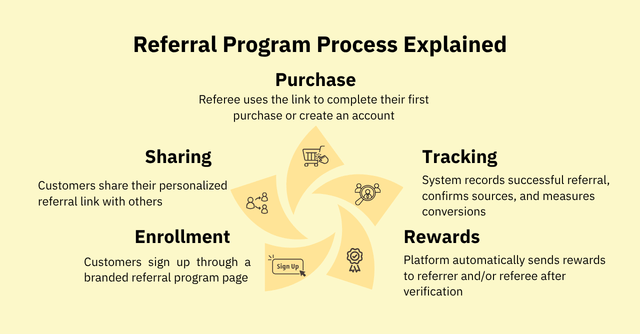
A referral marketing program works by providing existing customers (the referrers) with a personalized referral link so they can share it with others (the referees) and earn rewards for every successful referral.
Here’s the detailed process:
- Enrollment: Customers sign up through a branded referral program page to officially participate.
- Sharing: They share their referral link to someone they know, so that person can use this link to buy from the brand.
- Purchase: The referee uses the link to complete the first purchase or create their account for the brand.
- Tracking: The system records and monitors successful referrals, confirms referral sources, and measures conversion rates.
- Rewards: Once everything is verified, the platform automatically sends the “promised rewards” (i.e., $20 store credit) to either or both the referrer and referree.
Pretty simple, right? And it can bring so many benefits to your business, which we’ll talk about next.
Why is a Referral Program Important for Your Business?
A great referral program can help you grow your Shopify store without spending too much money on traditional ads and marketing campaigns. With it, you can build customer trust, lower customer acquisition costs, increase revenue, and improve customer engagement.
Let’s look at each of these benefits:
Build Customer Trust
A referral program is effective in building customer trust because it “fuels” emotional connection with existing and loyal customers.
You give them some power to represent your brand… and recommend it to people they care about. It’s like saying: “We trust you to share our brand with others, and we’d like to appreciate your effort.”
But that trust extends to the referees as well. Fireworks’ statistics show that customers who come through referrals are about 18% more loyal compared to other tactics. That’s what makes word-of-mouth marketing (WOM) special. It beats traditional marketing because it’s organic and authentic.
Lower Customer Acquisition Costs (CAC)
A referral program can also help you lower your customer acquisition cost (CAC), which has bubbled through the years.
Many eCommerce brands have to spend $59-$91 to get a single customer through paid ads. Not to mention that you have to invest money upfront and hope that most of it won’t go to waste.
In contrast, a referral program only requires you to “spend money” after a confirmed purchase is made. You’re paying for actual results, and not the clicks or impressions.
Plus, you spend less because you only need to cover rewards, software, and occasional promotional efforts to get the program running. So, that keeps your CAC in check but improves your return on investment (ROI).
Increase Revenue and Lifetime Value
Since a good referral program is based on performance and rewards, it can improve overall sales and customer lifetime value.
Imagine that you offer $15 store credit to customers who successfully refer a friend. That friend also gets 10% off their first order (plus free shipping). Once the new client proceeds with their first order, the referrer will automatically earn their reward. There’s a HUGE chance they’ll use it and buy another item from your store… before the offer expires.
This referral strategy also gives you the freedom to be creative and offer rewards, points, or free items to motivate repeat purchases.
Strengthen Customer Engagement and Retention
Engaged customers are the bread and butter of any growing Shopify store. A referral program is a great way to make them stay connected, as it offers that “sense of community and belonging.”
In what way? Well, it allows your customers to level up their status to brand advocates. From this moment, they become a part of your marketing team. They get the chance to earn rewards, see their total earnings, track their referrals, and so much more.
Because of that, these active participants treat the referral activity more as a “normal interaction” with your store.
Three Types of Referral Models
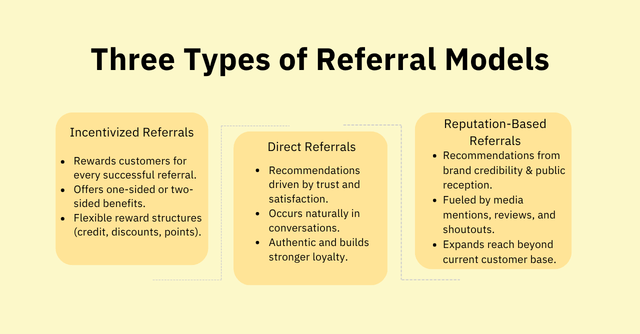
Incentivized, direct, and reputation-based are three types of referral models. We’ll talk about each one and what makes them a great option for your business.
Incentivized Referrals
An incentivized referral is where customers get rewarded for every successful referral. It’s the most popular and simplest strategy from our list. Customers love it because it follows the “give-and-take” approach.
It usually goes like this for one-sided rewards: Existing customers receive a referral link through a referral page. All they need to do is share that link with friends or followers. When anyone makes the purchase using the link, the existing customer gets rewarded. But, it can also work as two-sided (where both the advocate and referee get something).
This model allows you to be creative with your reward strategy. Some brands use simple store credit or discount codes.
Others explore tiered milestones, loyalty points, cash bonuses, free products, or exclusive perks. A few brands even add progress tracking to encourage multiple referrals.
PROS:
- You get more control
- Referrals can be tracked and measured
CONS:
- May attract low-quality referrals
- It requires a lot of testing and monitoring to find the “perfect” reward structure
Direct Referrals
Direct (or organic) referral happens when customers recommend your brand purely because of trust and satisfaction, not of any external rewards.
Unlike the incentivized one, where it’s a bit transactional, direct referral happens in a more natural way. It can happen in a group chat and face-to-face conversations.
The great thing about this is it’s 100% free, and since it’s more authentic, you can expect a deeper emotional connection with the referrer. And that can mean stronger customer loyalty.
PROS:
- Cost-effective strategy
- Higher quality leads
- No reward setup needed (low-effort on your part)
CONS:
- Limited engagement opportunities that might reduce the repeat purchase rate
Reputation-Based Referrals
Some people recommend brands they haven’t tried yet, but are popular and well-received by the public. This type of referral is reputation-based.
Once your brand reaches a certain level of “credibility,” you can expect that even non-customers will praise and refer your brand to communities, forums, and social media platforms.
Media, online reviews, and shoutouts are what contribute to this referral type the most. For example, some people might remember you because they heard about “your customer-centric service” or “how well-made your product is”.
Reputation-based referrals are effective for long-term growth because they reach people outside your customer base faster than the other two.
PROS:
- Best for getting more organic referrals
- Attracts high-intent customers who already trust your brand
- Keeps your brand reputation solid, so that you’re talked about for years (free marketing right there!)
CONS:
- Harder to control and predict because it’s strongly based on public opinion
- Requires more effort to protect the “brand image.”
Now that you know the types of referrals, it’s time to build your own program! We’ll show you the step-by-step process next.
How to Build a Customer Referral Program with TrustWILL?
TrustWILL is a ready-to-use Shopify app that allows you to set up a customer referral program and get started right off the bat. Here’s what you can do:
Set Up a Two-Sided Referral Rewards Program
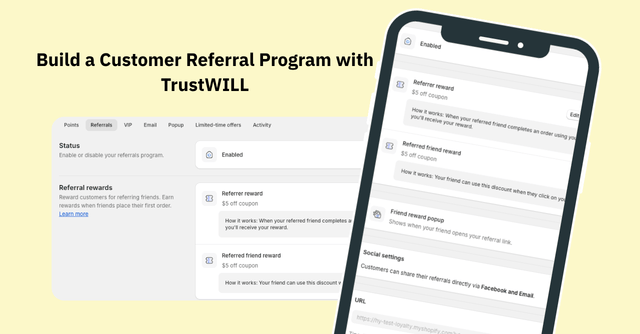
After installing TrustWILL from the Shopify app store, open it on your dashboard.
Then, go to Program > Referrals > Referral rewards. Here’s where you can edit what rewards the referrer and referred customer will get.
You can choose to give an amount or a percentage discount, free shipping, or a free product for each of them. But for the referrer, you can also choose to provide points as a reward. This can help you create tiered rewards for more engagement.
We suggest that you take advantage of two-sided rewards to motivate existing customers to share their link… and new customers to buy. More sales on your part and better customer experience for your buyers.
PRO-TIP: Start with a simple reward system and don’t overthink. TrustWILL allows you to edit as many times as you want, so you don’t have to get stuck thinking of the “perfect reward program.”
Next, you have to make sharing the referral link easy for your customers. Set this up under the “Share via social media” section and choose from the platforms available. With TrustWILL, you can also create an automated message for other potential customers to see.
But that’s not all. The branding and customization extend to the pop-up that referred customers will see. You can edit the image, colors, and layout of the pop-up to make sure it matches your store’s look. This is your chance to make the “offer” more appealing and increase the conversion rate.
Create a Seamless Referral Process In Different Channels
Besides a smooth setup for Shopify stores, our loyalty and referral app also makes the referral program 100% accessible to customers. It appears in three locations: the Loyalty Widget, Loyalty Page, and Loyalty Hub, so they can browse, manage, and monitor their rewards easily.
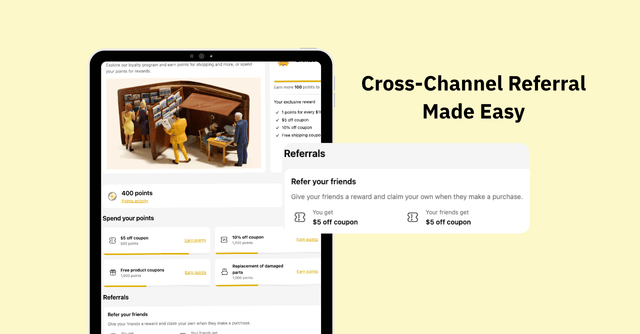
Because referrals are integrated into the loyalty experience, customers see them naturally during their shopping journey. This is intentional to increase participation and drive more referral activity for your brand.
Plus, it makes the process more seamless. Here’s a preview of how it works.
- Your customers copy their personalized referral link or use quick-share buttons.
- Once a friend or someone they know clicks, the referred customer is redirected to your store and sees the branded referral pop-up.
- They enter their email to claim the offer and become eligible for the “referral reward”.
- The system verifies the transaction after the referred customer completes their order.
- TrustWILL automatically sends the designated rewards to the referrer… and the new customer. (That’s it!)
On top of this, you also get other useful features that help you create a solid program. These include real-time tracking, automated notifications, and built-in fraud controls.
Proven Strategies to Optimize Your Referral Program
Before we end this article, let us share some of the best strategies you can apply to optimize your referral program. We’ve compiled this from what worked with our clients.
Make Your Referral Program Hard to Miss
Your referral program won’t work if people don’t know it exists (seems obvious, but you’d be surprised how many brands “bury” this under three menu layers).
Put your referral options where customers actually spend time. This means your homepage, product pages, checkout flow, and account dashboard. You can also add it to your main navigation so it’s always one click away.
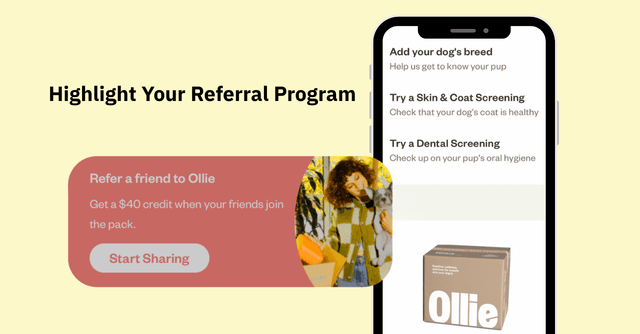
Take Ollie, for example. They place their referral program right at the top of their customers’ dashboard. The reward ($40 credit) is crystal clear and includes a “Start Sharing” button.
Design a High-Converting Two-Sided Reward Structure
A two-sided reward system gives your existing customers a reason to share… and gives new customers a reason to actually use that referral link. It’s a win for everyone (including you, since you’re getting new customers at a lower cost than paid ads).
But you also have to make sure that the rewards are “enticing” on both sides. Too low and nobody bothers. Too high and you’re losing money on every referral. We suggest somewhere between $10-$40 in value, but test what works for your brand.
You don’t have to stick with discounts either. Store credit, loyalty points, free shipping on the next order, or early access to new products all work. Pick what your customers actually want.
If you’re looking for a good example of two-sided rewards, check out Heyday’s “Give $40, Get $40” program:
Activate Your Most Loyal Customers First
Your loyal customers already love your products and tell their friends about you anyway. Why not give them an actual incentive to do it? They’re way more likely to refer people who will actually buy (because they know what kind of person would enjoy your store).
Start by looking at your customer data. Find people who have made three or more purchases, left positive reviews, or have high order values.
Then, send them a personal email about your new referral program before you announce it to everyone else. Make them feel like insiders (because they are). Give them their unique referral link and explain what they’ll get for sharing.
Simplify the Referral Process to Remove Friction
Always keep in mind that all your customers are busy. They won’t have time to fill out forms, copy codes, or figure out complicated reward structures.
So, the referral process should take less than 30 seconds. Something that they can do in three simple steps: click, copy, and share.
Plus, be upfront with the reward. “Give $20, Get $20” is way better than “Earn rewards when friends shop.” Your customers should know exactly what they’re getting without having to assume or guess.
Another thing you have to simplify is your landing page. New customers should see the offer clearly stated in plain language and the steps on how to redeem it.
Track Performance and Continuously Optimize
Last thing: you need to check how your referral program is performing and make changes based on what the data tells you.
Here’s what you can do:
- Track how many people click your referral links and how many of those clicks turn into purchases
- Test different reward amounts, messaging, and placement to see what drives the most conversions
- Review which customers refer the most and what they have in common
- Adjust your landing page based on where people drop off
One of our clients saw tons of link sharing but barely any completed purchases. After digging into the data, they realized their landing page was confusing. They cleaned up the message and made the reward obvious.
Within a few weeks, conversions went up, and they started seeing real revenue from referrals.
Conclusion
A referral program helps you turn customer recommendations into a reliable source of new sales. It lowers acquisition costs, increases repeat purchases, and strengthens customer loyalty without relying heavily on paid ads.
If you want to launch a referral program that is easy to manage and built for Shopify, try TrustWILL Loyalty and Referrals. You can set up two-sided rewards, track every referral, and keep everything organized in one place.
FAQs About Referral Program
What are the benefits of a referral program?
A referral program helps you get new customers without spending as much as you would on ads. When someone hears about your store from a friend, they’re more likely to buy and stick around. That means more repeat purchases and better long-term value from each customer.
How do you run a referral program?
A referral program rewards both the referrer and the buyer. Make sharing easy, use software to track referrals and automate rewards, and promote it via your store and email.
What is a two-sided reward?
A two-sided reward means both people get something. The customer who shares gets a reward, and the person who uses their link gets a reward too. It’s fair for everyone and gives both sides a reason to participate.
Where should you promote a referral program?
You can promote your referral program on your homepage, account dashboard, post-purchase pages, and in your emails. Social media works too if you want to reach more people.

Marketing Manager
Jaelle Lin is the Marketing Manager at CWILL, driving DTC growth on Shopify across retention, loyalty, and post-purchase experience. She works with brands to optimize the entire customer journey from acquisition to order tracking, shipping protection, returns, and lifecycle engagement, helping build sustainable, long-term revenue through customer relationships.